
Psychology One-page note
Negativity Bias: Why Bad Sticks
Ten compliments and one criticism: guess which one you'll remember tonight. Here's why bad sticks. Save this page.
Good to know
Baumeister et al. 2001; Rozin & Royzman 2001; Soroka et al. 2019; Robertson et al. 2023. Tips are general suggestions.
What's on the page
The note as text, so you can read it, copy it or use a screen reader.
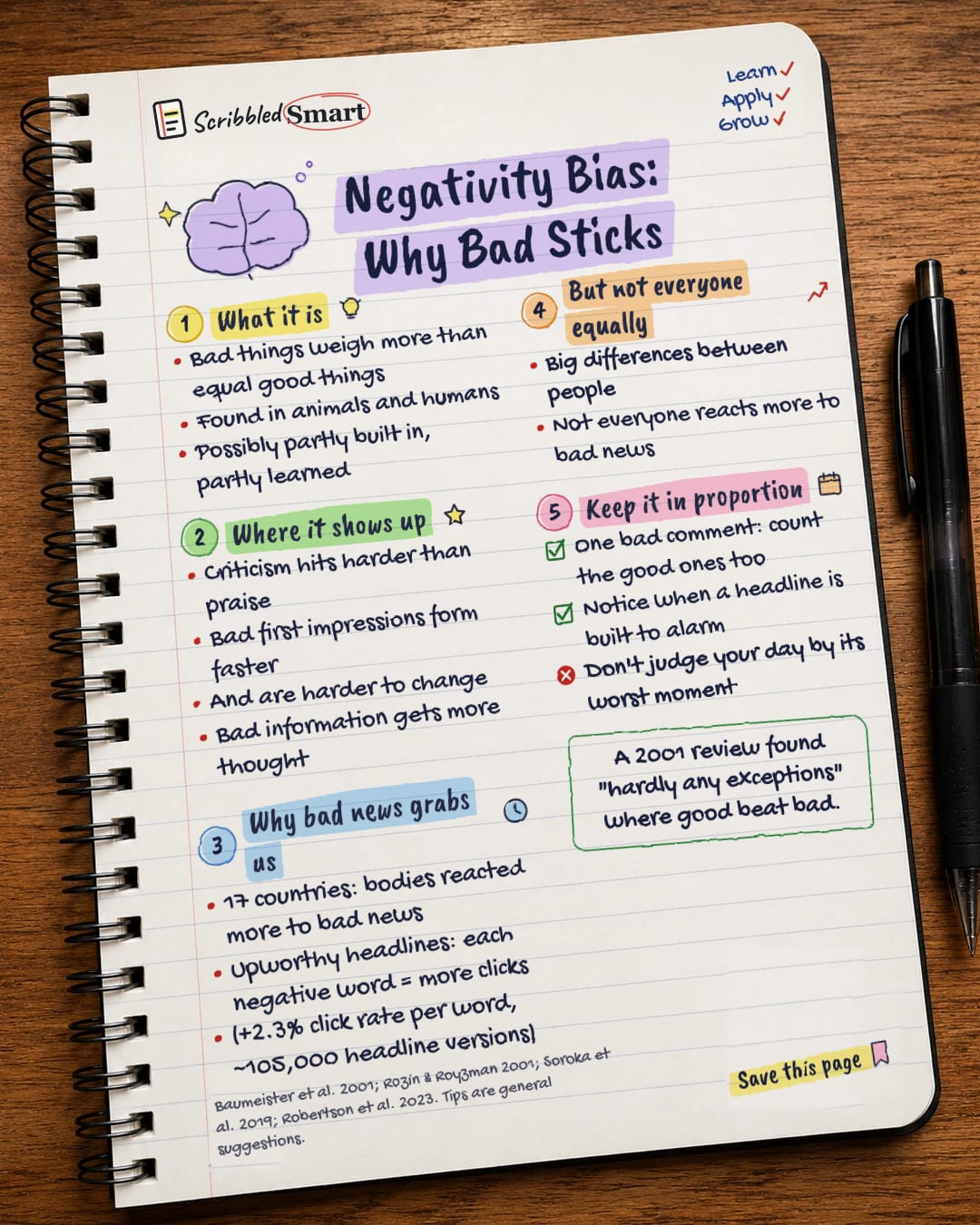
What it is
- Bad things weigh more than equal good things
- Found in animals and humans
- Possibly partly built in, partly learned
Where it shows up
- Criticism hits harder than praise
- Bad first impressions form faster
- And are harder to change
- Bad information gets more thought
Why bad news grabs us
- 17 countries: bodies reacted more to bad news
- Upworthy headlines: each negative word = more clicks
- (+2.3% click rate per word, ~105,000 headline versions)
But not everyone equally
- Big differences between people
- Not everyone reacts more to bad news
Keep it in proportion
- One bad comment: count the good ones too
- Notice when a headline is built to alarm
- Don't judge your day by its worst moment
Sources
- Baumeister, R. F., Bratslavsky, E., Finkenauer, C. & Vohs, K. D. (2001): Bad is stronger than good. Review of General Psychology
- Rozin, P. & Royzman, E. B. (2001): Negativity bias, negativity dominance, and contagion. Personality and Social Psychology Review
- Soroka, S., Fournier, P. & Nir, L. (2019): Cross-national evidence of a negativity bias in psychophysiological reactions to news. PNAS
- Robertson, C. E. et al. (2023): Negativity drives online news consumption. Nature Human Behaviour
How we checked this
Every fact on this note comes from the 4 sources listed here, checked against official or peer-reviewed sources where possible. AI tools help with drafting; a person checks every fact against the sources. How we research
Spotted a mistake? Tell us and we'll fix it and log it on the corrections page.


