
Psychology One-page note
7 Thinking Traps (Cognitive Biases)
Your brain takes shortcuts, and these 7 trip everyone up. Which one do you fall for most? Save this page.
What's on the page
The note as text, so you can read it, copy it or use a screen reader.
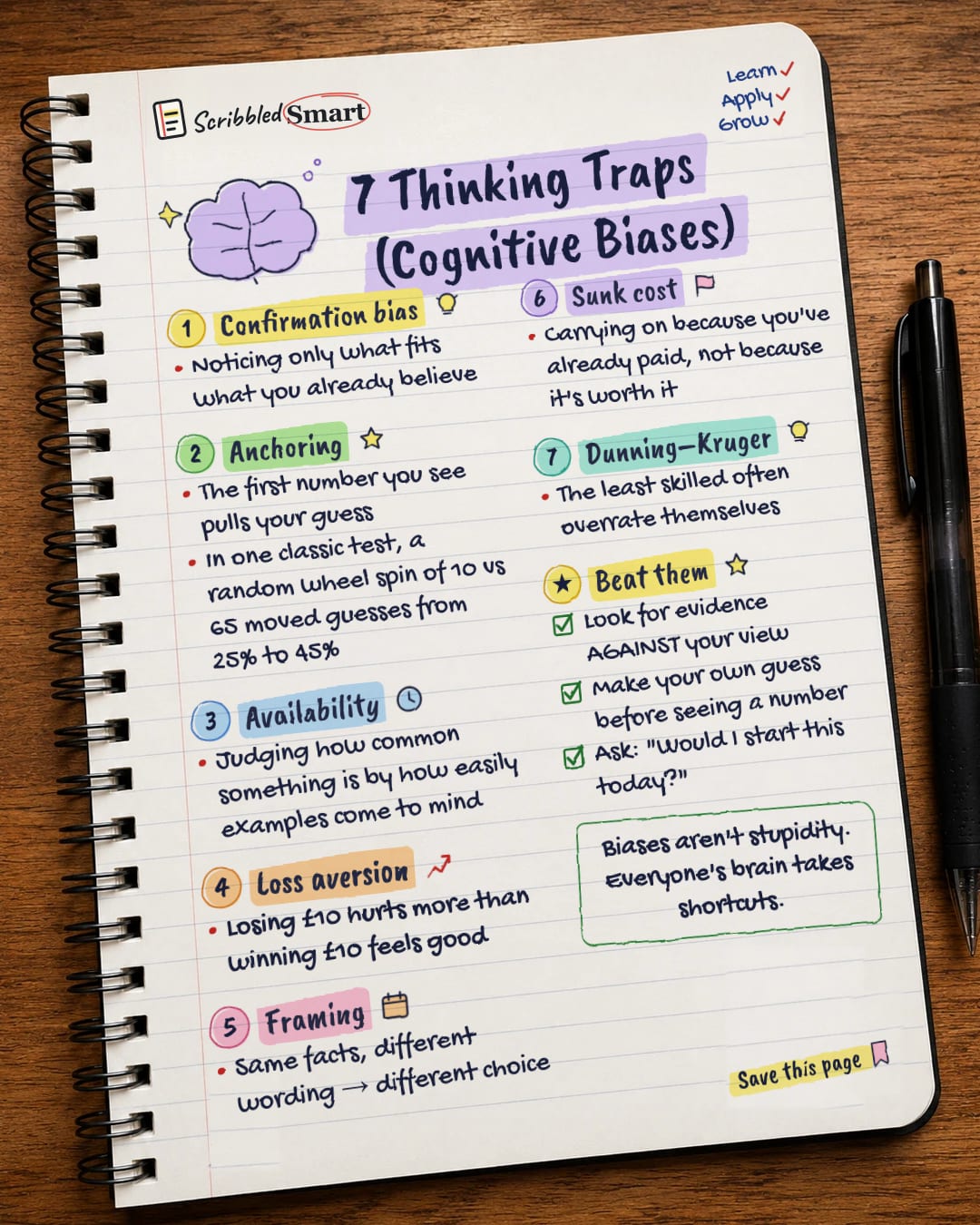
Confirmation bias
- Noticing only what fits what you already believe
Anchoring
- The first number you see pulls your guess
- In one classic test, a random wheel spin of 10 vs 65 moved guesses from 25% to 45%
Availability
- Judging how common something is by how easily examples come to mind
Loss aversion
- Losing £10 hurts more than winning £10 feels good
Framing
- Same facts, different wording → different choice
Sunk cost
- Carrying on because you've already paid, not because it's worth it
Dunning–Kruger
- The least skilled often overrate themselves
Beat them
- Look for evidence AGAINST your view
- Make your own guess before seeing a number
- Ask: "Would I start this today?"
Sources
- Nickerson (1998): Confirmation Bias: A Ubiquitous Phenomenon in Many Guises (PDF)
- CAUSEweb: Tversky & Kahneman (1974) summary
- Deceptive Design: Judgment under uncertainty summary
- UCSD course notes: prospect theory and framing (PDF)
- Arkes & Blumer (1985): The Psychology of Sunk Cost (PDF)
- Decision Science News: Arkes & Blumer
- Kruger & Dunning (1999), Journal of Personality and Social Psychology (PDF)
How we checked this
Every fact on this note comes from the 7 sources listed here, checked against official or peer-reviewed sources where possible. AI tools help with drafting; a person checks every fact against the sources. How we research
Spotted a mistake? Tell us and we'll fix it and log it on the corrections page.


