
Psychology One-page note
Cialdini's 6 Principles of Persuasion
Ever bought something just because it was "last one left"? That's persuasion science. Here's how it works, and how to spot it. Save this page.
Good to know
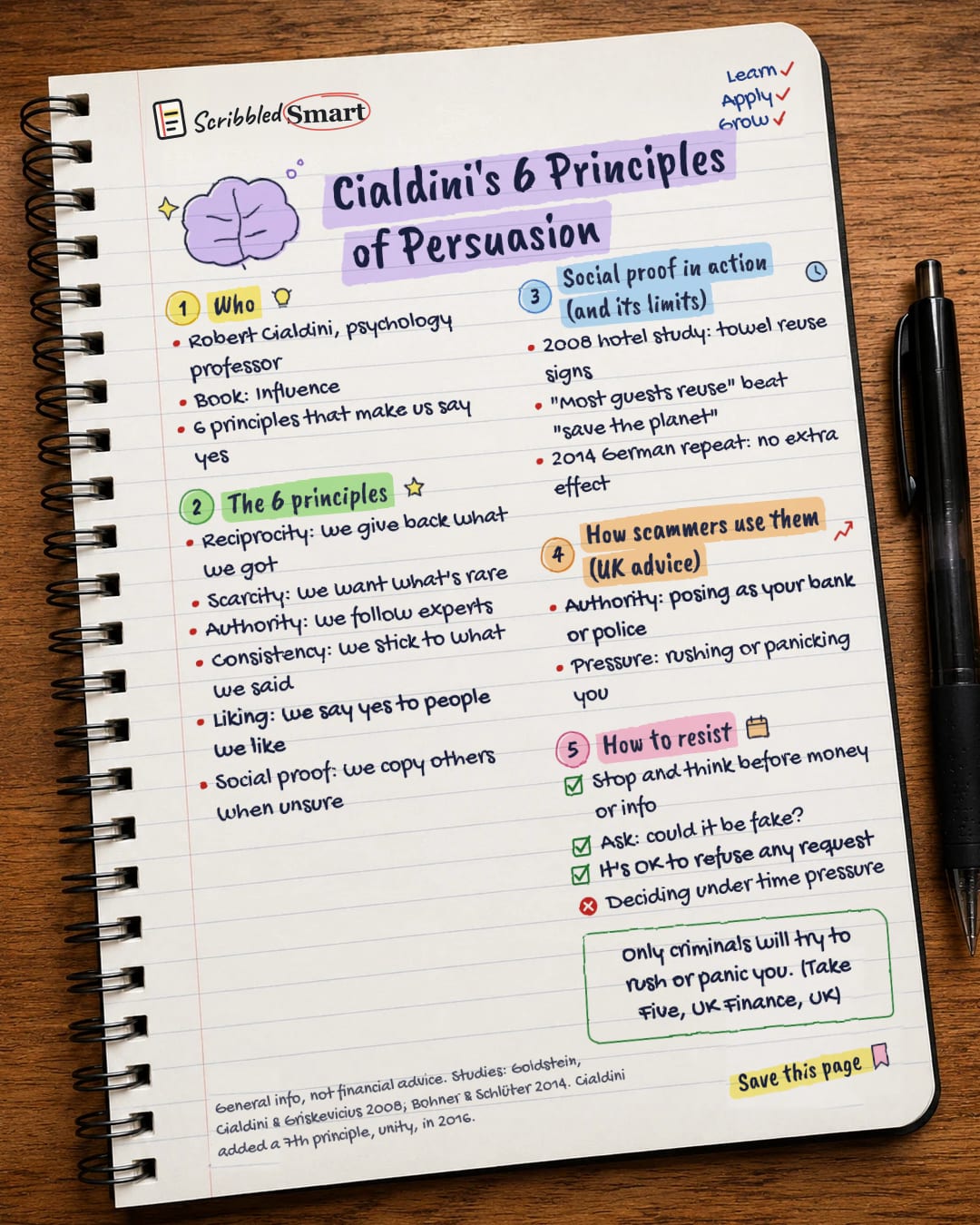
General info, not financial advice. Studies: Goldstein, Cialdini & Griskevicius 2008; Bohner & Schlüter 2014. Cialdini added a 7th principle, unity, in 2016.
What's on the page
The note as text, so you can read it, copy it or use a screen reader.
Who
- Robert Cialdini, psychology professor
- Book: Influence
- 6 principles that make us say yes
The 6 principles
- Reciprocity: we give back what we got
- Scarcity: we want what's rare
- Authority: we follow experts
- Consistency: we stick to what we said
- Liking: we say yes to people we like
- Social proof: we copy others when unsure
Social proof in action (and its limits)
- 2008 hotel study: towel reuse signs
- "Most guests reuse" beat "save the planet"
- 2014 German repeat: no extra effect
How scammers use them (UK advice)
- Authority: posing as your bank or police
- Pressure: rushing or panicking you
How to resist
- Stop and think before money or info
- Ask: could it be fake?
- It's OK to refuse any request
- Deciding under time pressure
Sources
- Influence at Work: Principles of persuasion
- Goldstein, N. J., Cialdini, R. B. & Griskevicius, V. (2008): A room with a viewpoint: using social norms to motivate environmental conservation in hotels
- Take Five to Stop Fraud (UK Finance): General advice
- W. P. Carey School of Business, ASU: The gentle science of persuasion, part seven: Unity
- Bohner, G. & Schlüter, L. E. (2014): A room with a viewpoint revisited: descriptive norms and hotel guests' towel reuse behavior. PLOS ONE
How we checked this
Every fact on this note comes from the 5 sources listed here, checked against official or peer-reviewed sources where possible. AI tools help with drafting; a person checks every fact against the sources. How we research
Spotted a mistake? Tell us and we'll fix it and log it on the corrections page.


