
Study One-page note
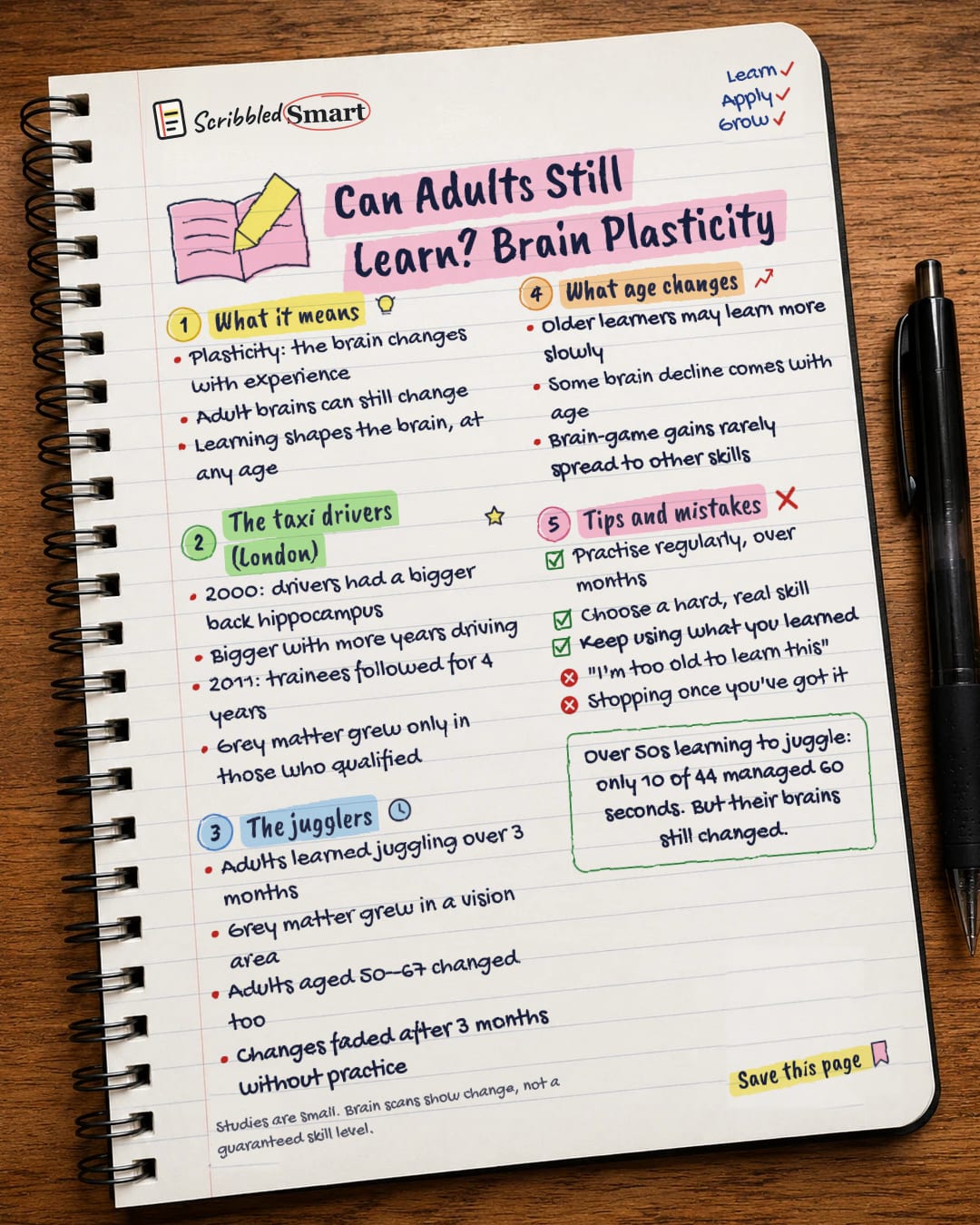
Can Adults Still Learn? Brain Plasticity
Think you're too old to learn something new? London cabbies and jugglers say otherwise. Save this page.
Good to know
Studies are small. Brain scans show change, not a guaranteed skill level.
What's on the page
The note as text, so you can read it, copy it or use a screen reader.
What it means
- Plasticity: the brain changes with experience
- Adult brains can still change
- Learning shapes the brain, at any age
The taxi drivers (London)
- 2000: drivers had a bigger back hippocampus
- Bigger with more years driving
- 2011: trainees followed for 4 years
- Grey matter grew only in those who qualified
The jugglers
- Adults learned juggling over 3 months
- Grey matter grew in a vision area
- Adults aged 50–67 changed too
- Changes faded after 3 months without practice
What age changes
- Older learners may learn more slowly
- Some brain decline comes with age
- Brain-game gains rarely spread to other skills
Tips and mistakes
- Practise regularly, over months
- Choose a hard, real skill
- Keep using what you learned
- "I'm too old to learn this"
- Stopping once you've got it
Sources
- Maguire et al. (2000), Navigation-related structural change in the hippocampi of taxi drivers, PNAS
- Woollett & Maguire (2011), Acquiring "the Knowledge" of London's layout drives structural brain changes, Current Biology
- Draganski et al. (2004), Neuroplasticity: changes in grey matter induced by training, Nature
- Boyke et al. (2008), Training-induced brain structure changes in the elderly, J Neurosci
- Park & Bischof (2013), The aging mind: neuroplasticity in response to cognitive training, Dialogues Clin Neurosci
- Clark et al. (2020), Does hippocampal volume explain performance differences on hippocampal-dependant tasks? NeuroImage
- Europe PMC REST API (abstracts)
How we checked this
Every fact on this note comes from the 7 sources listed here, checked against official or peer-reviewed sources where possible. AI tools help with drafting; a person checks every fact against the sources. How we research
Spotted a mistake? Tell us and we'll fix it and log it on the corrections page.


