
Study One-page note
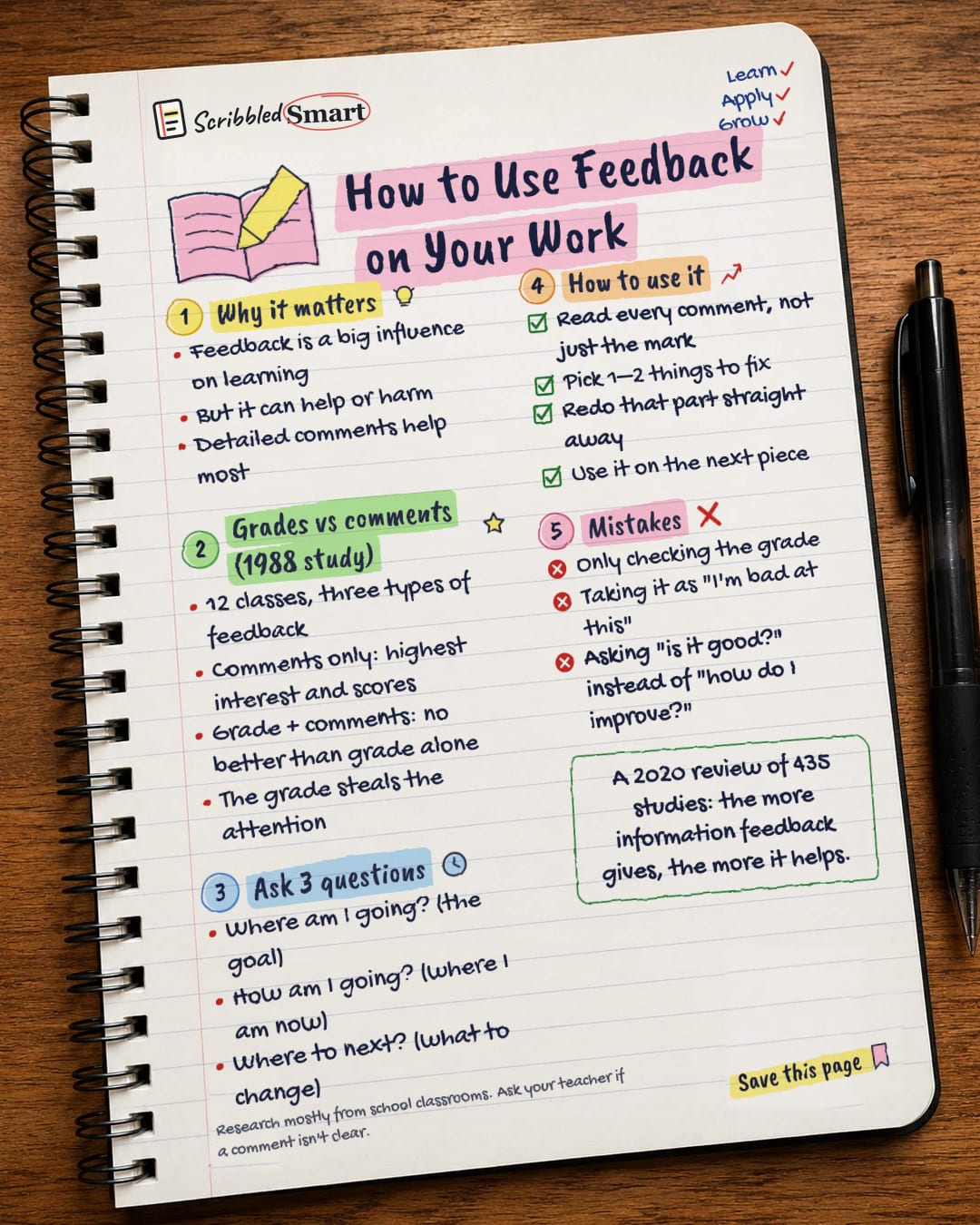
How to Use Feedback on Your Work
Most students look at the grade and skip the comments. That's where the learning is. Save this page.
Good to know
Research mostly from school classrooms. Ask your teacher if a comment isn't clear.
What's on the page
The note as text, so you can read it, copy it or use a screen reader.
Why it matters
- Feedback is a big influence on learning
- But it can help or harm
- Detailed comments help most
Grades vs comments (1988 study)
- 12 classes, three types of feedback
- Comments only: highest interest and scores
- Grade + comments: no better than grade alone
- The grade steals the attention
Ask 3 questions
- Where am I going? (the goal)
- How am I going? (where I am now)
- Where to next? (what to change)
How to use it
- Read every comment, not just the mark
- Pick 1–2 things to fix
- Redo that part straight away
- Use it on the next piece
Mistakes
- Only checking the grade
- Taking it as "I'm bad at this"
- Asking "is it good?" instead of "how do I improve?"
Sources
- Butler (1988), Enhancing and undermining intrinsic motivation, BJEP 58(1), 1–14
- Butler & Nisan (1986), J Educ Psychol 78(3), 210–216
- Hattie & Timperley (2007), The Power of Feedback
- Wisniewski, Zierer & Hattie (2020), The Power of Feedback Revisited
- BERA blog: How to optimise the use of Hattie and Timperley's feedback levels
- EEF: Teacher Feedback to Improve Pupil Learning (2021)
How we checked this
Every fact on this note comes from the 6 sources listed here, checked against official or peer-reviewed sources where possible. AI tools help with drafting; a person checks every fact against the sources. How we research
Spotted a mistake? Tell us and we'll fix it and log it on the corrections page.


