
Study One-page note
The Serial Position Effect
Why do you remember the first and last things on a list, but forget the middle? It's the serial position effect. Save this page.
Good to know
Lab studies of word lists. Explanations are still debated.
What's on the page
The note as text, so you can read it, copy it or use a screen reader.
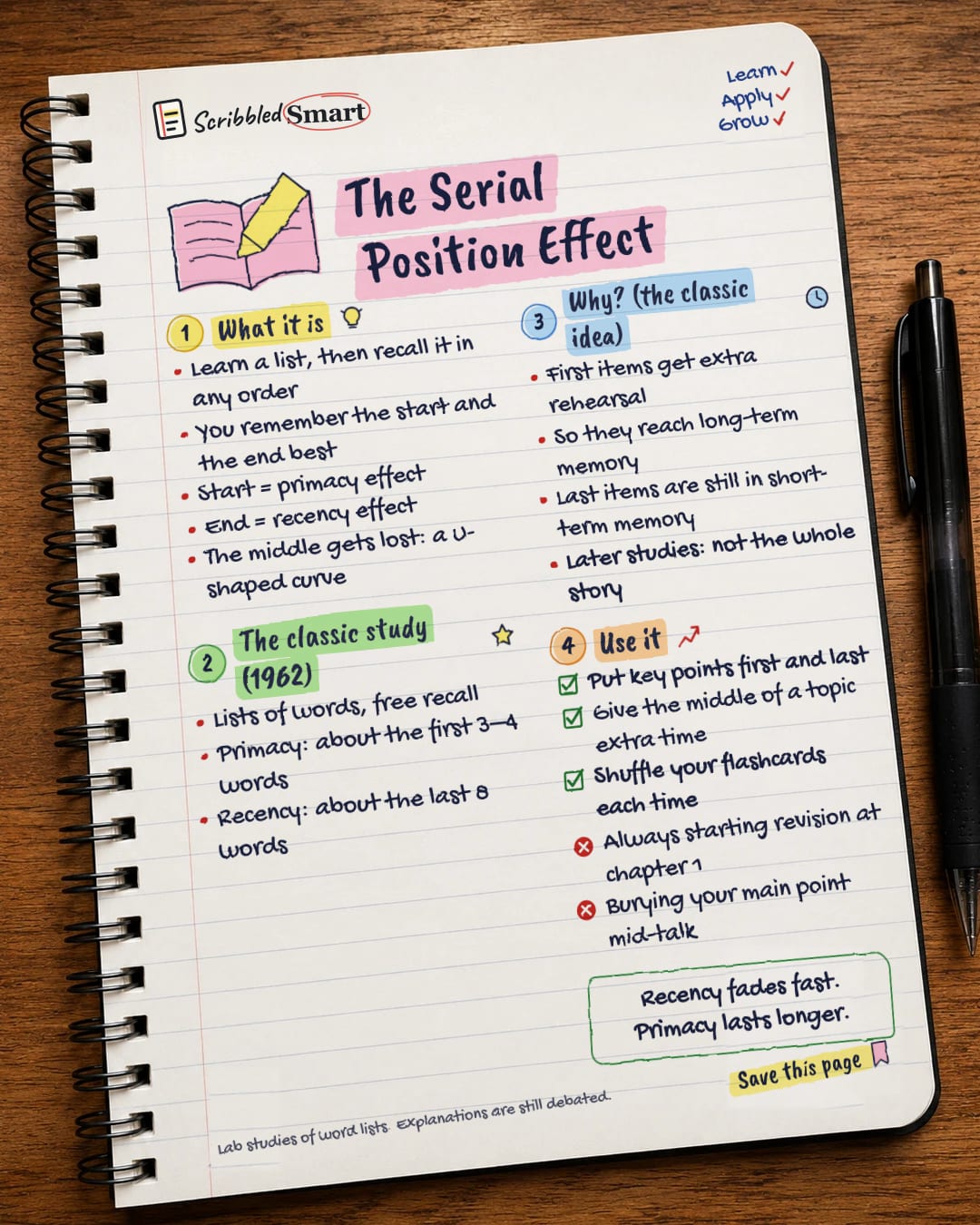
What it is
- Learn a list, then recall it in any order
- You remember the start and the end best
- Start = primacy effect
- End = recency effect
- The middle gets lost: a U-shaped curve
The classic study (1962)
- Lists of words, free recall
- Primacy: about the first 3–4 words
- Recency: about the last 8 words
Why? (the classic idea)
- First items get extra rehearsal
- So they reach long-term memory
- Last items are still in short-term memory
- Later studies: not the whole story
Use it
- Put key points first and last
- Give the middle of a topic extra time
- Shuffle your flashcards each time
- Always starting revision at chapter 1
- Burying your main point mid-talk
Sources
- Murdock, B.B. (1962): The serial position effect of free recall. Journal of Experimental Psychology 64(5), 482–488
- Glanzer, M. & Cunitz, A.R. (1966): Two storage mechanisms in free recall. Journal of Verbal Learning and Verbal Behavior 5(4), 351–360
- Cortis Mack, C., Cinel, C., Davies, N., Harding, M. & Ward, G. (2017): Serial position, output order, and list length effects for words presented on smartphones over very long intervals. Journal of Memory and Language 97, 61–80
How we checked this
Every fact on this note comes from the 3 sources listed here, checked against official or peer-reviewed sources where possible. AI tools help with drafting; a person checks every fact against the sources. How we research
Spotted a mistake? Tell us and we'll fix it and log it on the corrections page.


