
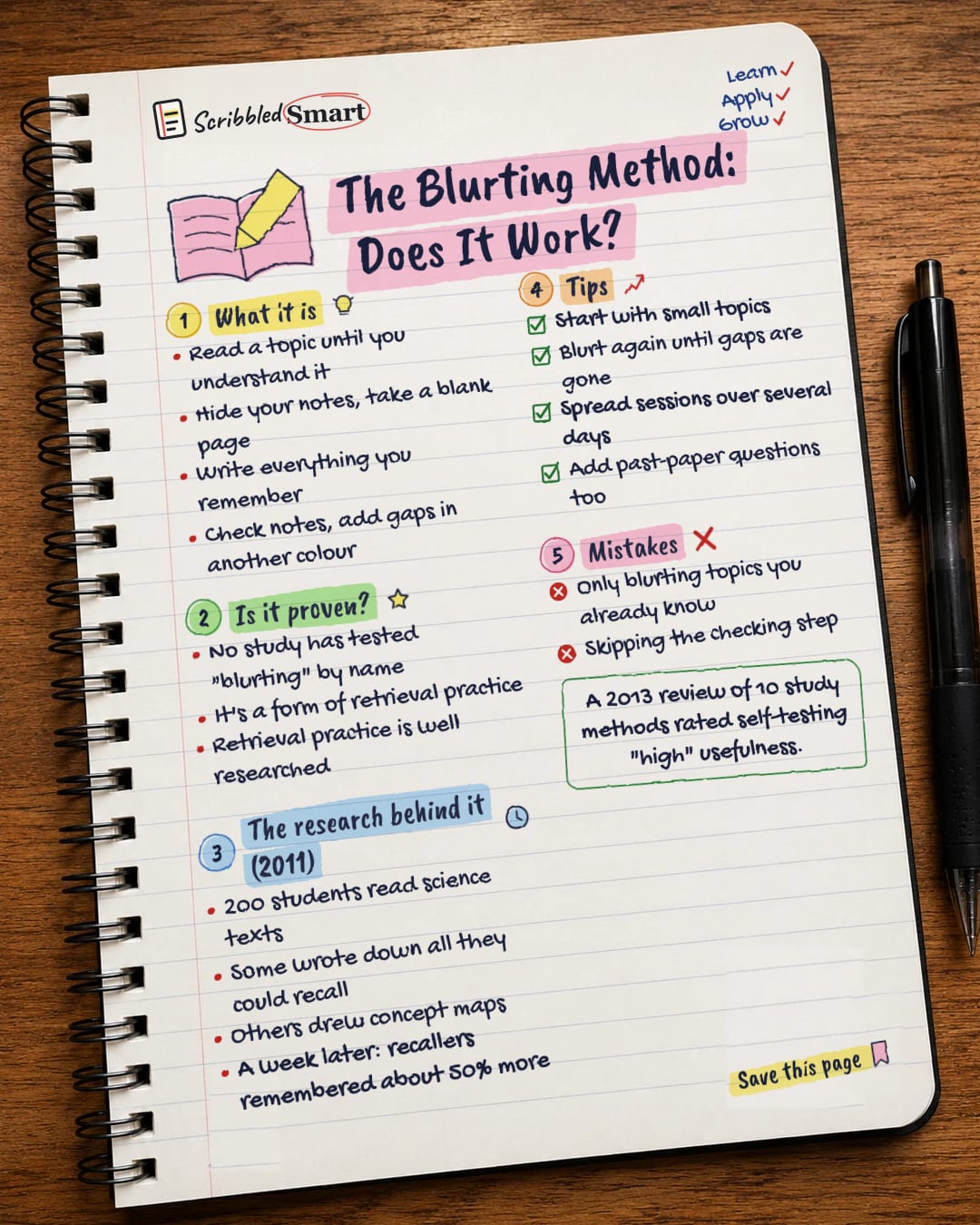
Study One-page note
The Blurting Method: Does It Work?
Blurting went viral on StudyTok. Here's what the science actually says. Save this page.
What's on the page
The note as text, so you can read it, copy it or use a screen reader.
What it is
- Read a topic until you understand it
- Hide your notes, take a blank page
- Write everything you remember
- Check notes, add gaps in another colour
Is it proven?
- No study has tested "blurting" by name
- It's a form of retrieval practice
- Retrieval practice is well researched
The research behind it (2011)
- 200 students read science texts
- Some wrote down all they could recall
- Others drew concept maps
- A week later: recallers remembered about 50% more
Tips
- Start with small topics
- Blurt again until gaps are gone
- Spread sessions over several days
- Add past-paper questions too
Mistakes
- Only blurting topics you already know
- Skipping the checking step
Sources
- Birmingham City University: How to revise with the blurting method
- ScienceDaily (Purdue University, 2011): Learning science: Actively recalling information from memory beats elaborate study methods
- Karpicke & Blunt (2011), Science 331(6018), 772–775
- Dunlosky (2013), Strengthening the Student Toolbox, American Educator
- APS: Which study strategies make the grade?
- Donoghue & Hattie (2021), A Meta-Analysis of Ten Learning Techniques, Frontiers in Education 6
- Cognito: The blurting revision method
How we checked this
Every fact on this note comes from the 7 sources listed here, checked against official or peer-reviewed sources where possible. AI tools help with drafting; a person checks every fact against the sources. How we research
Spotted a mistake? Tell us and we'll fix it and log it on the corrections page.


