
AI & Tech One-page note
KB, MB, GB, TB: Data Sizes Explained
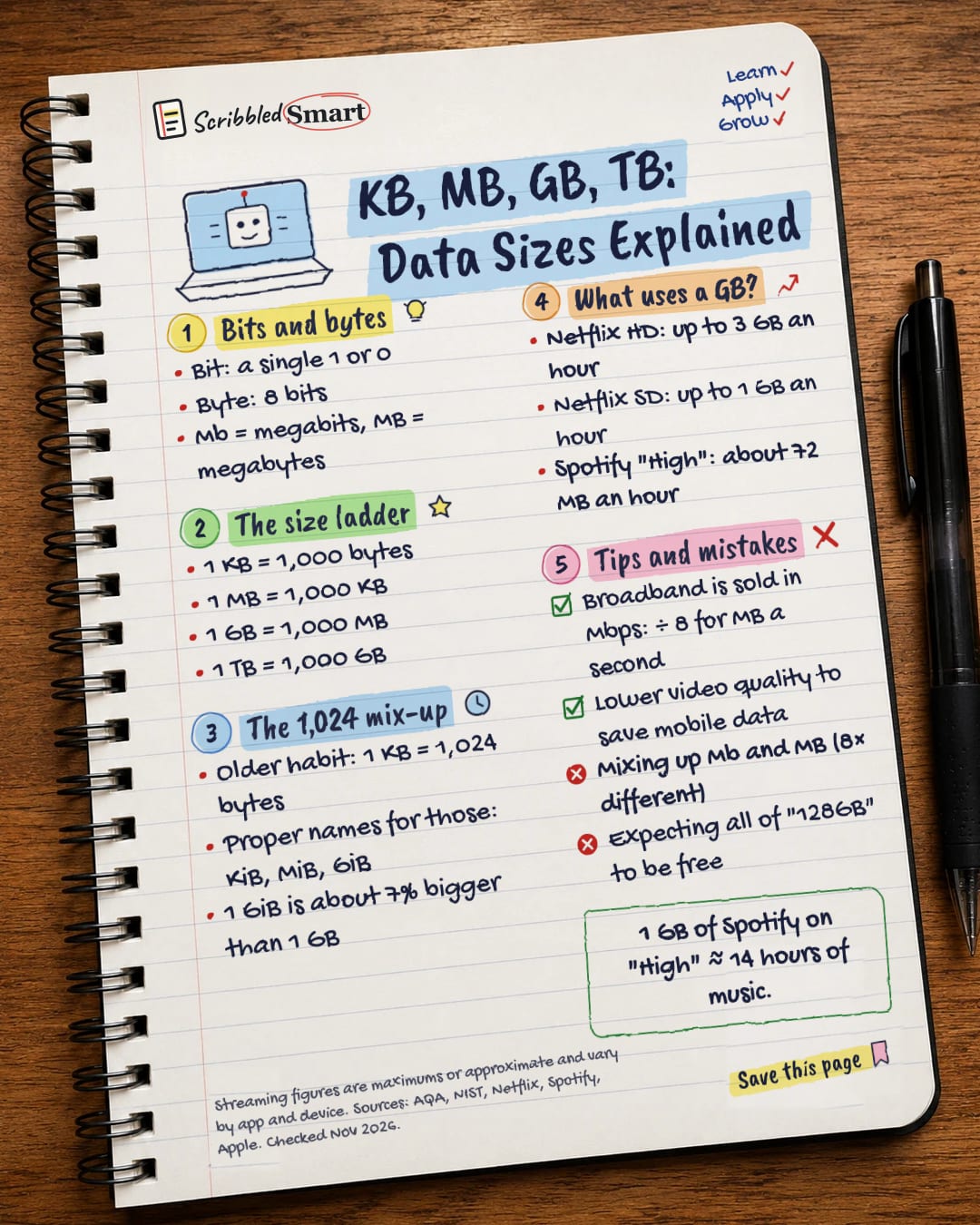
How many hours of Netflix is 1 GB? And why does a "1TB" drive never seem to be 1TB? Data sizes, explained in one page. Save this page.
Good to know
Streaming figures are maximums or approximate and vary by app and device. Sources: AQA, NIST, Netflix, Spotify, Apple. Checked Nov 2026.
What's on the page
The note as text, so you can read it, copy it or use a screen reader.
Bits and bytes
- Bit: a single 1 or 0
- Byte: 8 bits
- Mb = megabits, MB = megabytes
The size ladder
- 1 KB = 1,000 bytes
- 1 MB = 1,000 KB
- 1 GB = 1,000 MB
- 1 TB = 1,000 GB
The 1,024 mix-up
- Older habit: 1 KB = 1,024 bytes
- Proper names for those: KiB, MiB, GiB
- 1 GiB is about 7% bigger than 1 GB
What uses a GB?
- Netflix HD: up to 3 GB an hour
- Netflix SD: up to 1 GB an hour
- Spotify "High": about 72 MB an hour
Tips and mistakes
- Broadband is sold in Mbps: ÷ 8 for MB a second
- Lower video quality to save mobile data
- Mixing up Mb and MB (8× different)
- Expecting all of "128GB" to be free
Sources
- AQA: GCSE Computer Science 8525, 3.3 Fundamentals of data representation
- NIST: Prefixes for binary multiples
- Netflix Help Center: How to control how much data Netflix uses
- Spotify Support: Audio quality
- Zzoomm: The difference between Megabit (Mbps) and Megabyte (MBps)
- Apple Support: How storage capacity is measured on Apple devices
How we checked this
Every fact on this note comes from the 6 sources listed here, checked against official or peer-reviewed sources where possible. AI tools help with drafting; a person checks every fact against the sources. How we research
Spotted a mistake? Tell us and we'll fix it and log it on the corrections page.


