
General knowledge One-page note
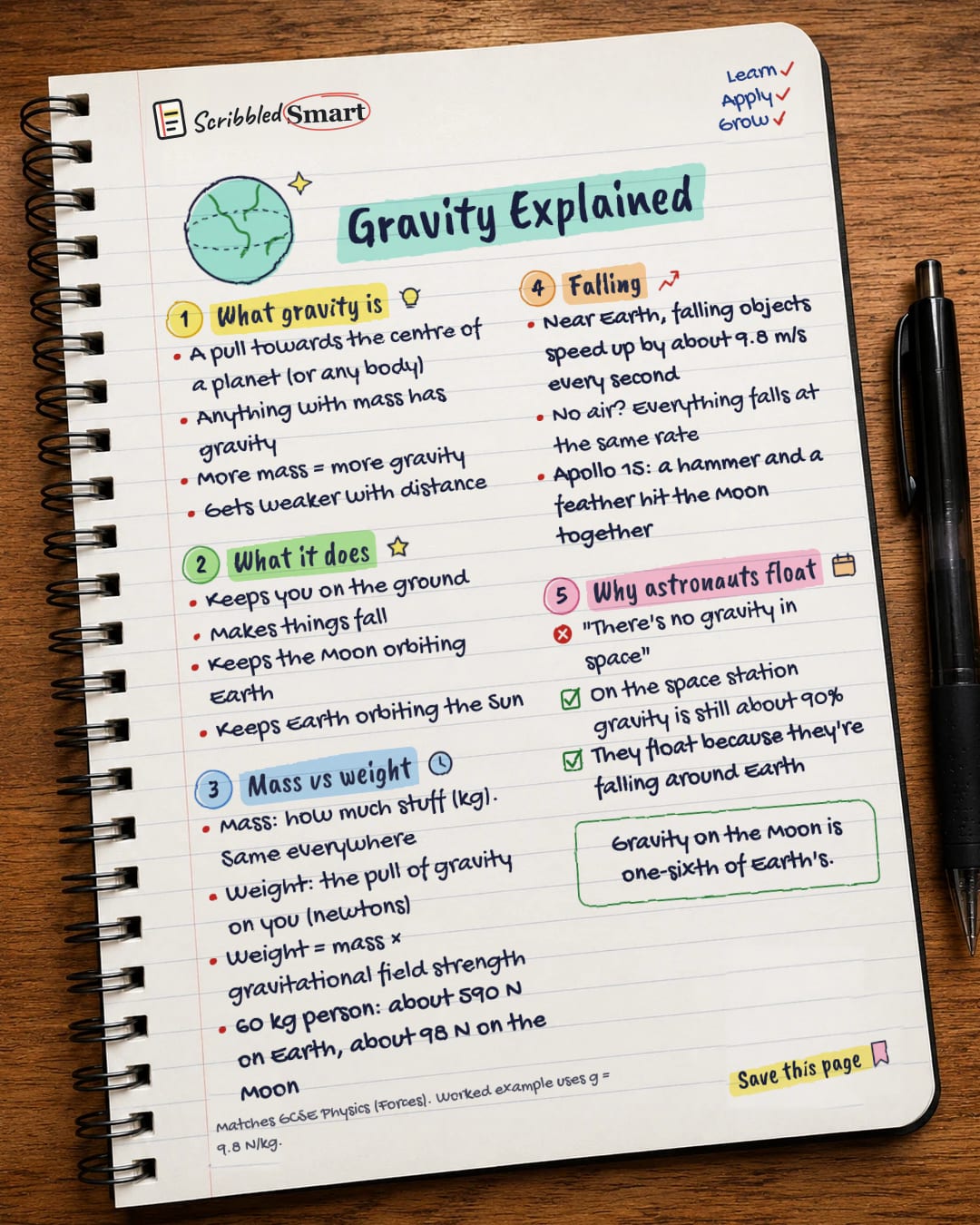
Gravity Explained
Astronauts float, but not because there's no gravity. Gravity in one page. Save this page.
Good to know
Matches GCSE Physics (Forces). Worked example uses g = 9.8 N/kg.
What's on the page
The note as text, so you can read it, copy it or use a screen reader.
What gravity is
- A pull towards the centre of a planet (or any body)
- Anything with mass has gravity
- More mass = more gravity
- Gets weaker with distance
What it does
- Keeps you on the ground
- Makes things fall
- Keeps the Moon orbiting Earth
- Keeps Earth orbiting the Sun
Mass vs weight
- Mass: how much stuff (kg). Same everywhere
- Weight: the pull of gravity on you (newtons)
- Weight = mass × gravitational field strength
- 60 kg person: about 590 N on Earth, about 98 N on the Moon
Falling
- Near Earth, falling objects speed up by about 9.8 m/s every second
- No air? Everything falls at the same rate
- Apollo 15: a hammer and a feather hit the Moon together
Why astronauts float
- "There's no gravity in space"
- On the space station gravity is still about 90%
- They float because they're falling around Earth
Sources
How we checked this
Every fact on this note comes from the 6 sources listed here, checked against official or peer-reviewed sources where possible. AI tools help with drafting; a person checks every fact against the sources. How we research
Spotted a mistake? Tell us and we'll fix it and log it on the corrections page.


