
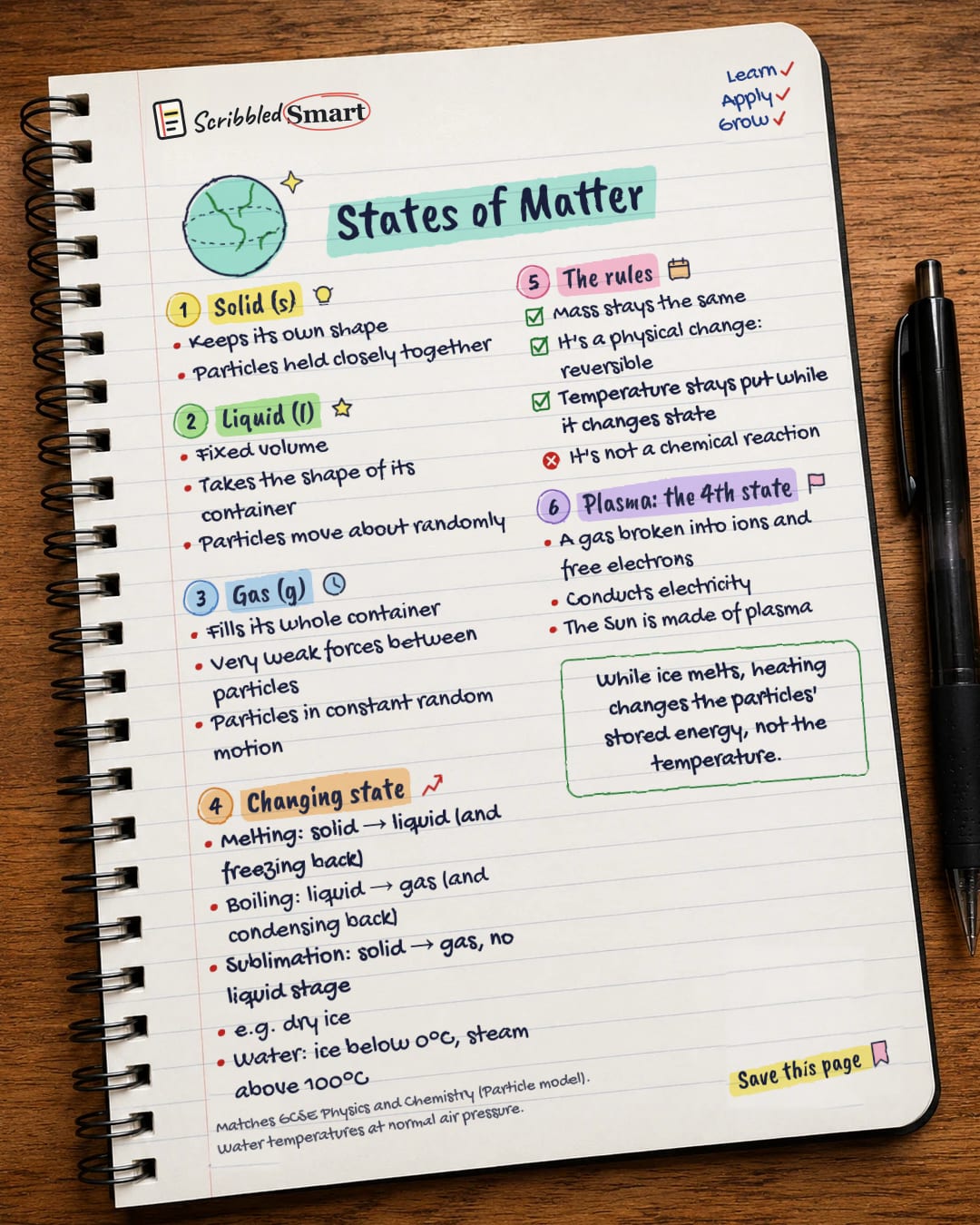
General knowledge One-page note
States of Matter
Solid, liquid, gas, and the fourth one most people forget. States of matter in one page. Save this page.
Good to know
Matches GCSE Physics and Chemistry (Particle model). Water temperatures at normal air pressure.
What's on the page
The note as text, so you can read it, copy it or use a screen reader.
Solid (s)
- Keeps its own shape
- Particles held closely together
Liquid (l)
- Fixed volume
- Takes the shape of its container
- Particles move about randomly
Gas (g)
- Fills its whole container
- Very weak forces between particles
- Particles in constant random motion
Changing state
- Melting: solid → liquid (and freezing back)
- Boiling: liquid → gas (and condensing back)
- Sublimation: solid → gas, no liquid stage
- e.g. dry ice
- Water: ice below 0°C, steam above 100°C
The rules
- Mass stays the same
- It's a physical change: reversible
- Temperature stays put while it changes state
- It's not a chemical reaction
Plasma: the 4th state
- A gas broken into ions and free electrons
- Conducts electricity
- The Sun is made of plasma
Sources
- AQA: GCSE Physics (8463) specification, 4.3 Particle model of matter
- AQA: GCSE Chemistry (8462) specification, 4.2 Bonding, structure and the properties of matter
- NASA Glenn Research Center: States of matter
- NASA Goddard Space Flight Center: Plasma
- NASA Science: Glossary (P)
- USGS Water Science School: Sublimation and the water cycle
How we checked this
Every fact on this note comes from the 6 sources listed here, checked against official or peer-reviewed sources where possible. AI tools help with drafting; a person checks every fact against the sources. How we research
Spotted a mistake? Tell us and we'll fix it and log it on the corrections page.


