
General knowledge One-page note
How the National Grid Works
Why do pylons carry 400,000 volts when your plug needs 230? It's all about wasting less. Save this page.
Good to know
Great Britain (England, Scotland, Wales). Checked Nov 2026.
What's on the page
The note as text, so you can read it, copy it or use a screen reader.
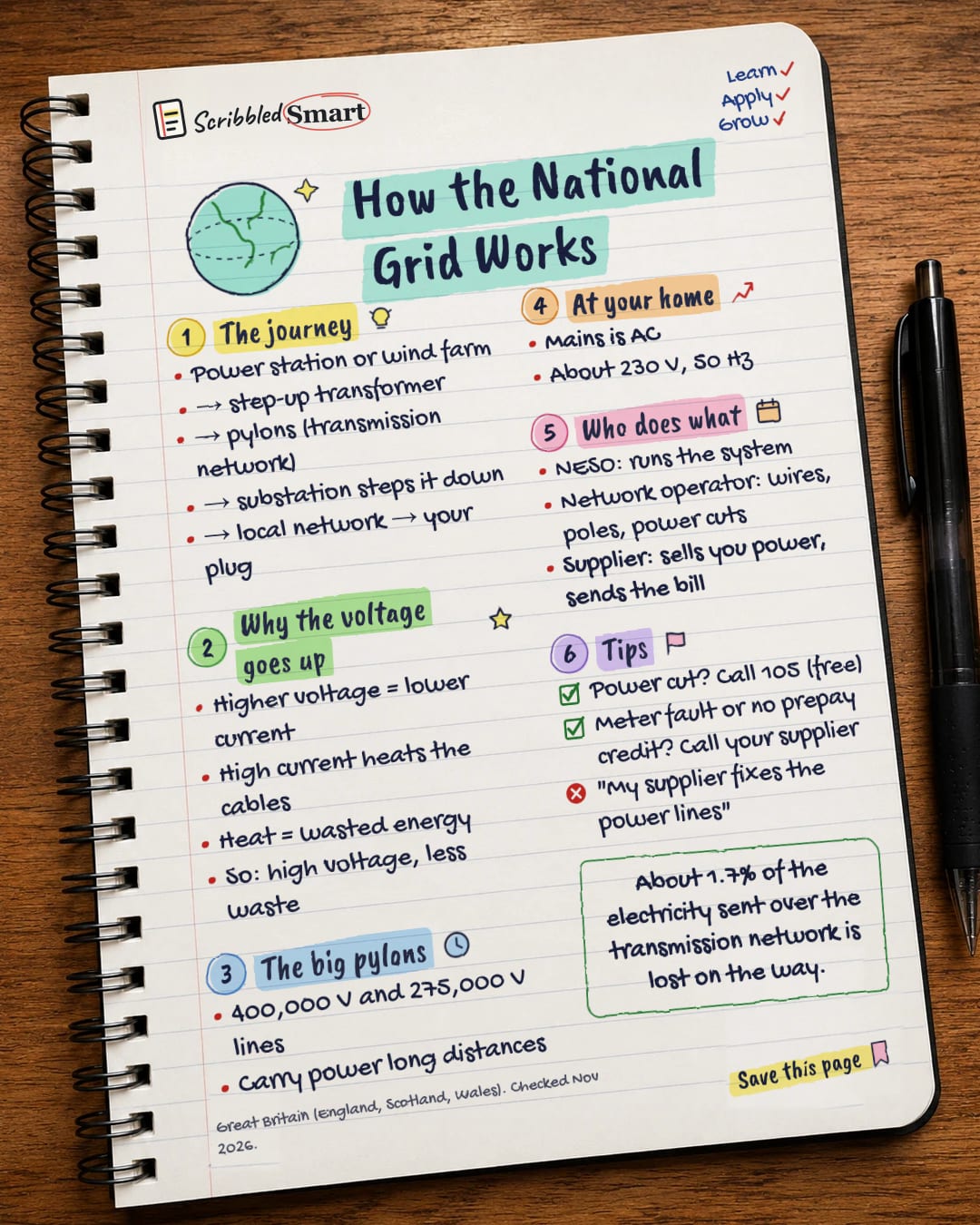
The journey
- Power station or wind farm
- → step-up transformer
- → pylons (transmission network)
- → substation steps it down
- → local network → your plug
Why the voltage goes up
- Higher voltage = lower current
- High current heats the cables
- Heat = wasted energy
- So: high voltage, less waste
The big pylons
- 400,000 V and 275,000 V lines
- Carry power long distances
At your home
- Mains is AC
- About 230 V, 50 Hz
Who does what
- NESO: runs the system
- Network operator: wires, poles, power cuts
- Supplier: sells you power, sends the bill
Tips
- Power cut? Call 105 (free)
- Meter fault or no prepay credit? Call your supplier
- "My supplier fixes the power lines"
Sources
- AQA: GCSE Physics (8463) specification, 4.2 Electricity
- Ofgem: What we regulate
- Met Office: What to do in a power cut
- NESO: How does electricity get to where it's needed?
- NESO: Public Introduction to Transmission Losses Guidance Document (Jan 2026)
- National Grid: Substations, pylons and overhead lines
- Ofgem: Plan for a power cut
How we checked this
Every fact on this note comes from the 7 sources listed here, checked against official or peer-reviewed sources where possible. AI tools help with drafting; a person checks every fact against the sources. How we research
Spotted a mistake? Tell us and we'll fix it and log it on the corrections page.


