
General knowledge One-page note UK only
Solar and Lunar Eclipses
Why the Moon turns red, and when the UK gets its next eclipse. Save this page.
Good to know
UK dates. Checked November 2026.
What's on the page
The note as text, so you can read it, copy it or use a screen reader.
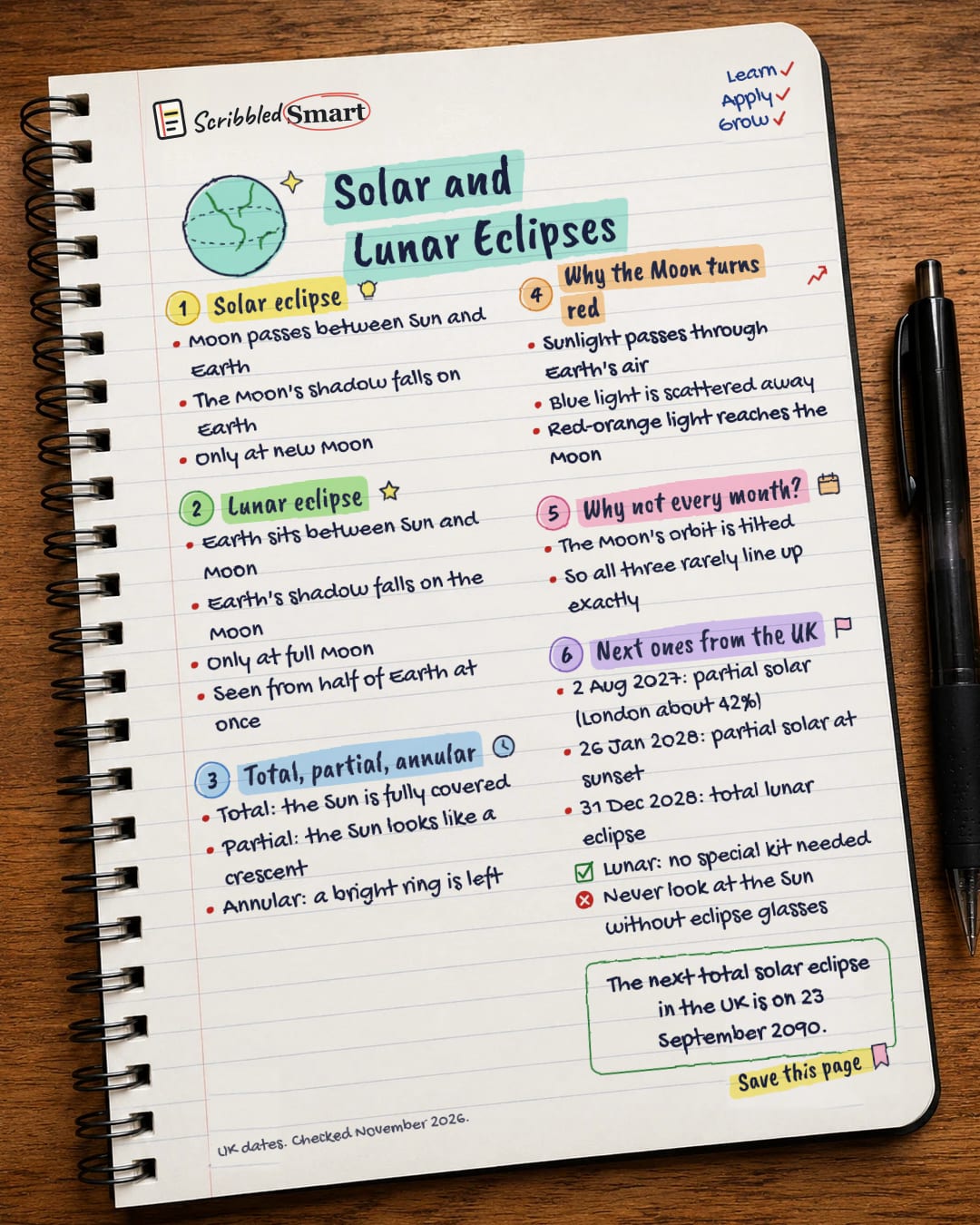
Solar eclipse
- Moon passes between Sun and Earth
- The Moon's shadow falls on Earth
- Only at new Moon
Lunar eclipse
- Earth sits between Sun and Moon
- Earth's shadow falls on the Moon
- Only at full Moon
- Seen from half of Earth at once
Total, partial, annular
- Total: the Sun is fully covered
- Partial: the Sun looks like a crescent
- Annular: a bright ring is left
Why the Moon turns red
- Sunlight passes through Earth's air
- Blue light is scattered away
- Red-orange light reaches the Moon
Why not every month?
- The Moon's orbit is tilted
- So all three rarely line up exactly
Next ones from the UK
- 2 Aug 2027: partial solar (London about 42%)
- 26 Jan 2028: partial solar at sunset
- 31 Dec 2028: total lunar eclipse
- Lunar: no special kit needed
- Never look at the Sun without eclipse glasses
Sources
- NASA Science: Types of eclipses / solar eclipses
- NASA Science: Eclipses and the Moon
- NASA Science: What you need to know about the March 2025 total lunar eclipse
- NASA GSFC: Solar eclipses 2021–2030
- NASA GSFC: Lunar eclipses 2021–2030
- BBC Sky at Night Magazine: Upcoming UK solar eclipses
- timeanddate: Total lunar eclipse 31 December 2028
How we checked this
Every fact on this note comes from the 7 sources listed here, checked against official or peer-reviewed sources where possible. AI tools help with drafting; a person checks every fact against the sources. How we research
Spotted a mistake? Tell us and we'll fix it and log it on the corrections page.


