
Money One-page note
Unit Pricing: Spot the Real Bargain
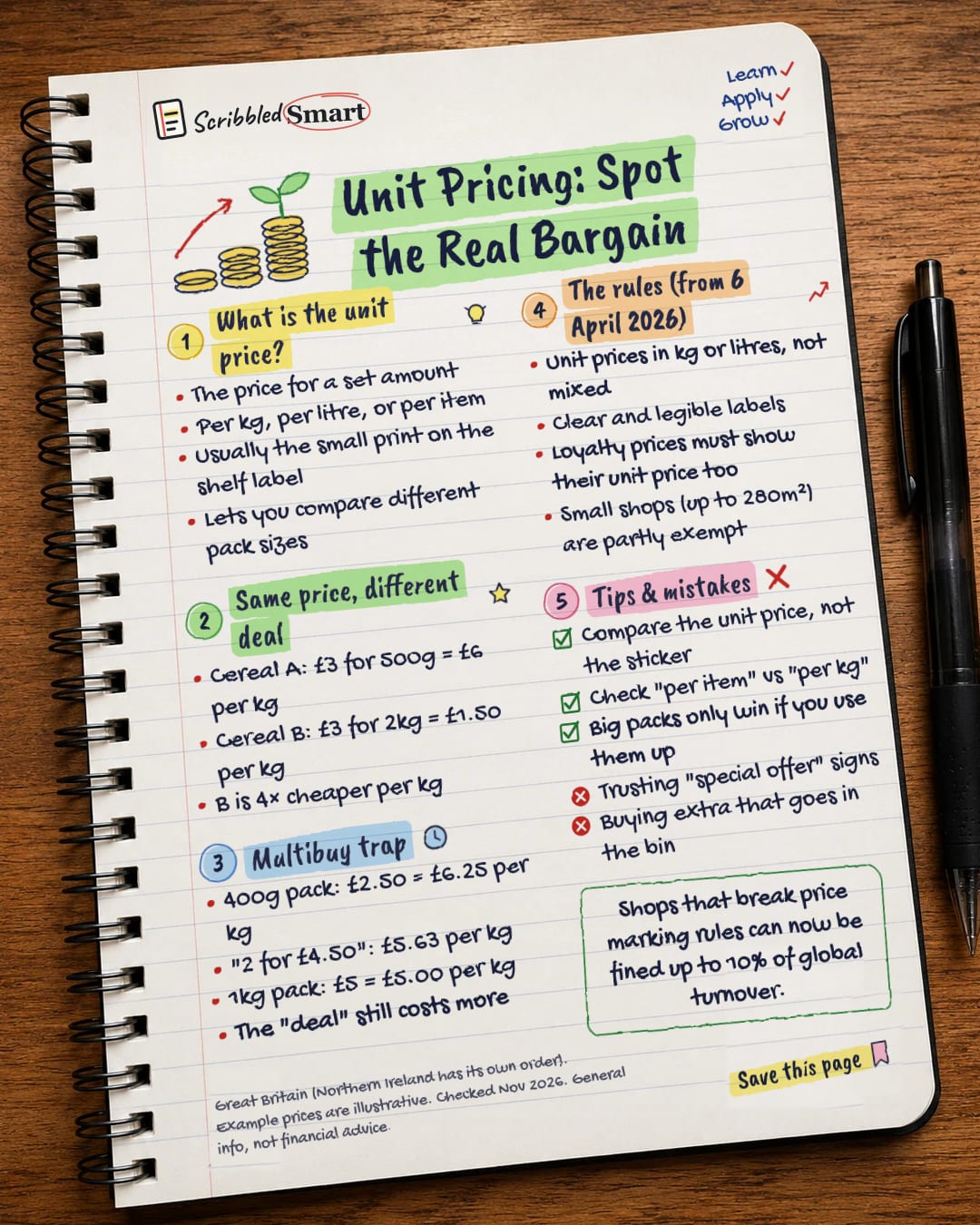
The big shelf price tells you what you pay. The tiny unit price tells you if it's actually a bargain. Save this page.
Good to know
Great Britain (Northern Ireland has its own order). Example prices are illustrative. Checked Nov 2026. General info, not financial advice.
What's on the page
The note as text, so you can read it, copy it or use a screen reader.
What is the unit price?
- The price for a set amount
- Per kg, per litre, or per item
- Usually the small print on the shelf label
- Lets you compare different pack sizes
Same price, different deal
- Cereal A: £3 for 500g = £6 per kg
- Cereal B: £3 for 2kg = £1.50 per kg
- B is 4× cheaper per kg
Multibuy trap
- 400g pack: £2.50 = £6.25 per kg
- "2 for £4.50": £5.63 per kg
- 1kg pack: £5 = £5.00 per kg
- The "deal" still costs more
The rules (from 6 April 2026)
- Unit prices in kg or litres, not mixed
- Clear and legible labels
- Loyalty prices must show their unit price too
- Small shops (up to 280m²) are partly exempt
Tips & mistakes
- Compare the unit price, not the sticker
- Check "per item" vs "per kg"
- Big packs only win if you use them up
- Trusting "special offer" signs
- Buying extra that goes in the bin
Sources
- Department for Business and Trade (GOV.UK): Price Marking Order 2004: government guidance (22 Sep 2025)
- legislation.gov.uk: The Price Marking Order 2004 (SI 2004/102)
- legislation.gov.uk: Price Marking Order (Northern Ireland) 2004 (search result)
- Lewis Silkin: Price marking update: another price marking amendment order made (search summary)
How we checked this
Every fact on this note comes from the 4 sources listed here, checked against official or peer-reviewed sources where possible. AI tools help with drafting; a person checks every fact against the sources. How we research
Spotted a mistake? Tell us and we'll fix it and log it on the corrections page.


