
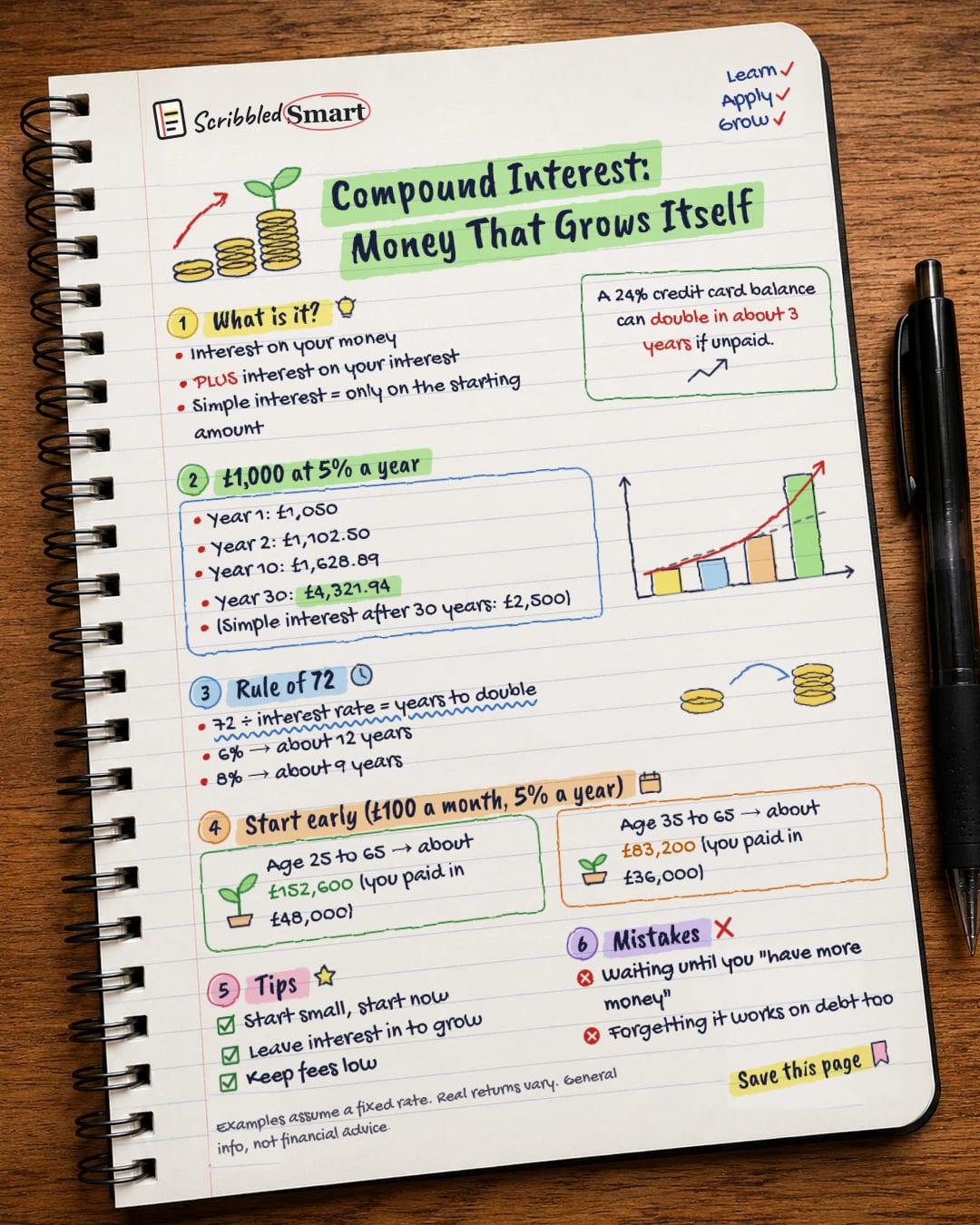
Money One-page note
Compound Interest: Money That Grows Itself
Einstein probably never said it, but compound interest really is powerful. Here is how it works in one page. Save this for later.
Good to know
Examples assume a fixed rate. Real returns vary. General info, not financial advice.
What's on the page
The note as text, so you can read it, copy it or use a screen reader.
What is it?
- Interest on your money
- PLUS interest on your interest
- Simple interest = only on the starting amount
£1,000 at 5% a year
- Year 1: £1,050
- Year 2: £1,102.50
- Year 10: £1,628.89
- Year 30: £4,321.94
- (Simple interest after 30 years: £2,500)
Rule of 72
- 72 ÷ interest rate = years to double
- 6% → about 12 years
- 8% → about 9 years
Start early (£100 a month, 5% a year)
- Age 25 to 65 → about £152,600 (you paid in £48,000)
- Age 35 to 65 → about £83,200 (you paid in £36,000)
Tips
- Start small, start now
- Leave interest in to grow
- Keep fees low
Mistakes
- Waiting until you "have more money"
- Forgetting it works on debt too
Sources
- Investor.gov: Compound Interest (glossary)
- Investor.gov: What is compound interest?
- CFPB: How does compound interest work?
- NS&I: What is compound interest?
- FCA Occasional Paper 32: Now you see it: drawing attention to charges in the asset management industry (2018)
- Financial Advice Working Group for HM Treasury and the FCA: Rules of Thumb and Nudges (2017)
- New Mexico State University, Arrowhead Center: What is the Rule of 72? (PDF)
How we checked this
Every fact on this note comes from the 7 sources listed here, checked against official or peer-reviewed sources where possible. AI tools help with drafting; a person checks every fact against the sources. How we research
Spotted a mistake? Tell us and we'll fix it and log it on the corrections page.


