
Productivity One-page note
Work With Your Body Clock
Morning lark or night owl? Your best hours for hard work may not be 9am. Save this page.
Good to know
General info. Findings vary by study, person and task.
What's on the page
The note as text, so you can read it, copy it or use a screen reader.
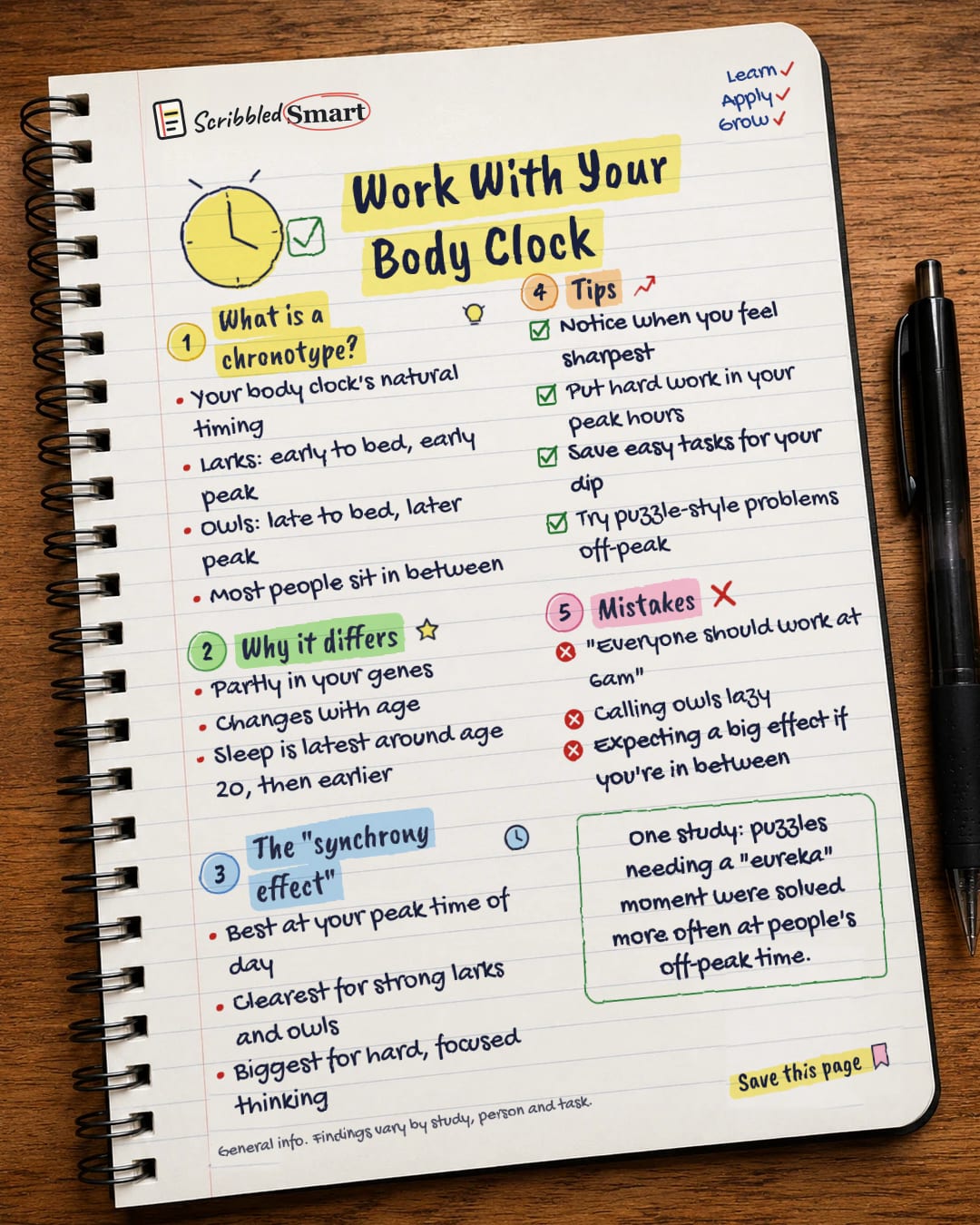
What is a chronotype?
- Your body clock's natural timing
- Larks: early to bed, early peak
- Owls: late to bed, later peak
- Most people sit in between
Why it differs
- Partly in your genes
- Changes with age
- Sleep is latest around age 20, then earlier
The "synchrony effect"
- Best at your peak time of day
- Clearest for strong larks and owls
- Biggest for hard, focused thinking
Tips
- Notice when you feel sharpest
- Put hard work in your peak hours
- Save easy tasks for your dip
- Try puzzle-style problems off-peak
Mistakes
- "Everyone should work at 6am"
- Calling owls lazy
- Expecting a big effect if you're in between
Sources
- Europe PMC: May, Hasher & Healey (2023), Perspectives on Psychological Science
- Europe PMC: Wittmann et al. (2006), "Social jetlag", Chronobiology International
- Europe PMC: Roenneberg et al. (2007), "Epidemiology of the human circadian clock", Sleep Medicine Reviews
- Europe PMC / PMC: Jones et al. (2019), Nature Communications
- Nature news: "Lazy teenagers" change sleep pattern at 20 (2004)
- Current Biology: Roenneberg et al. (2004), "A marker for the end of adolescence"
- BPS Research Digest: "You're most creative when you're at your groggiest"
- Thinking & Reasoning: Wieth & Zacks (2011)
- Europe PMC: Schmidt et al. (2007), "A time to think"
How we checked this
Every fact on this note comes from the 9 sources listed here, checked against official or peer-reviewed sources where possible. AI tools help with drafting; a person checks every fact against the sources. How we research
Spotted a mistake? Tell us and we'll fix it and log it on the corrections page.


