
Productivity One-page note
The Eisenhower Matrix
Busy isn't the same as productive. Sort your to-do list into 4 boxes. Save this page.
What's on the page
The note as text, so you can read it, copy it or use a screen reader.
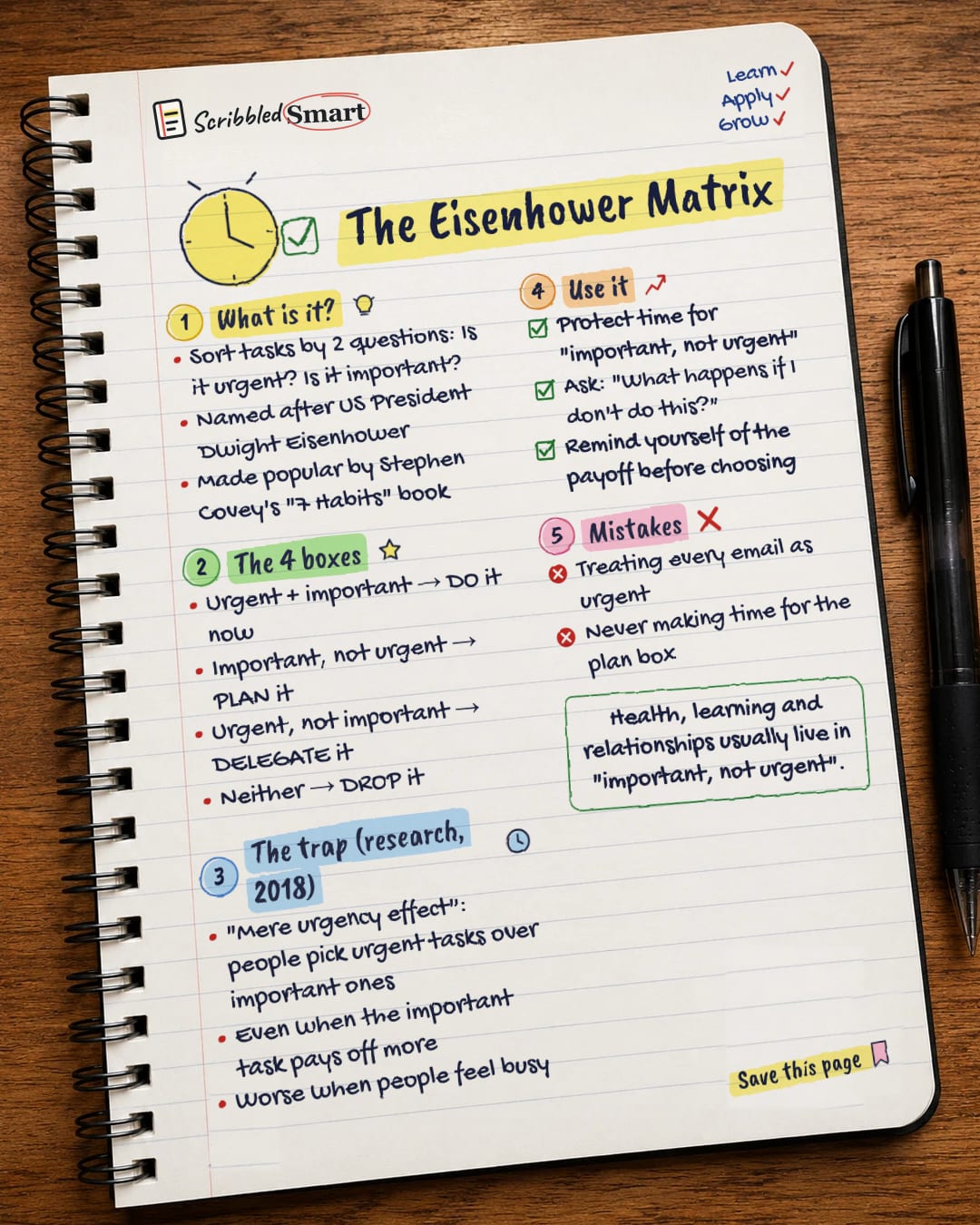
What is it?
- Sort tasks by 2 questions: Is it urgent? Is it important?
- Named after US President Dwight Eisenhower
- Made popular by Stephen Covey's "7 Habits" book
The 4 boxes
- Urgent + important → DO it now
- Important, not urgent → PLAN it
- Urgent, not important → DELEGATE it
- Neither → DROP it
The trap (research, 2018)
- "Mere urgency effect": people pick urgent tasks over important ones
- Even when the important task pays off more
- Worse when people feel busy
Use it
- Protect time for "important, not urgent"
- Ask: "What happens if I don't do this?"
- Remind yourself of the payoff before choosing
Mistakes
- Treating every email as urgent
- Never making time for the plan box
Sources
- Johns Hopkins Hub (2018): Meeting deadlines and time management behaviours
- Zhu, Yang & Hsee (2018): The Mere Urgency Effect (record)
- Medical Xpress (2018): press coverage (PDF)
- Mindtools: Eisenhower's urgent/important principle
- Psychology Today: How to use a sense of urgency
- FranklinCovey: Habit 3, Put First Things First
- Wikipedia: The 7 Habits of Highly Effective People
How we checked this
Every fact on this note comes from the 7 sources listed here, checked against official or peer-reviewed sources where possible. AI tools help with drafting; a person checks every fact against the sources. How we research
Spotted a mistake? Tell us and we'll fix it and log it on the corrections page.


