
On this page
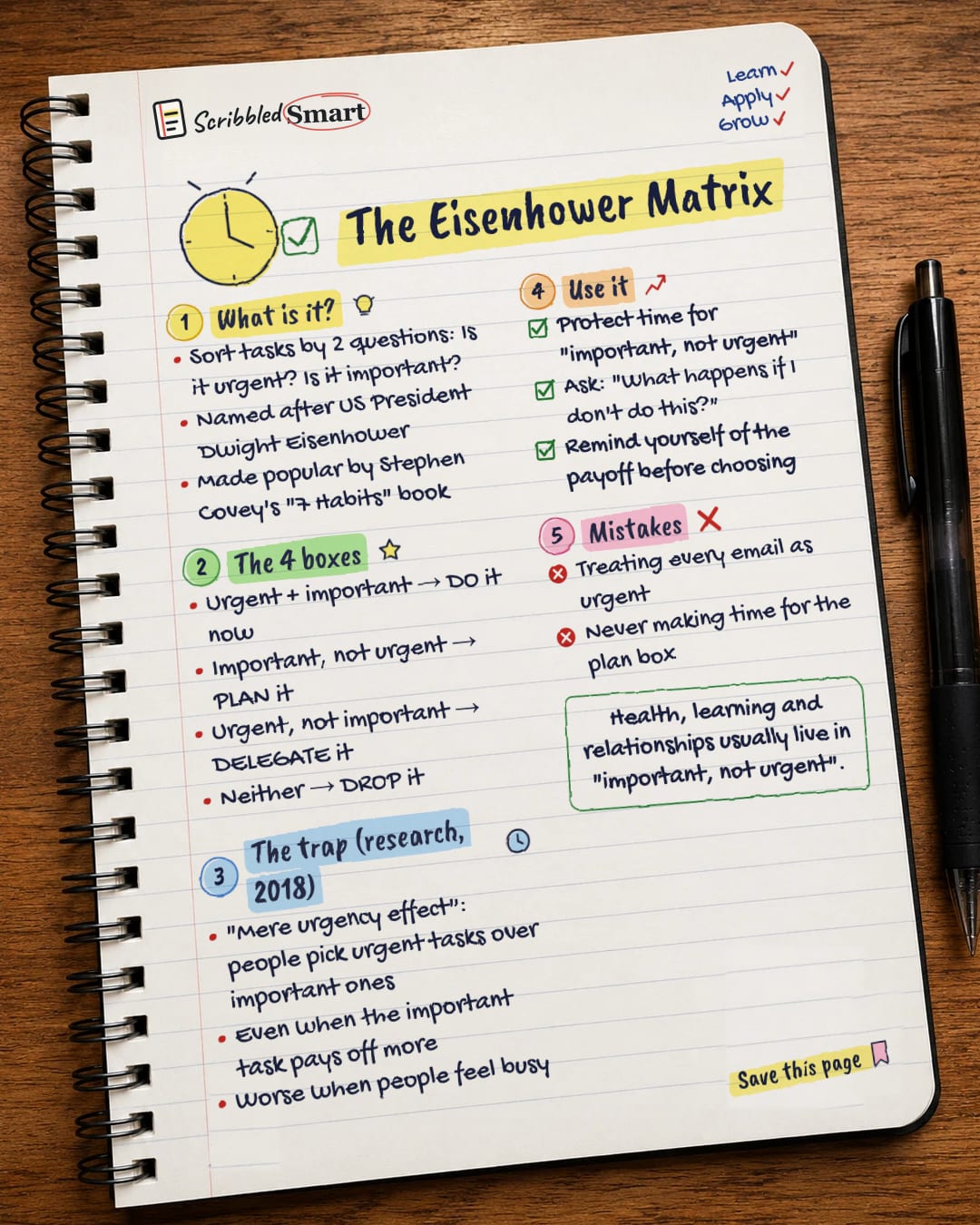
The Eisenhower Matrix is a way to sort your tasks by asking two questions: is it urgent, and is it important? The answers put each task in one of four boxes: do it now, plan it, delegate it, or drop it. Below you'll find how each box works, the research on why we keep picking the wrong tasks, and how to use the matrix well.
What is the Eisenhower Matrix?
The Eisenhower Matrix is a simple grid with two questions:
- Is it urgent? Does it need doing soon?
- Is it important? Does it really matter to your goals?
It's named after US President Dwight Eisenhower. Mindtools links the urgent/important idea to an address Eisenhower gave in 1954 to the World Council of Churches in Evanston.
Stephen Covey used the same urgent/important grid in his bestselling 1989 book The 7 Habits of Highly Effective People, under the habit "Put First Things First". FranklinCovey, which teaches the 7 Habits, calls it the four quadrants of time management.
What are the 4 boxes of the Eisenhower Matrix?
Each task lands in one of four boxes. Each box has its own action.
| Urgent | Not urgent | |
|---|---|---|
| Important | DO it now | PLAN it |
| Not important | DELEGATE it | DROP it |
Urgent and important: do it now
These tasks matter and can't wait. Deal with them first.
Important, not urgent: plan it
These tasks matter, but nothing forces you to do them today. That's exactly why they get pushed aside. Give them a set time in your diary. Time blocking your calendar is one way to make sure they actually get done.
Health, learning and relationships often live in this box. FranklinCovey's guide to the habit says the best return on your time comes from things that aren't urgent but are important, such as planning, creative thinking, and learning and renewal.
Urgent, not important: delegate it
These tasks shout for attention but don't move your goals forward. If someone else can do them, hand them over.
Neither urgent nor important: drop it
These tasks don't need doing at all. Cross them off.
Why do we pick urgent tasks over important ones?
The hard part of the Eisenhower Matrix isn't drawing the boxes. It's choosing the important task when an urgent one is right in front of you.
The "mere urgency effect": what the 2018 research found
A 2018 study by Zhu, Yang and Hsee, published in the Journal of Consumer Research, named this the "mere urgency effect". People tended to choose unimportant tasks that only seemed urgent over important tasks with better payoffs.
Three findings stand out:
- People picked urgency over importance, even when the important task paid off more.
- The effect was stronger in people who saw themselves as busy.
- Reminding people of the payoffs at the moment of choice reduced the effect.
That last point is useful. It means you can push back against the urgency trap with a simple habit.
How to use the Eisenhower Matrix well
- Protect time for "important, not urgent". Book it in your calendar like a meeting.
- Ask: "What happens if I don't do this?" If the answer is "not much", it probably isn't important.
- Remind yourself of the payoff before choosing. This is the tip that comes straight from the 2018 research.
- Be honest about "urgent". Urgent means it truly needs doing soon, not that it arrived recently.
A quick example
Imagine your list has: reply to a newsletter, finish a report due today, book a health check-up, and tidy an old folder.
- Report due today → urgent and important → do it now.
- Health check-up → important, not urgent → plan it.
- Newsletter reply → maybe urgent-feeling, not important → delegate or keep it short.
- Old folder → neither → drop it, for now at least.
Common Eisenhower Matrix mistakes
- Treating every email as urgent. A new email can feel urgent without mattering much.
- Never making time for the plan box. This is where health, learning and relationships often live. If you never schedule them, they're easy to keep putting off.
- Feeling busy and calling it productive. The research found the urgency trap is worse when people see themselves as busy.
Related reading
- Time blocking and the planning fallacy: how to give your "plan it" tasks a real slot in the day.
- Check email less: a study on why constant inbox checking adds stress.
- Cognitive biases: more thinking traps that shape everyday choices.
- Getting Things Done: another system for organising everything on your plate.
Sources
- Johns Hopkins Hub (2018): Meeting deadlines and time management behaviours
- Zhu, Yang & Hsee (2018): The Mere Urgency Effect (record)
- Medical Xpress (2018): press coverage (PDF)
- Mindtools: Eisenhower's urgent/important principle
- Psychology Today: How to use a sense of urgency
- FranklinCovey: Habit 3, Put First Things First
- Wikipedia: The 7 Habits of Highly Effective People
How we checked this
Every fact in this article comes from the 7 sources listed above, checked against official or peer-reviewed sources where possible. AI tools help with drafting; a person checks every fact against the sources. How we research
- Published and checked
Spotted a mistake? Tell us and we'll fix it and log it on the corrections page.


