
Psychology One-page note
The 36 Questions That Lead to Love
36 questions, 45 minutes, two strangers. Here's what the famous "fall in love" study really found. Save this page.
Good to know
Study: Aron et al. 1997, Personality and Social Psychology Bulletin. Questions: Greater Good Science Center, UC Berkeley.
What's on the page
The note as text, so you can read it, copy it or use a screen reader.
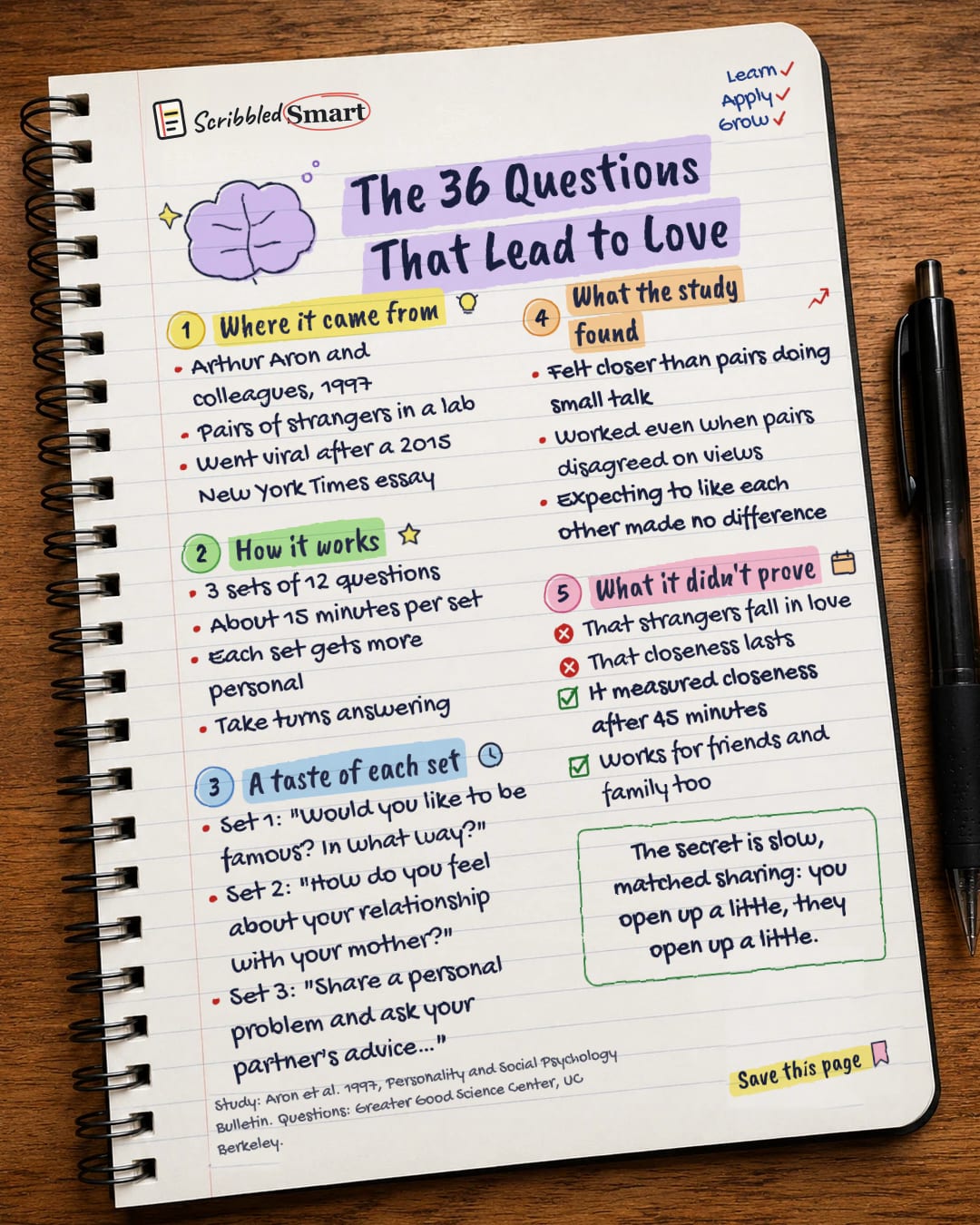
Where it came from
- Arthur Aron and colleagues, 1997
- Pairs of strangers in a lab
- Went viral after a 2015 New York Times essay
How it works
- 3 sets of 12 questions
- About 15 minutes per set
- Each set gets more personal
- Take turns answering
A taste of each set
- Set 1: "Would you like to be famous? In what way?"
- Set 2: "How do you feel about your relationship with your mother?"
- Set 3: "Share a personal problem and ask your partner's advice…"
What the study found
- Felt closer than pairs doing small talk
- Worked even when pairs disagreed on views
- Expecting to like each other made no difference
What it didn't prove
- That strangers fall in love
- That closeness lasts
- It measured closeness after 45 minutes
- Works for friends and family too
Sources
- Aron, A., Melinat, E., Aron, E. N., Vallone, R. D. & Bator, R. J. (1997): The experimental generation of interpersonal closeness: a procedure and some preliminary findings
- Greater Good in Action (UC Berkeley): 36 Questions for Increasing Closeness
- Roanoke College news: Alumna's essay on science of falling in love published in New York Times
How we checked this
Every fact on this note comes from the 3 sources listed here, checked against official or peer-reviewed sources where possible. AI tools help with drafting; a person checks every fact against the sources. How we research
Spotted a mistake? Tell us and we'll fix it and log it on the corrections page.


