
Psychology One-page note
Classical vs Operant Conditioning
Why does your mouth water at a lunch notification? Pavlov vs Skinner on one page. Save this page.
Good to know
Examples are illustrations.
What's on the page
The note as text, so you can read it, copy it or use a screen reader.
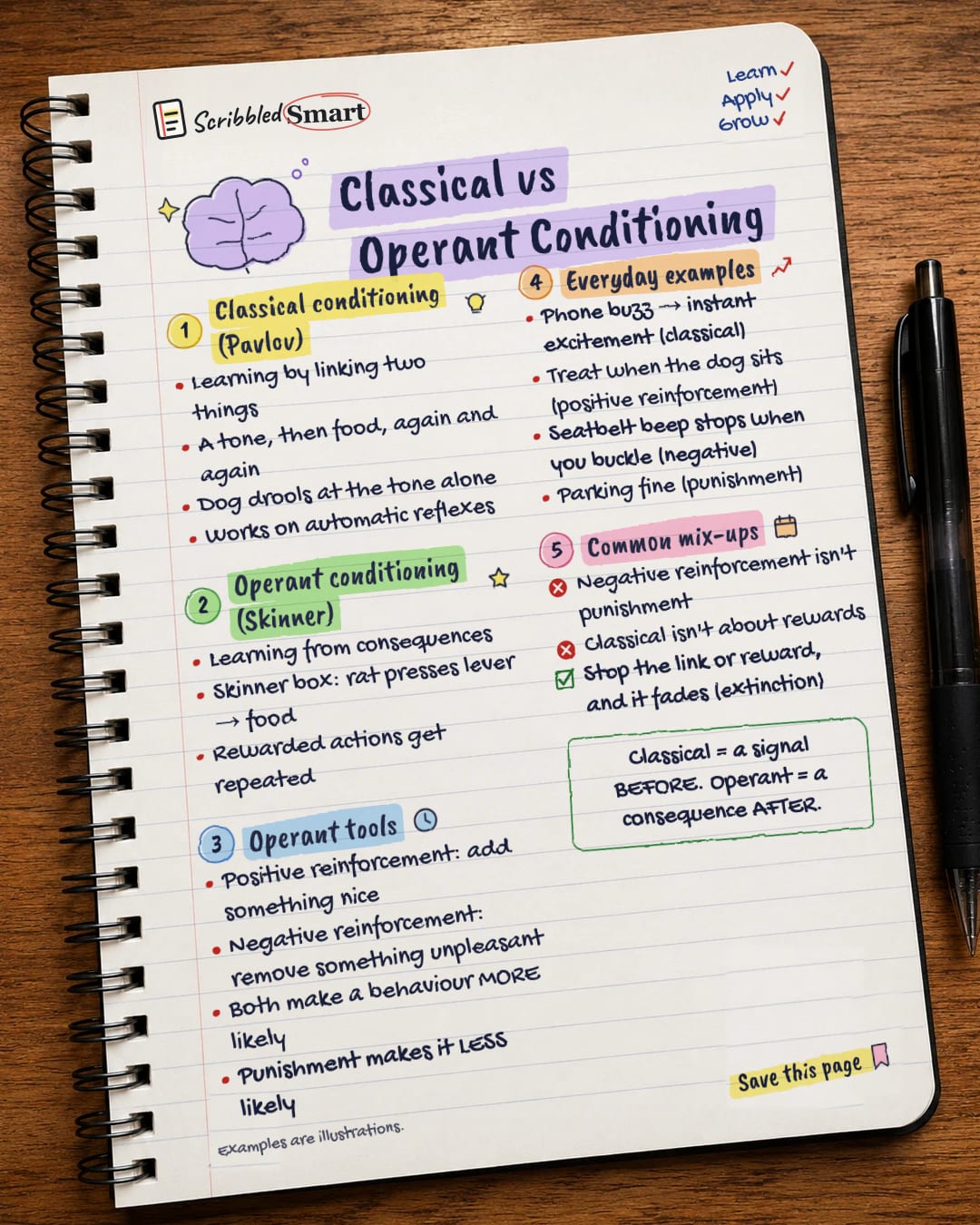
Classical conditioning (Pavlov)
- Learning by linking two things
- A tone, then food, again and again
- Dog drools at the tone alone
- Works on automatic reflexes
Operant conditioning (Skinner)
- Learning from consequences
- Skinner box: rat presses lever → food
- Rewarded actions get repeated
Operant tools
- Positive reinforcement: add something nice
- Negative reinforcement: remove something unpleasant
- Both make a behaviour MORE likely
- Punishment makes it LESS likely
Everyday examples
- Phone buzz → instant excitement (classical)
- Treat when the dog sits (positive reinforcement)
- Seatbelt beep stops when you buckle (negative)
- Parking fine (punishment)
Common mix-ups
- Negative reinforcement isn't punishment
- Classical isn't about rewards
- Stop the link or reward, and it fades (extinction)
Sources
- APA Dictionary of Psychology: classical conditioning
- APA Dictionary of Psychology: operant conditioning
- APA Dictionary of Psychology: operant conditioning chamber
- APA Dictionary of Psychology: positive reinforcement
- APA Dictionary of Psychology: negative reinforcement
- APA Dictionary of Psychology: punishment
- APA Dictionary of Psychology: extinction
- Nobel Prize: The Nobel Prize in Physiology or Medicine 1904
How we checked this
Every fact on this note comes from the 8 sources listed here, checked against official or peer-reviewed sources where possible. AI tools help with drafting; a person checks every fact against the sources. How we research
Spotted a mistake? Tell us and we'll fix it and log it on the corrections page.


