
Psychology One-page note
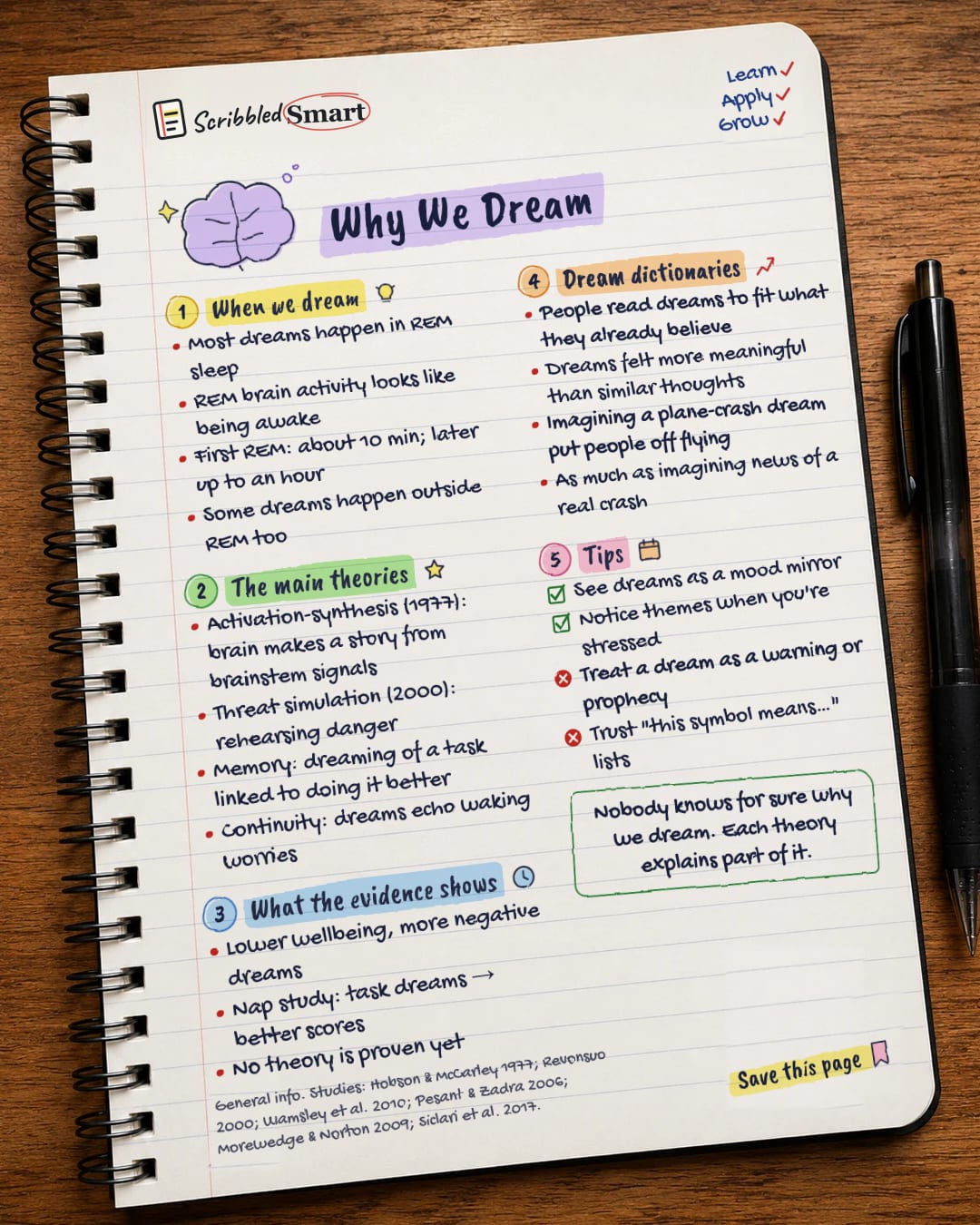
Why We Dream
Why does your brain make films every night? Here's what scientists actually know, and why dream dictionaries aren't science. Save this page.
Good to know
General info. Studies: Hobson & McCarley 1977; Revonsuo 2000; Wamsley et al. 2010; Pesant & Zadra 2006; Morewedge & Norton 2009; Siclari et al. 2017.
What's on the page
The note as text, so you can read it, copy it or use a screen reader.
When we dream
- Most dreams happen in REM sleep
- REM brain activity looks like being awake
- First REM: about 10 min; later up to an hour
- Some dreams happen outside REM too
The main theories
- Activation-synthesis (1977): brain makes a story from brainstem signals
- Threat simulation (2000): rehearsing danger
- Memory: dreaming of a task linked to doing it better
- Continuity: dreams echo waking worries
What the evidence shows
- Lower wellbeing, more negative dreams
- Nap study: task dreams → better scores
- No theory is proven yet
Dream dictionaries
- People read dreams to fit what they already believe
- Dreams felt more meaningful than similar thoughts
- Imagining a plane-crash dream put people off flying
- As much as imagining news of a real crash
Tips
- See dreams as a mood mirror
- Notice themes when you're stressed
- Treat a dream as a warning or prophecy
- Trust "this symbol means…" lists
Sources
- Cleveland Clinic: Sleep: What it is, why it's important, stages, REM & NREM
- Hobson, J. A. & McCarley, R. W. (1977): The brain as a dream state generator: an activation-synthesis hypothesis of the dream process
- Revonsuo, A. (2000): The reinterpretation of dreams: an evolutionary hypothesis of the function of dreaming
- Wamsley, E. J. et al. (2010): Dreaming of a learning task is associated with enhanced sleep-dependent memory consolidation
- Pesant, N. & Zadra, A. (2006): Dream content and psychological well-being: a longitudinal study of the continuity hypothesis
- Morewedge, C. K. & Norton, M. I. (2009): When dreaming is believing: the (motivated) interpretation of dreams
- Siclari, F. et al. (2017): The neural correlates of dreaming
- StatPearls: Physiology, Sleep Stages (abstract via Europe PMC, PMID 30252388).
How we checked this
Every fact on this note comes from the 8 sources listed here, checked against official or peer-reviewed sources where possible. AI tools help with drafting; a person checks every fact against the sources. How we research
Spotted a mistake? Tell us and we'll fix it and log it on the corrections page.


