
On this page
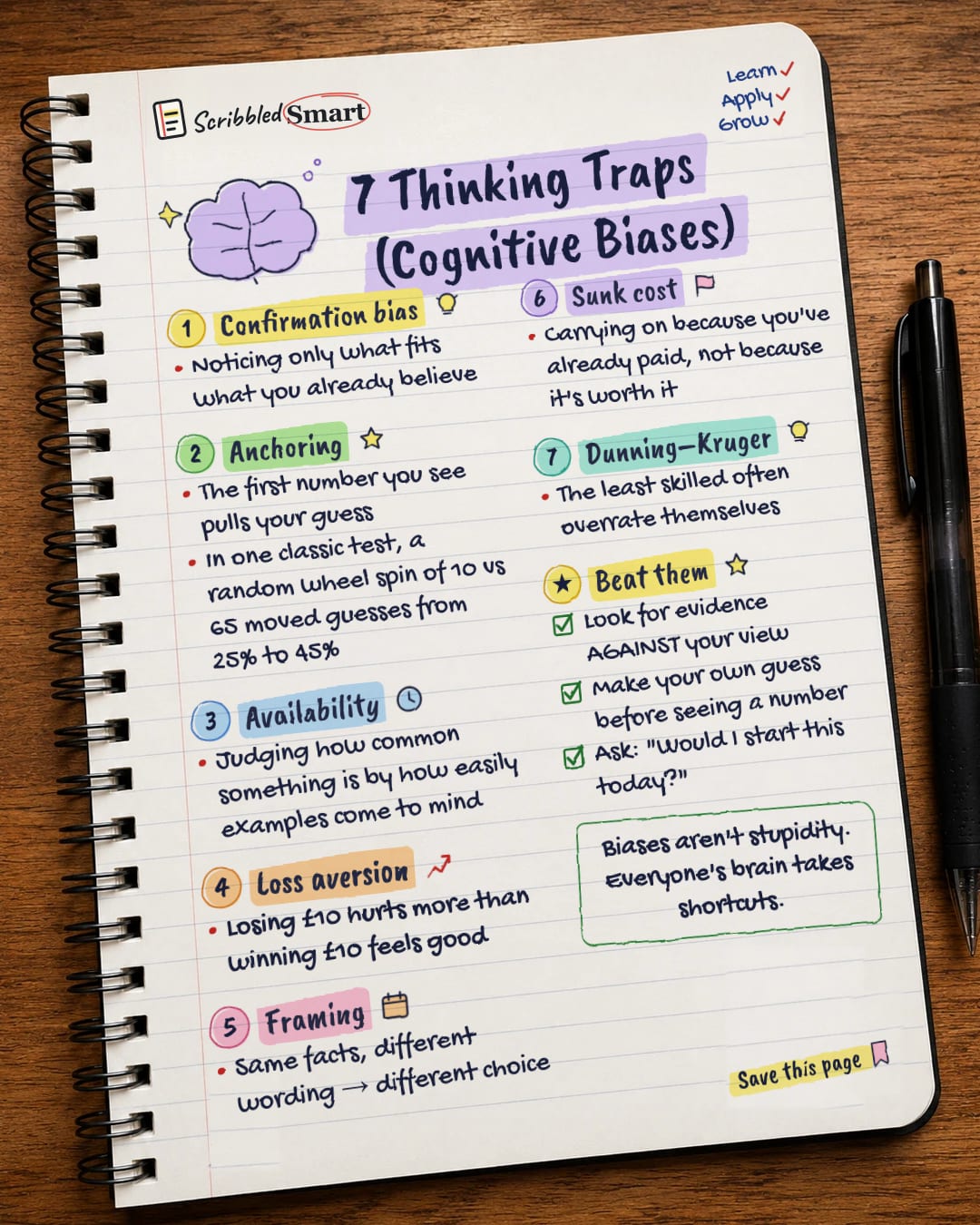
Cognitive biases are predictable errors that come from the mental shortcuts your brain uses to make quick judgements. They are not a sign of stupidity. Everyone has them, because everyone's brain takes shortcuts. This article walks through seven of the best-established thinking traps, what the classic studies found, and simple ways to catch yourself.
Where do cognitive biases come from?
Every bias starts as a useful shortcut that sometimes misfires. In their famous 1974 paper in Science, "Judgment under Uncertainty: Heuristics and Biases", Tversky and Kahneman described "heuristics". These are mental shortcuts. The authors saw them as usually effective. Biases are the predictable mistakes those shortcuts make.
That is why the side note on our page says biases aren't stupidity. They are the cost of a brain that works fast.
One more point on honesty. Some popular "biases" you see online have weak replication, meaning later studies struggled to repeat the results. Ego depletion is one example. The seven below are all well-established findings.
The 7 thinking traps
These seven cognitive biases are all well-established findings. Each one has a simple definition and a classic study behind it.
1. Confirmation bias
Confirmation bias means noticing and favouring information that fits what you already believe. Nickerson's 1998 review in Review of General Psychology called it "a ubiquitous phenomenon in many guises": it shows up everywhere, in many forms.
2. Anchoring
Anchoring is when the first number you see pulls your estimate towards it. People do adjust away from that first number, but usually not far enough.
The classic test is from Tversky and Kahneman's 1974 paper. People watched a wheel of fortune land on a number. Then they guessed what share of United Nations members were African countries. When the wheel showed 10, the median guess was 25%. When it showed 65, the median guess was 45%. The wheel had nothing to do with the question, yet it moved the answers.
3. Availability
The availability heuristic, from the same 1974 paper, means judging how common something is by how easily examples come to mind. If examples pop into your head quickly, you tend to think the thing happens a lot.
4. Loss aversion
Loss aversion means a loss weighs more than a gain of the same size. It comes from Kahneman and Tversky's "Prospect Theory" (1979, Econometrica), a classic and well-established finding.
A simple way to picture it: losing £10 hurts more than winning £10 feels good. That £10 is our own illustration, not a figure from a study.
5. Framing
Framing means the same facts, worded differently, can lead to a different choice. Tversky and Kahneman showed this in a 1981 Science paper, "The Framing of Decisions and the Psychology of Choice". Its best-known example is the "Asian disease problem".
6. Sunk cost
The sunk cost effect is carrying on with something because you have already paid for it, not because it is still worth it. Arkes and Blumer studied this in 1985.
In one of their studies, theatre subscribers who had paid more for their season tickets went to more plays. The money was already spent either way, but the bigger past payment kept people going.
7. Dunning–Kruger
The Dunning–Kruger effect is the finding that the least skilled people often overrate themselves. It comes from Kruger and Dunning's 1999 paper in the Journal of Personality and Social Psychology. Our guide to what the Dunning–Kruger study really found explains what it does and doesn't show, and why researchers still debate it.
A bonus trap: representativeness
Representativeness is judging by stereotype instead of by the odds. The 1974 paper had a third main heuristic: representativeness. This means judging something by how much it looks like a stereotype, while ignoring base rates (how common things actually are). The well-known "Linda problem" from 1983 is an example of this trap.
How can you beat cognitive biases?
The best defence is to slow down and check your thinking at key moments. You can't switch biases off. But you can slow down at the moments they do the most damage. These tips come straight from how each bias works.
Look for evidence against your view
This targets confirmation bias. Before you decide, ask: "What would prove me wrong?" Then actually look for it. This is sometimes called "considering the opposite".
Make your own guess before seeing a number
This targets anchoring. If you are about to see a price, a forecast or a "usual" figure, write your own estimate first. That way the first number you meet is yours.
Ask: "Would I start this today?"
This targets sunk cost. Forget what you have already spent. If you would not choose this project, course or subscription today, starting from scratch, the money already gone is not a good reason to keep going.
Other habits that help
- Reword the choice. If an option sounds good as "90% success", say it as "10% failure" and see if you still feel the same. This is a check against framing.
- Count, don't recall. When you judge how often something happens, look for real numbers instead of trusting how easily examples come to mind.
Common mistakes
- Thinking you're immune. Everyone's brain takes shortcuts. Knowing about biases doesn't make them disappear.
- Treating every shortcut as bad. The 1974 authors saw heuristics as usually effective. The goal is to catch the errors, not to distrust every quick thought.
- Believing every "bias" you read about. Some popular ones have weak replication. Stick to well-established findings.
To read more, Kahneman's popular book Thinking, Fast and Slow (2011) explains these ideas for a general reader. The original papers in the sources below are also worth a look, especially Tversky and Kahneman's 1974 paper on heuristics and biases.
Related reading
- Imposter syndrome explained: the flip side of overrating yourself.
- Why we overthink: another way our thinking can work against us.
- Avalanche vs snowball: a money decision where how you feel about progress matters.
- Why AI makes things up: why checking evidence matters with tools, too.
Sources
- Nickerson (1998): Confirmation Bias: A Ubiquitous Phenomenon in Many Guises (PDF)
- CAUSEweb: Tversky & Kahneman (1974) summary
- Deceptive Design: Judgment under uncertainty summary
- UCSD course notes: prospect theory and framing (PDF)
- Arkes & Blumer (1985): The Psychology of Sunk Cost (PDF)
- Decision Science News: Arkes & Blumer
- Kruger & Dunning (1999), Journal of Personality and Social Psychology (PDF)
How we checked this
Every fact in this article comes from the 7 sources listed above, checked against official or peer-reviewed sources where possible. AI tools help with drafting; a person checks every fact against the sources. How we research
- Published and checked
General info, not professional advice.
Spotted a mistake? Tell us and we'll fix it and log it on the corrections page.


