
Psychology One-page note
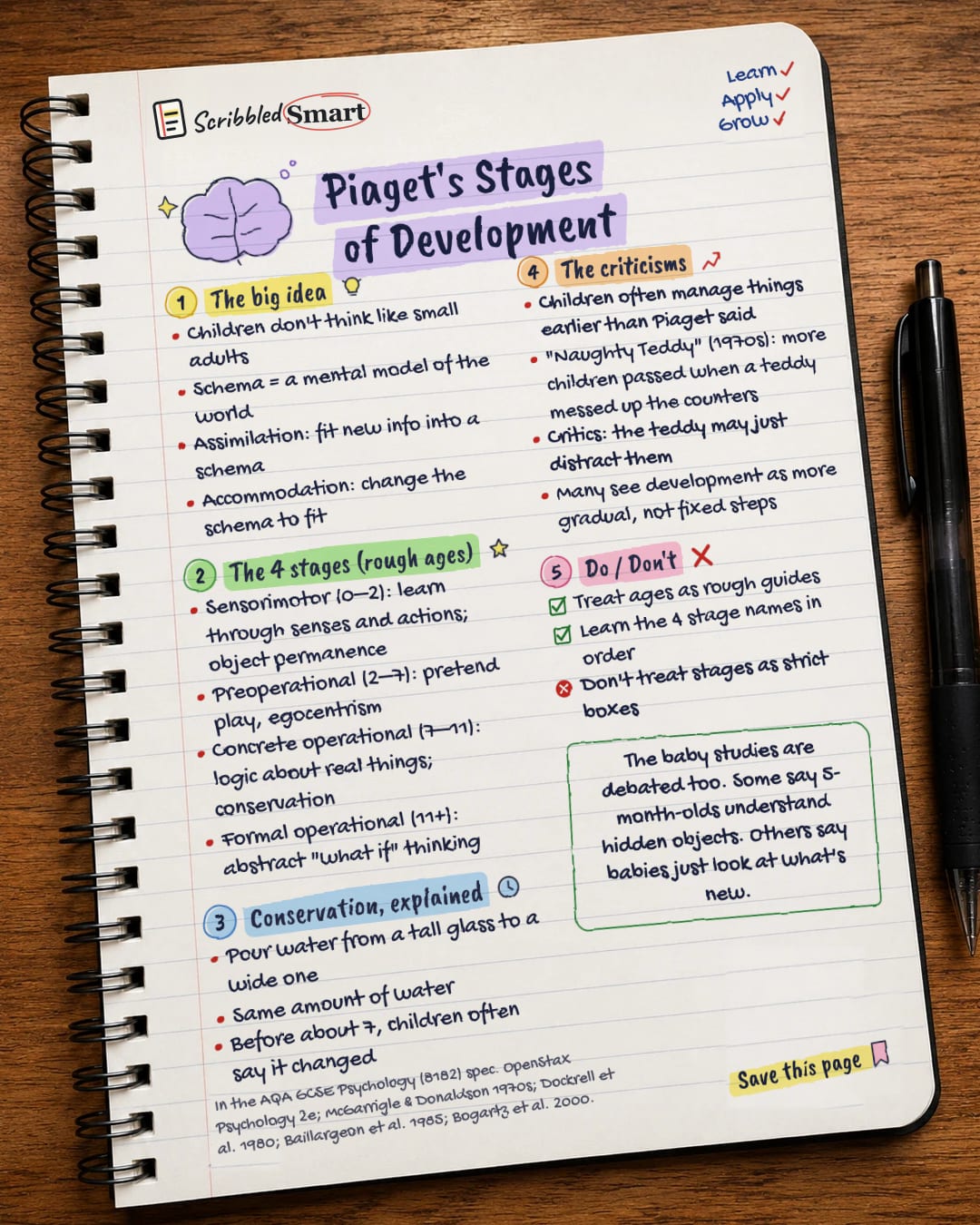
Piaget's Stages of Development
Sensorimotor, preoperational, concrete, formal: Piaget's 4 stages on one page, plus why scientists still argue about them. Save this page.
Good to know
In the AQA GCSE Psychology (8182) spec. OpenStax Psychology 2e; McGarrigle & Donaldson 1970s; Dockrell et al. 1980; Baillargeon et al. 1985; Bogartz et al. 2000.
What's on the page
The note as text, so you can read it, copy it or use a screen reader.
The big idea
- Children don't think like small adults
- Schema = a mental model of the world
- Assimilation: fit new info into a schema
- Accommodation: change the schema to fit
The 4 stages (rough ages)
- Sensorimotor (0–2): learn through senses and actions; object permanence
- Preoperational (2–7): pretend play, egocentrism
- Concrete operational (7–11): logic about real things; conservation
- Formal operational (11+): abstract "what if" thinking
Conservation, explained
- Pour water from a tall glass to a wide one
- Same amount of water
- Before about 7, children often say it changed
The criticisms
- Children often manage things earlier than Piaget said
- "Naughty Teddy" (1970s): more children passed when a teddy messed up the counters
- Critics: the teddy may just distract them
- Many see development as more gradual, not fixed steps
Do / Don't
- Treat ages as rough guides
- Learn the 4 stage names in order
- Don't treat stages as strict boxes
Sources
- OpenStax (Spielman, Jenkins & Lovett 2020): Psychology 2e, 9.2 Lifespan Theories
- AQA: GCSE Psychology 8182 specification, 3.1 Cognition and behaviour
- Dockrell, J., Campbell, R. & Neilson, I. (1980): Conservation accidents revisited. International Journal of Behavioral Development 3(4), 423–439
- Baillargeon, R., Spelke, E. S. & Wasserman, S. (1985): Object permanence in five-month-old infants. Cognition 20(3)
- Bogartz, R. S., Shinskey, J. L. & Schilling, T. H. (2000): Object permanence in five-and-a-half-month-old infants? Infancy 1(4)
How we checked this
Every fact on this note comes from the 5 sources listed here, checked against official or peer-reviewed sources where possible. AI tools help with drafting; a person checks every fact against the sources. How we research
Spotted a mistake? Tell us and we'll fix it and log it on the corrections page.


