
Psychology One-page note
Earworms: Why Songs Get Stuck
Got a song stuck in your head right now? Here's why it happens and how to get it out. Save this page.
Good to know
Jakubowski et al. 2017 (Durham/Goldsmiths); Beaman & Williams 2010; Beaman et al. 2015; Liikkanen & Jakubowski 2020 review. Song list: survey of 3,000 people, 2010–13.
What's on the page
The note as text, so you can read it, copy it or use a screen reader.
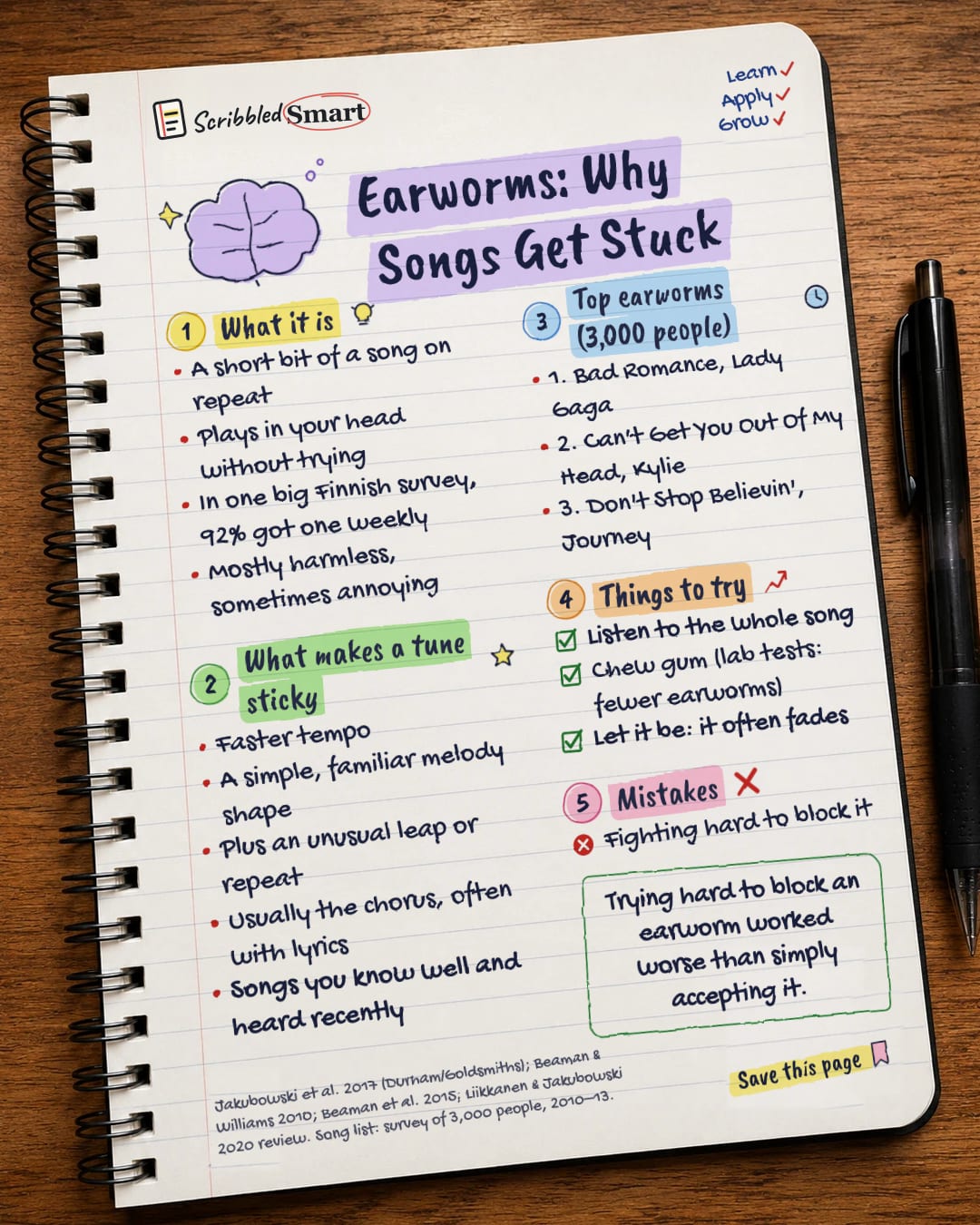
What it is
- A short bit of a song on repeat
- Plays in your head without trying
- In one big Finnish survey, 92% got one weekly
- Mostly harmless, sometimes annoying
What makes a tune sticky
- Faster tempo
- A simple, familiar melody shape
- Plus an unusual leap or repeat
- Usually the chorus, often with lyrics
- Songs you know well and heard recently
Top earworms (3,000 people)
- 1. Bad Romance, Lady Gaga
- 2. Can't Get You Out Of My Head, Kylie
- 3. Don't Stop Believin', Journey
Things to try
- Listen to the whole song
- Chew gum (lab tests: fewer earworms)
- Let it be: it often fades
Mistakes
- Fighting hard to block it
Sources
- Liikkanen, L. A. & Jakubowski, K. (2020): Involuntary musical imagery as a component of ordinary music cognition: a review of empirical evidence. Psychonomic Bulletin & Review
- American Psychological Association via ScienceDaily (4 Nov 2016): Psychologists identify key characteristics of earworms
- Goldsmiths, University of London (3 Nov 2016): Scientists find key to writing catchy pop hits
- Jakubowski, K., Finkel, S., Stewart, L. & Müllensiefen, D. (2017): Dissecting an earworm: melodic features and song popularity predict involuntary musical imagery. Psychology of Aesthetics, Creativity, and the Arts 11(2), 122–135
- Beaman, C. P. & Williams, T. I. (2010): Earworms (stuck song syndrome): towards a natural history of intrusive thoughts. British Journal of Psychology 101
- Williamson, V. J. et al. (2014): Sticky tunes: how do people react to involuntary musical imagery? PLoS ONE 9(1)
- Beaman, C. P., Powell, K. & Rapley, E. (2015): Want to block earworms from conscious awareness? B(u)y gum! Quarterly Journal of Experimental Psychology 68(6), 1049–1057
How we checked this
Every fact on this note comes from the 7 sources listed here, checked against official or peer-reviewed sources where possible. AI tools help with drafting; a person checks every fact against the sources. How we research
Spotted a mistake? Tell us and we'll fix it and log it on the corrections page.


