
Psychology One-page note UK only
Sleep Paralysis: What's Happening
Woke up unable to move, sure someone was in the room? That's sleep paralysis, and here's what's happening. Save this page.
Good to know
NHS (UK), reviewed Sep 2026; Sharpless & Barber 2011; Cheyne & Girard 2007; Wang et al. 2025. General info, not medical advice.
What's on the page
The note as text, so you can read it, copy it or use a screen reader.
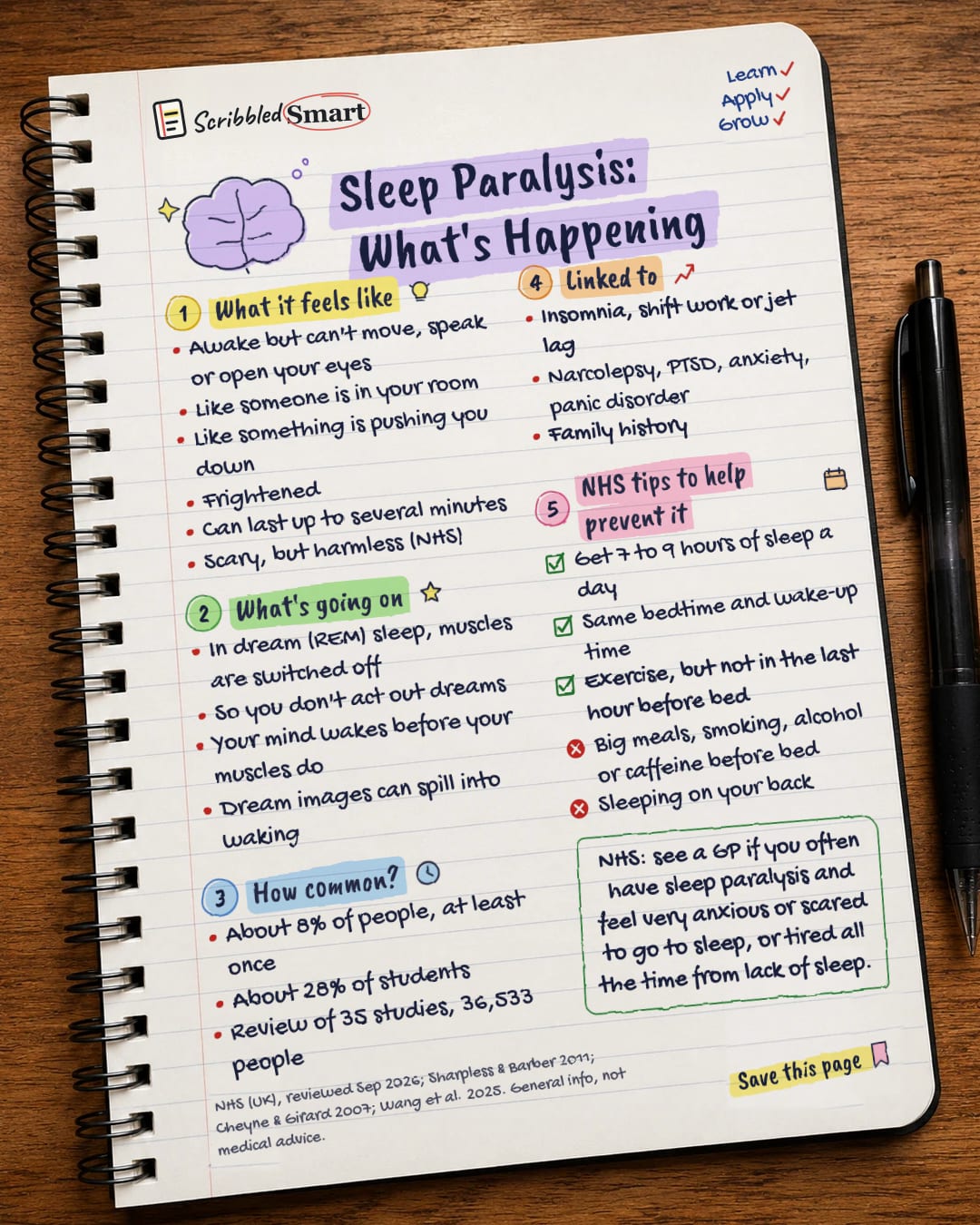
What it feels like
- Awake but can't move, speak or open your eyes
- Like someone is in your room
- Like something is pushing you down
- Frightened
- Can last up to several minutes
- Scary, but harmless (NHS)
What's going on
- In dream (REM) sleep, muscles are switched off
- So you don't act out dreams
- Your mind wakes before your muscles do
- Dream images can spill into waking
How common?
- About 8% of people, at least once
- About 28% of students
- Review of 35 studies, 36,533 people
Linked to
- Insomnia, shift work or jet lag
- Narcolepsy, PTSD, anxiety, panic disorder
- Family history
NHS tips to help prevent it
- Get 7 to 9 hours of sleep a day
- Same bedtime and wake-up time
- Exercise, but not in the last hour before bed
- Big meals, smoking, alcohol or caffeine before bed
- Sleeping on your back
Sources
- NHS: Sleep paralysis (page last reviewed 9 Sep 2026)
- Sharpless, B. A. & Barber, J. P. (2011): Lifetime prevalence rates of sleep paralysis: a systematic review. Sleep Medicine Reviews 15(5)
- Cheyne, J. A. & Girard, T. A. (2007): Paranoid delusions and threatening hallucinations: a prospective study of sleep paralysis experiences. Consciousness and Cognition 16
- Cheyne, J. A. & Girard, T. A. (2004): Spatial characteristics of hallucinations associated with sleep paralysis. Cognitive Neuropsychiatry 9
- Wang, Y. et al. (2025): Sleep paralysis: pathogenesis, clinical manifestations, and treatment strategies. Journal of Integrative Neuroscience
- Sleep Foundation: REM sleep behavior disorder
- Henry Ford Health: REM sleep behavior disorder
- Hishikawa, Y. & Shimizu, T. (1995): Physiology of REM sleep, cataplexy, and sleep paralysis. Advances in Neurology 67.
How we checked this
Every fact on this note comes from the 8 sources listed here, checked against official or peer-reviewed sources where possible. AI tools help with drafting; a person checks every fact against the sources. How we research
Spotted a mistake? Tell us and we'll fix it and log it on the corrections page.


