
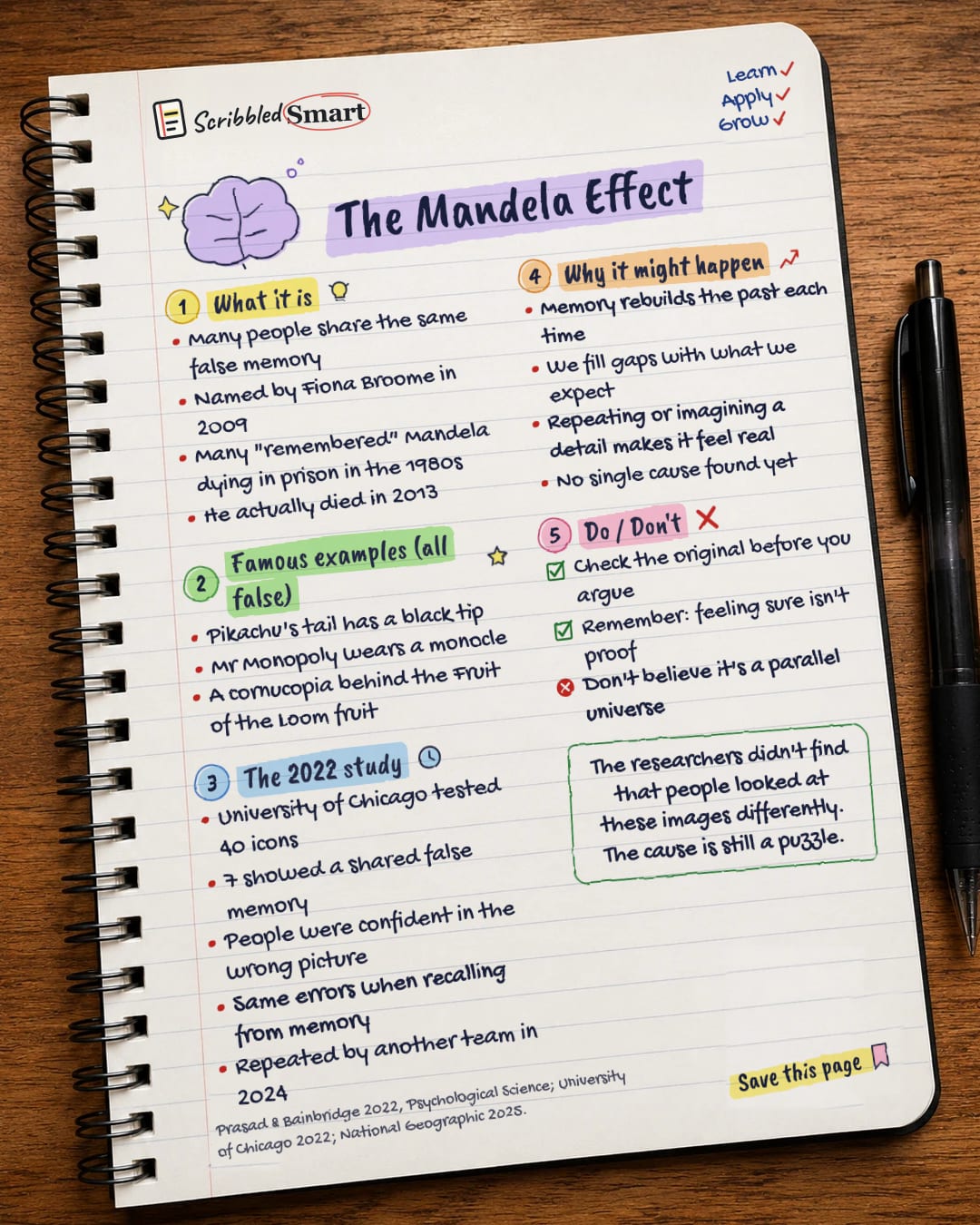
Psychology One-page note
The Mandela Effect
Does Pikachu's tail have a black tip? If you said yes, you're not alone, and you're wrong. Save this page.
Good to know
Prasad & Bainbridge 2022, Psychological Science; University of Chicago 2022; National Geographic 2025.
What's on the page
The note as text, so you can read it, copy it or use a screen reader.
What it is
- Many people share the same false memory
- Named by Fiona Broome in 2009
- Many "remembered" Mandela dying in prison in the 1980s
- He actually died in 2013
Famous examples (all false)
- Pikachu's tail has a black tip
- Mr Monopoly wears a monocle
- A cornucopia behind the Fruit of the Loom fruit
The 2022 study
- University of Chicago tested 40 icons
- 7 showed a shared false memory
- People were confident in the wrong picture
- Same errors when recalling from memory
- Repeated by another team in 2024
Why it might happen
- Memory rebuilds the past each time
- We fill gaps with what we expect
- Repeating or imagining a detail makes it feel real
- No single cause found yet
Do / Don't
- Check the original before you argue
- Remember: feeling sure isn't proof
- Don't believe it's a parallel universe
Sources
- Prasad, D. & Bainbridge, W. A. (2022): The Visual Mandela Effect as evidence for shared and specific false memories across people. Psychological Science 33(12)
- University of Chicago News (15 Jul 2022): Can you pick out the correct version of these famous pop culture icons?
- Handley-Miner, I. J. & Metskas, A. K. (2024): Replication of a study from "The Visual Mandela Effect ..." PsyArXiv
- National Geographic (Wells, S., 30 Jul 2025): The Mandela effect tricks our brains with false memories. Is AI making it worse?
How we checked this
Every fact on this note comes from the 4 sources listed here, checked against official or peer-reviewed sources where possible. AI tools help with drafting; a person checks every fact against the sources. How we research
Spotted a mistake? Tell us and we'll fix it and log it on the corrections page.


