
Psychology One-page note
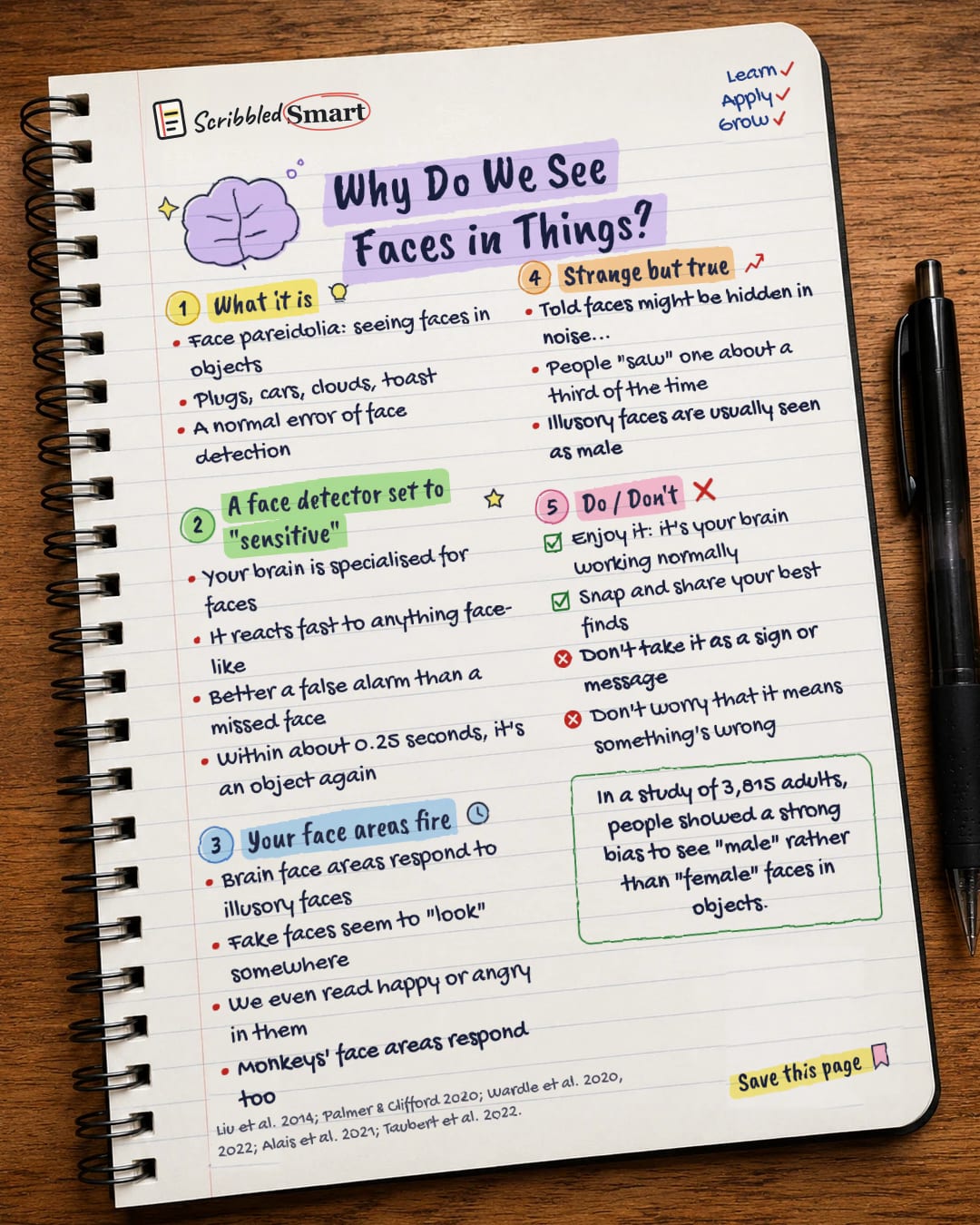
Why Do We See Faces in Things?
A grumpy plug socket, a shocked car, a smiling cloud... Here's why your brain sees faces everywhere. Save this page.
Good to know
Liu et al. 2014; Palmer & Clifford 2020; Wardle et al. 2020, 2022; Alais et al. 2021; Taubert et al. 2022.
What's on the page
The note as text, so you can read it, copy it or use a screen reader.
What it is
- Face pareidolia: seeing faces in objects
- Plugs, cars, clouds, toast
- A normal error of face detection
A face detector set to "sensitive"
- Your brain is specialised for faces
- It reacts fast to anything face-like
- Better a false alarm than a missed face
- Within about 0.25 seconds, it's an object again
Your face areas fire
- Brain face areas respond to illusory faces
- Fake faces seem to "look" somewhere
- We even read happy or angry in them
- Monkeys' face areas respond too
Strange but true
- Told faces might be hidden in noise...
- People "saw" one about a third of the time
- Illusory faces are usually seen as male
Do / Don't
- Enjoy it: it's your brain working normally
- Snap and share your best finds
- Don't take it as a sign or message
- Don't worry that it means something's wrong
Sources
- Liu, J. et al. (2014): Seeing Jesus in toast: neural and behavioral correlates of face pareidolia. Cortex 53
- Palmer, C. J. & Clifford, C. W. G. (2020): Face pareidolia recruits mechanisms for detecting human social attention. Psychological Science 31
- Wardle, S. G. et al. (2020): Rapid and dynamic processing of face pareidolia in the human brain. Nature Communications 11
- Wardle, S. G. et al. (2022): Illusory faces are more likely to be perceived as male than female. PNAS 119
- Alais, D. et al. (2021): A shared mechanism for facial expression in human faces and face pareidolia. Proc R Soc B 288
- Taubert, J. et al. (2022): The cortical and subcortical correlates of face pareidolia in the macaque brain. Social Cognitive and Affective Neuroscience 17
- Wardle, S. G. et al. (2023): Children perceive illusory faces in objects as male more often than female. Cognition
How we checked this
Every fact on this note comes from the 7 sources listed here, checked against official or peer-reviewed sources where possible. AI tools help with drafting; a person checks every fact against the sources. How we research
Spotted a mistake? Tell us and we'll fix it and log it on the corrections page.


