
Psychology One-page note
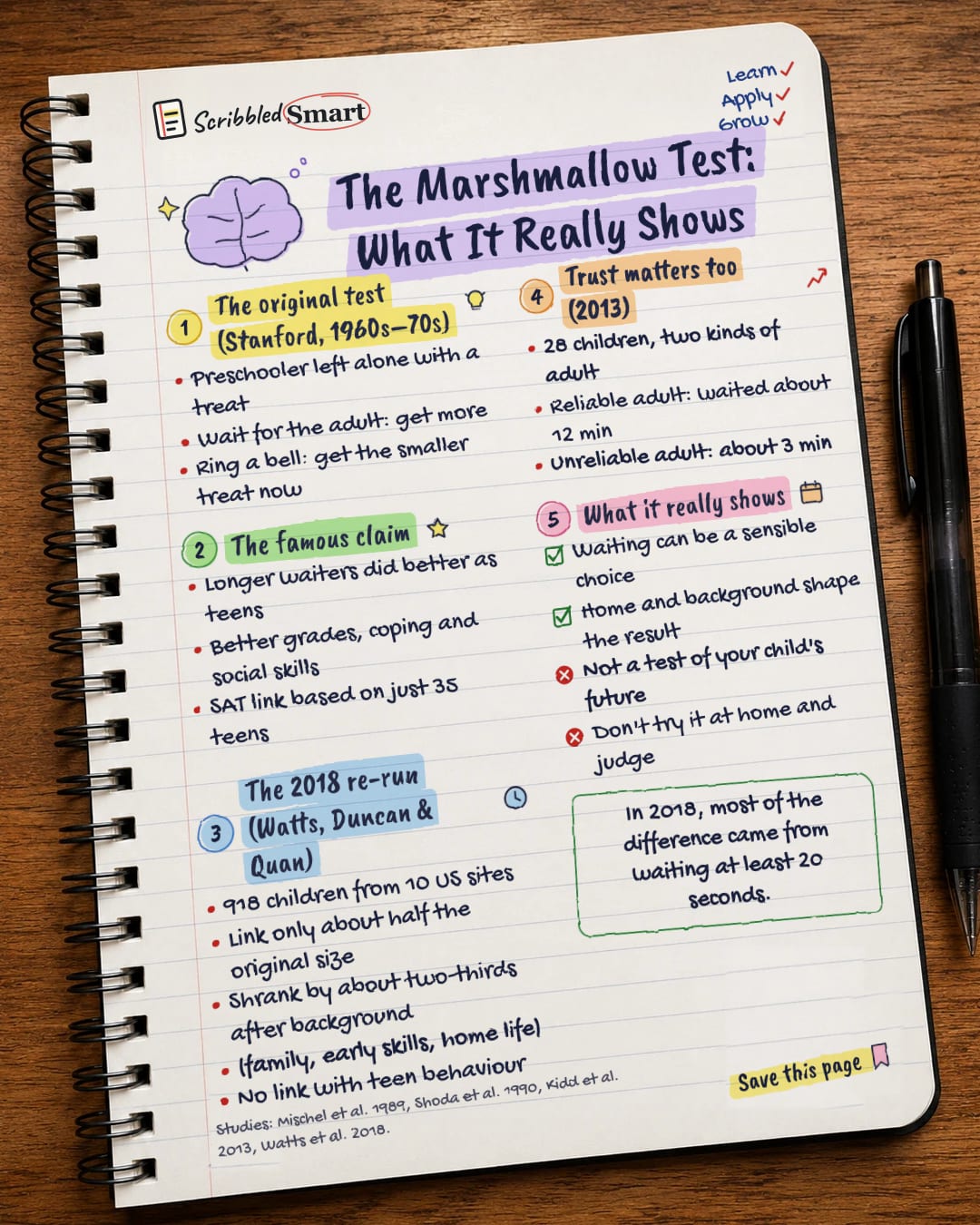
The Marshmallow Test: What It Really Shows
The marshmallow test "predicted success"? The 2018 re-run tells a different story. Save this page.
Good to know
Studies: Mischel et al. 1989, Shoda et al. 1990, Kidd et al. 2013, Watts et al. 2018.
What's on the page
The note as text, so you can read it, copy it or use a screen reader.
The original test (Stanford, 1960s–70s)
- Preschooler left alone with a treat
- Wait for the adult: get more
- Ring a bell: get the smaller treat now
The famous claim
- Longer waiters did better as teens
- Better grades, coping and social skills
- SAT link based on just 35 teens
The 2018 re-run (Watts, Duncan & Quan)
- 918 children from 10 US sites
- Link only about half the original size
- Shrank by about two-thirds after background
- (family, early skills, home life)
- No link with teen behaviour
Trust matters too (2013)
- 28 children, two kinds of adult
- Reliable adult: waited about 12 min
- Unreliable adult: about 3 min
What it really shows
- Waiting can be a sensible choice
- Home and background shape the result
- Not a test of your child's future
- Don't try it at home and judge
Sources
- Watts, T. W., Duncan, G. J. & Quan, H. (2018): Revisiting the Marshmallow Test. Psychological Science
- Mischel, W., Shoda, Y. & Rodriguez, M. L. (1989): Delay of gratification in children. Science
- Shoda, Y., Mischel, W. & Peake, P. K. (1990): Predicting adolescent cognitive and self-regulatory competencies from preschool delay of gratification. Developmental Psychology 26(6), 978–986.
- Kidd, C., Palmeri, H. & Aslin, R. N. (2013): Rational snacking. Cognition
- University of Rochester (11 Oct 2012): The marshmallow study revisited (press release)
- Duckworth, A. L., Tsukayama, E. & Kirby, T. A. (2013): Is it really self-control? Personality and Social Psychology Bulletin
How we checked this
Every fact on this note comes from the 6 sources listed here, checked against official or peer-reviewed sources where possible. AI tools help with drafting; a person checks every fact against the sources. How we research
Spotted a mistake? Tell us and we'll fix it and log it on the corrections page.


