
Psychology One-page note
Maslow's Hierarchy of Needs: Myth vs Facts
The famous pyramid? Maslow never drew it. Here's what he actually said. Save this page.
Good to know
Sources: Maslow 1943 (Psychological Review), Bridgman et al. 2019, Tay & Diener 2011.
What's on the page
The note as text, so you can read it, copy it or use a screen reader.
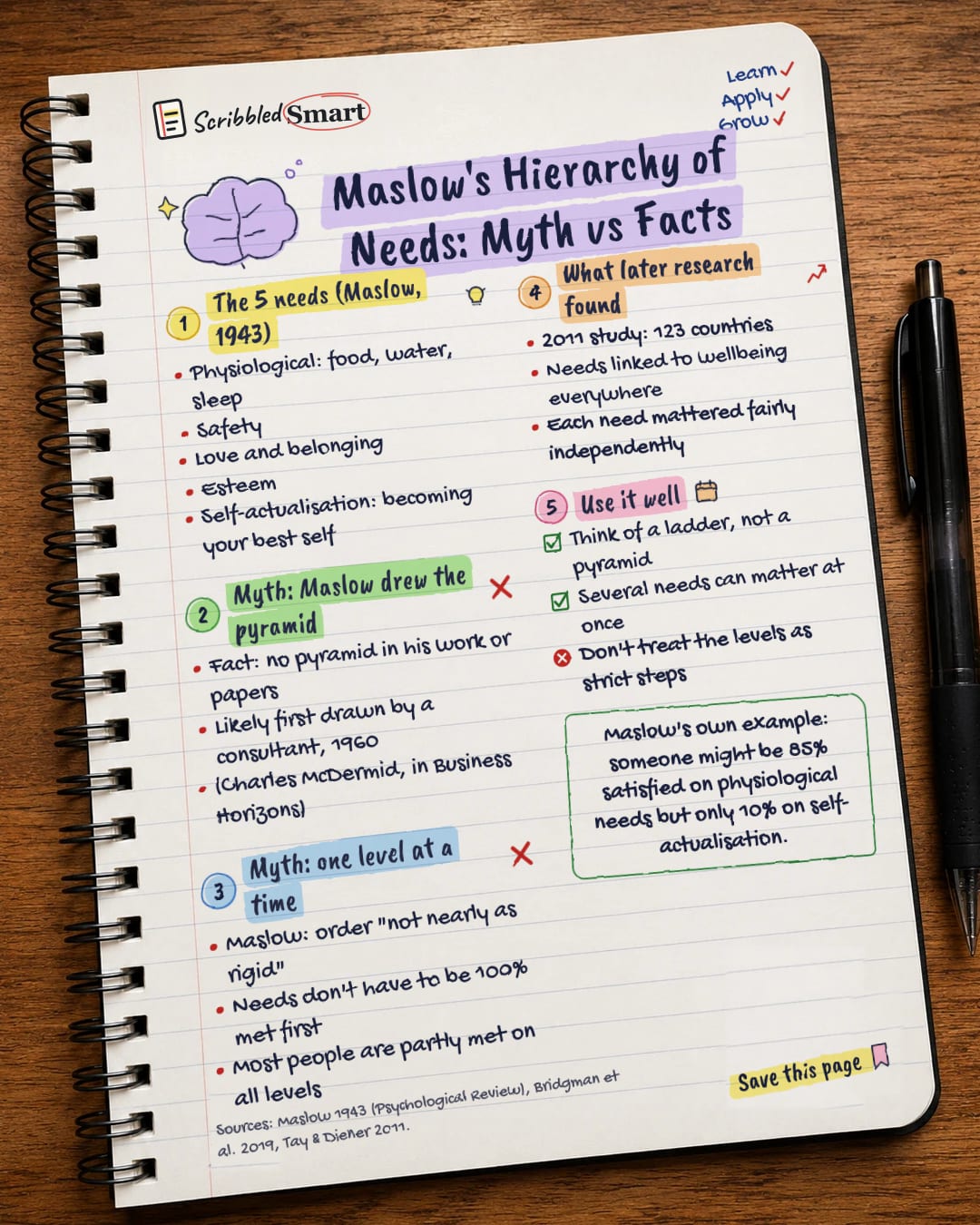
The 5 needs (Maslow, 1943)
- Physiological: food, water, sleep
- Safety
- Love and belonging
- Esteem
- Self-actualisation: becoming your best self
Myth: Maslow drew the pyramid
- Fact: no pyramid in his work or papers
- Likely first drawn by a consultant, 1960
- (Charles McDermid, in Business Horizons)
Myth: one level at a time
- Maslow: order "not nearly as rigid"
- Needs don't have to be 100% met first
- Most people are partly met on all levels
What later research found
- 2011 study: 123 countries
- Needs linked to wellbeing everywhere
- Each need mattered fairly independently
Use it well
- Think of a ladder, not a pyramid
- Several needs can matter at once
- Don't treat the levels as strict steps
Sources
- Maslow, A. H. (1943): A Theory of Human Motivation. Psychological Review
- Scientific American (Scott Barry Kaufman, 23 Apr 2019): Who Created Maslow's Iconic Pyramid?
- Bridgman, T., Cummings, S. & Ballard, J. (2019): Who Built Maslow's Pyramid? Academy of Management Learning & Education 18(1).
- Tay, L. & Diener, E. (2011): Needs and subjective well-being around the world. Journal of Personality and Social Psychology
How we checked this
Every fact on this note comes from the 4 sources listed here, checked against official or peer-reviewed sources where possible. AI tools help with drafting; a person checks every fact against the sources. How we research
Spotted a mistake? Tell us and we'll fix it and log it on the corrections page.


