
Psychology One-page note UK only
The Bystander Effect
Would anyone help you? The famous 38 witnesses story is a myth, and real CCTV says people usually do. Save this page.
Good to know
In an emergency in the UK, call 999. Studies: Darley & Latané 1968, Fischer et al. 2011, Philpot et al. 2020.
What's on the page
The note as text, so you can read it, copy it or use a screen reader.
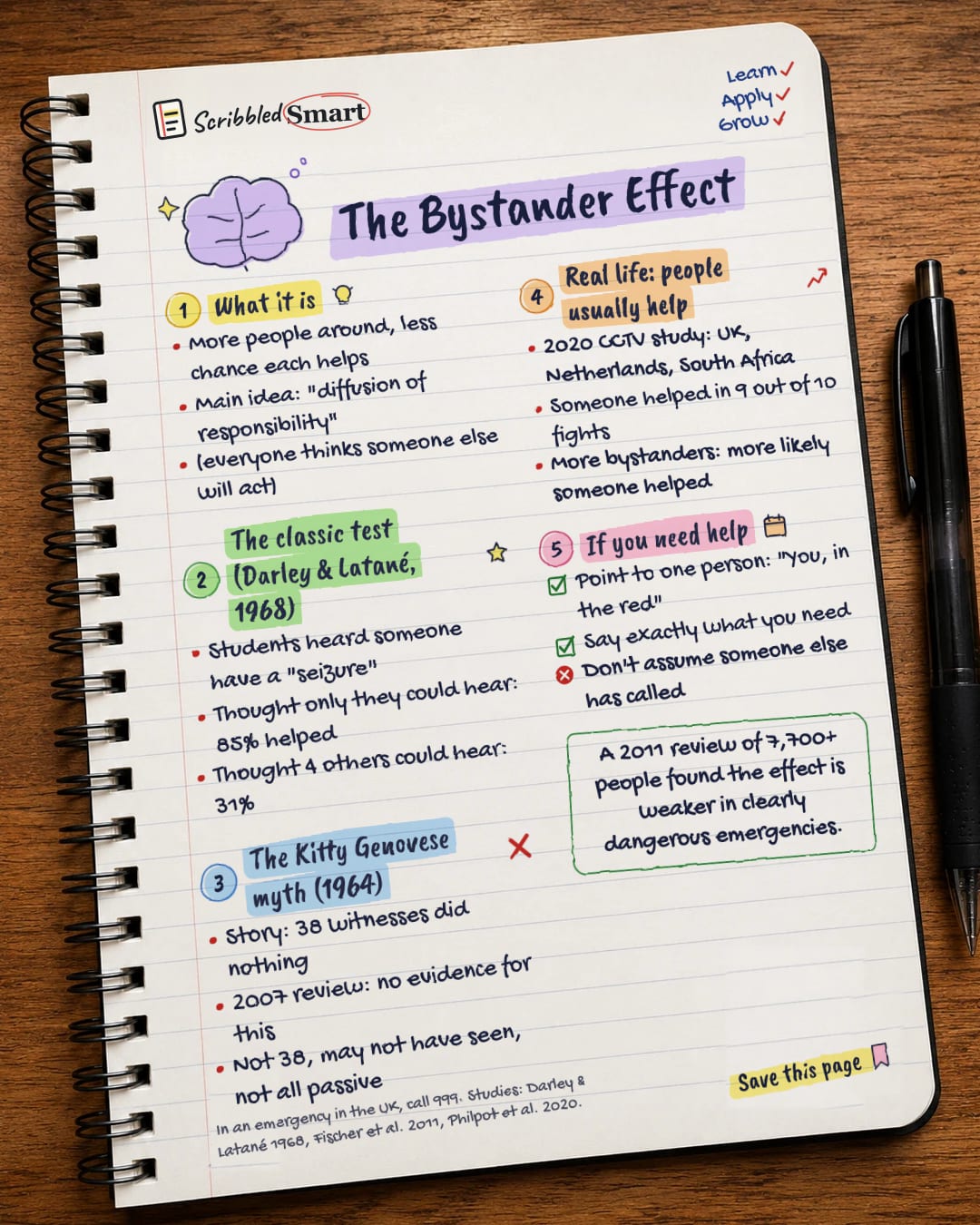
What it is
- More people around, less chance each helps
- Main idea: "diffusion of responsibility"
- (everyone thinks someone else will act)
The classic test (Darley & Latané, 1968)
- Students heard someone have a "seizure"
- Thought only they could hear: 85% helped
- Thought 4 others could hear: 31%
The Kitty Genovese myth (1964)
- Story: 38 witnesses did nothing
- 2007 review: no evidence for this
- Not 38, may not have seen, not all passive
Real life: people usually help
- 2020 CCTV study: UK, Netherlands, South Africa
- Someone helped in 9 out of 10 fights
- More bystanders: more likely someone helped
If you need help
- Point to one person: "You, in the red"
- Say exactly what you need
- Don't assume someone else has called
Sources
- Fischer, P. et al. (2011): The bystander-effect: a meta-analytic review. Psychological Bulletin
- Philpot, R. et al. (2020): Would I be helped? Cross-national CCTV footage shows that intervention is the norm in public conflicts. American Psychologist
- Manning, R., Levine, M. & Collins, A. (2007): The Kitty Genovese murder and the social psychology of helping. American Psychologist
- Lumen Learning (SUNY Research Methods): Chapter 6 Introduction
- Darley, J. M. & Latané, B. (1968): Bystander intervention in emergencies: diffusion of responsibility. JPSP 8(4), 377–383.
How we checked this
Every fact on this note comes from the 5 sources listed here, checked against official or peer-reviewed sources where possible. AI tools help with drafting; a person checks every fact against the sources. How we research
Spotted a mistake? Tell us and we'll fix it and log it on the corrections page.


