
Psychology One-page note
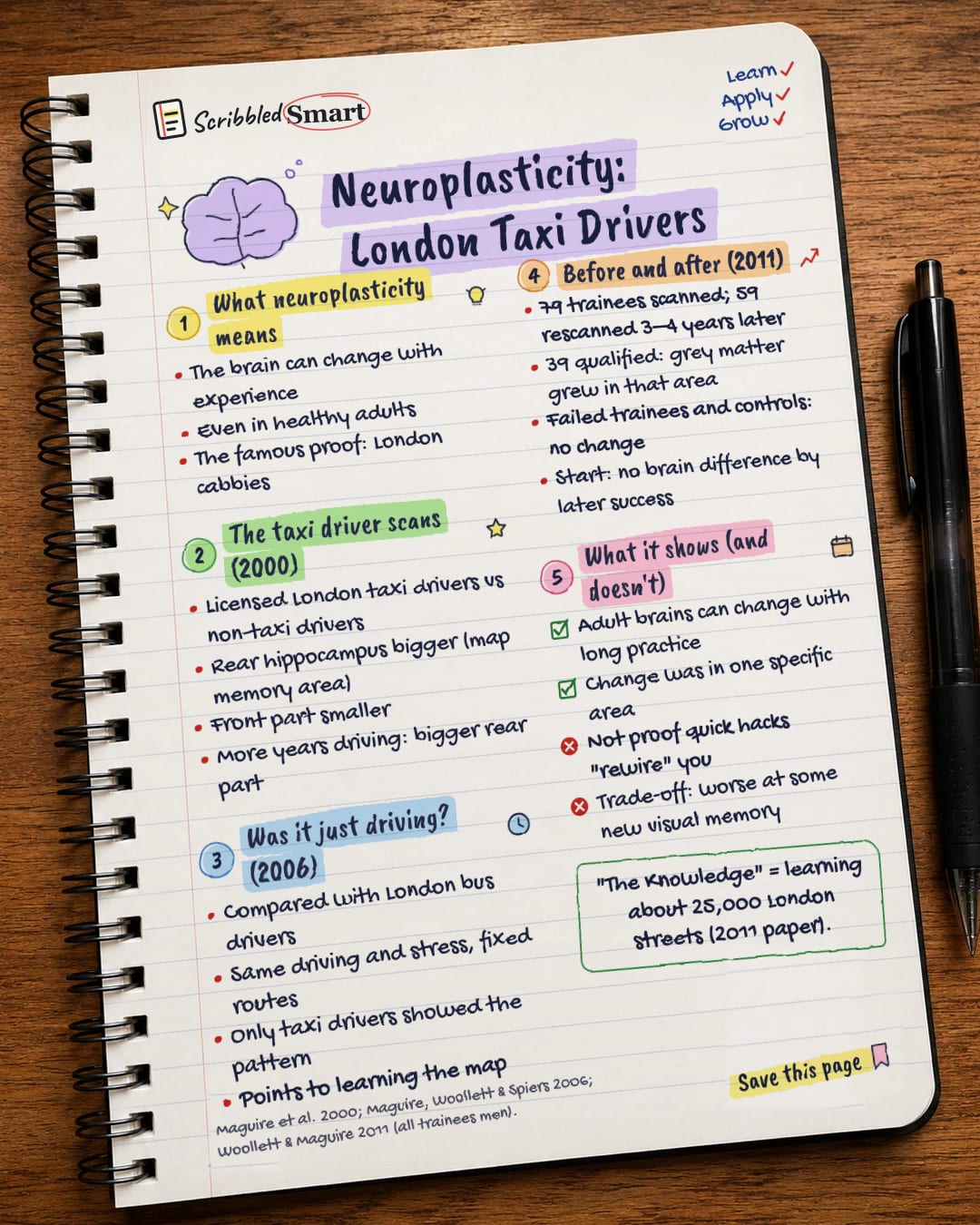
Neuroplasticity: London Taxi Drivers
London cabbies' brains changed as they learned 25,000 streets. Here's what that study really shows about neuroplasticity. Save this page.
Good to know
Maguire et al. 2000; Maguire, Woollett & Spiers 2006; Woollett & Maguire 2011.
What's on the page
The note as text, so you can read it, copy it or use a screen reader.
What neuroplasticity means
- The brain can change with experience
- Even in healthy adults
- The famous proof: London cabbies
The taxi driver scans (2000)
- Licensed London taxi drivers vs non-drivers
- Rear hippocampus bigger (map memory area)
- Front part smaller
- More years driving: bigger rear part
Was it just driving? (2006)
- Compared with London bus drivers
- Same driving and stress, fixed routes
- Only taxi drivers showed the pattern
- Points to learning the map
Before and after (2011)
- 79 trainees scanned, then 3–4 years later
- 39 qualified: grey matter grew in that area
- Failed trainees and others: no change
- No brain difference before training
What it shows (and doesn't)
- Adult brains can change with long practice
- Change was in one specific area
- Not proof quick hacks "rewire" you
- Not all gain: worse at some new visual memory
Sources
- Maguire, E. A. et al. (2000): Navigation-related structural change in the hippocampi of taxi drivers. PNAS
- Maguire, E. A., Woollett, K. & Spiers, H. J. (2006): London taxi drivers and bus drivers: a structural MRI and neuropsychological analysis. Hippocampus
- Woollett, K. & Maguire, E. A. (2011): Acquiring "the Knowledge" of London's layout drives structural brain changes. Current Biology
How we checked this
Every fact on this note comes from the 3 sources listed here, checked against official or peer-reviewed sources where possible. AI tools help with drafting; a person checks every fact against the sources. How we research
Spotted a mistake? Tell us and we'll fix it and log it on the corrections page.


