
Psychology One-page note
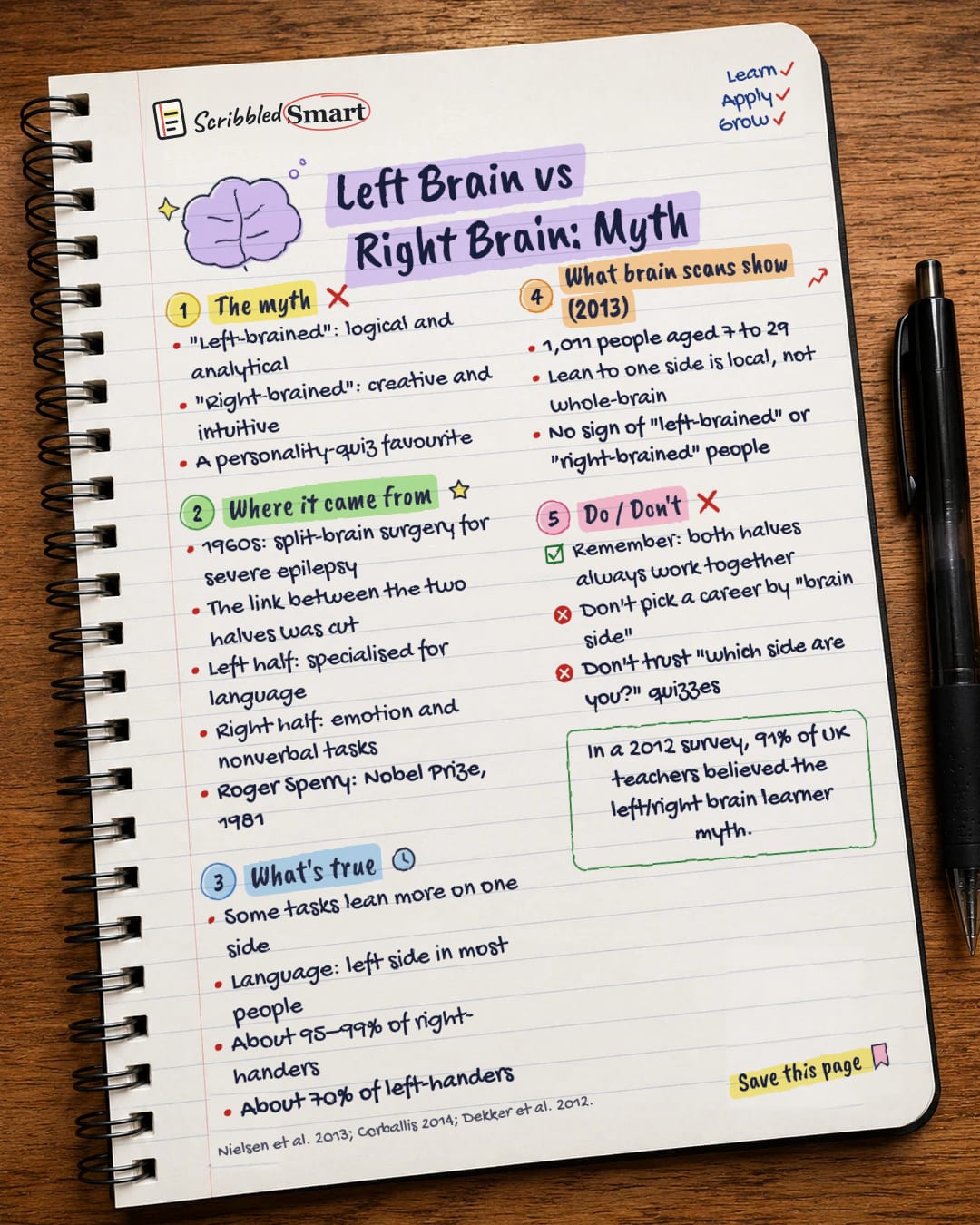
Left Brain vs Right Brain: Myth
You're not "left-brained" or "right-brained". Here's where the myth came from and what brain scans really show. Save this page.
Good to know
Nielsen et al. 2013; Corballis 2014; Dekker et al. 2012.
What's on the page
The note as text, so you can read it, copy it or use a screen reader.
The myth
- "Left-brained": logical and analytical
- "Right-brained": creative and intuitive
- A personality-quiz favourite
Where it came from
- 1960s: split-brain surgery for severe epilepsy
- The link between the two halves was cut
- Left half: specialised for language
- Right half: emotion and nonverbal tasks
- Roger Sperry: Nobel Prize, 1981
What's true
- Some tasks lean more on one side
- Language: left side in most people
- About 95–99% of right-handers
- About 70% of left-handers
What brain scans show (2013)
- 1,011 people aged 7 to 29
- Lean to one side is local, not whole-brain
- No sign of "left-brained" or "right-brained" people
Do / Don't
- Remember: both halves always work together
- Don't pick a career by "brain side"
- Don't trust "which side are you?" quizzes
Sources
- Nielsen, J. A. et al. (2013): An evaluation of the left-brain vs. right-brain hypothesis with resting state functional connectivity MRI. PLoS ONE
- Corballis, M. C. (2014): Left brain, right brain: facts and fantasies. PLoS Biology
- Dekker, S., Lee, N. C., Howard-Jones, P. & Jolles, J. (2012): Neuromyths in education: prevalence and predictors of misconceptions among teachers. Frontiers in Psychology
- Gazzaniga, M. S. (2005): Forty-five years of split-brain research and still going strong. Nature Reviews Neuroscience
How we checked this
Every fact on this note comes from the 4 sources listed here, checked against official or peer-reviewed sources where possible. AI tools help with drafting; a person checks every fact against the sources. How we research
Spotted a mistake? Tell us and we'll fix it and log it on the corrections page.


