
Study One-page note
Too Old to Learn a Language? Myth vs Facts
Too old to learn a language? Adults often make faster early progress than young kids. Here's what the age research really shows. Save this page.
Good to know
Studies measure different skills (grammar, accent, early progress). Results vary.
What's on the page
The note as text, so you can read it, copy it or use a screen reader.
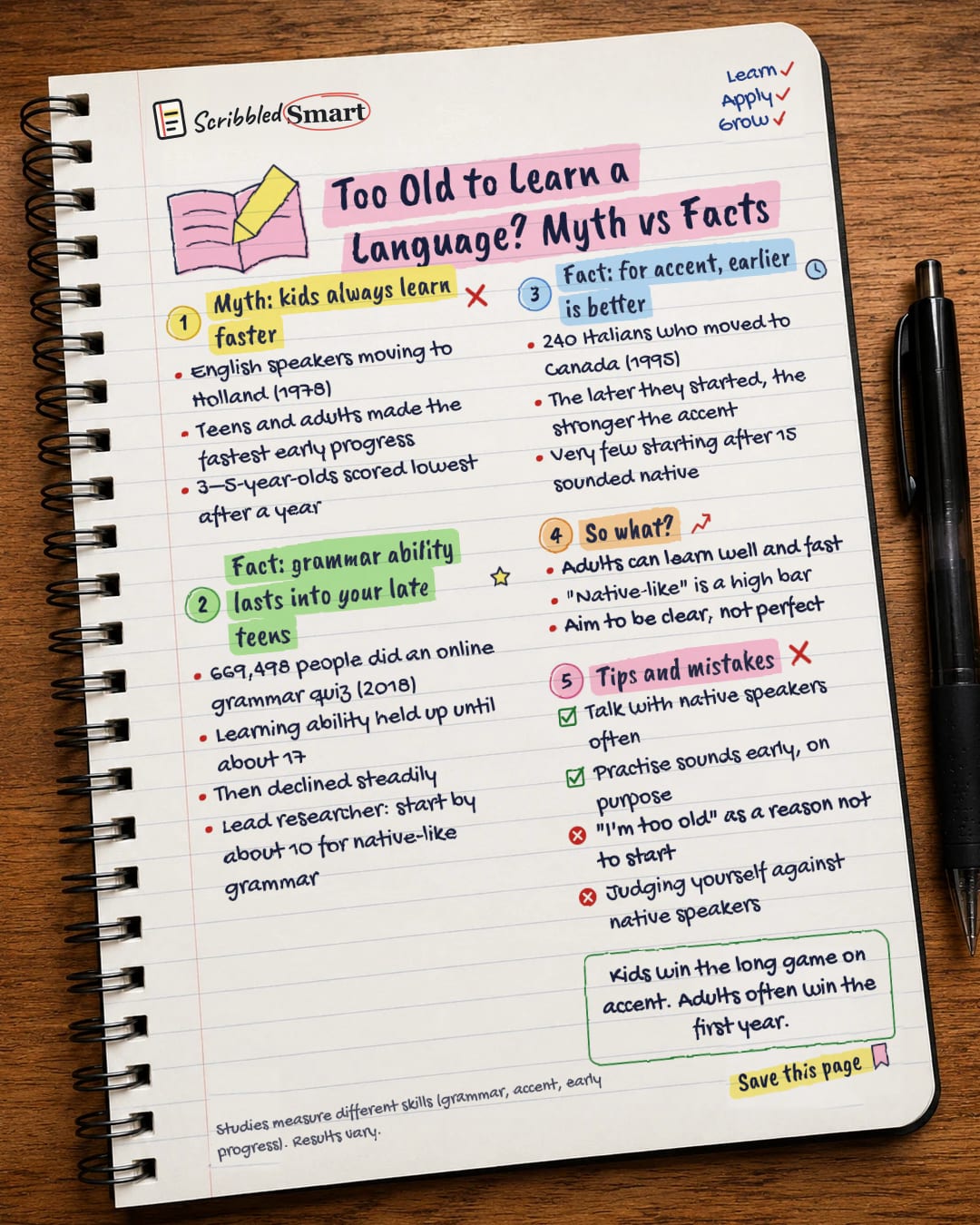
Myth: kids always learn faster
- English speakers moving to Holland (1978)
- Teens and adults made the fastest early progress
- 3–5-year-olds scored lowest after a year
Fact: grammar ability lasts into your late teens
- 669,498 people did an online grammar quiz (2018)
- Learning ability held up until about 17
- Then declined steadily
- Lead researcher: start by about 10 for native-like grammar
Fact: for accent, earlier is better
- 240 Italians who moved to Canada (1995)
- The later they started, the stronger the accent
- Very few starting after 15 sounded native
So what?
- Adults can learn well and fast
- "Native-like" is a high bar
- Aim to be clear, not perfect
Tips and mistakes
- Talk with native speakers often
- Practise sounds early, on purpose
- "I'm too old" as a reason not to start
- Judging yourself against native speakers
Sources
- Snow, C.E. & Hoefnagel-Höhle, M. (1978): The Critical Period for Language Acquisition: Evidence from Second Language Learning. Child Development 49(4), 1114–1128
- Hartshorne, J.K., Tenenbaum, J.B. & Pinker, S. (2018): A critical period for second language acquisition: Evidence from 2/3 million English speakers. Cognition 177, 263–277
- MIT News / MIT BCS (Trafton, A., 1 May 2018): Cognitive scientists define critical period for learning language
- Flege, J.E., Munro, M.J. & MacKay, I.R. (1995): Factors affecting strength of perceived foreign accent in a second language. JASA 97(5), 3125–3134
How we checked this
Every fact on this note comes from the 4 sources listed here, checked against official or peer-reviewed sources where possible. AI tools help with drafting; a person checks every fact against the sources. How we research
Spotted a mistake? Tell us and we'll fix it and log it on the corrections page.


