
Study One-page note
Brain Training Games: Do They Work?
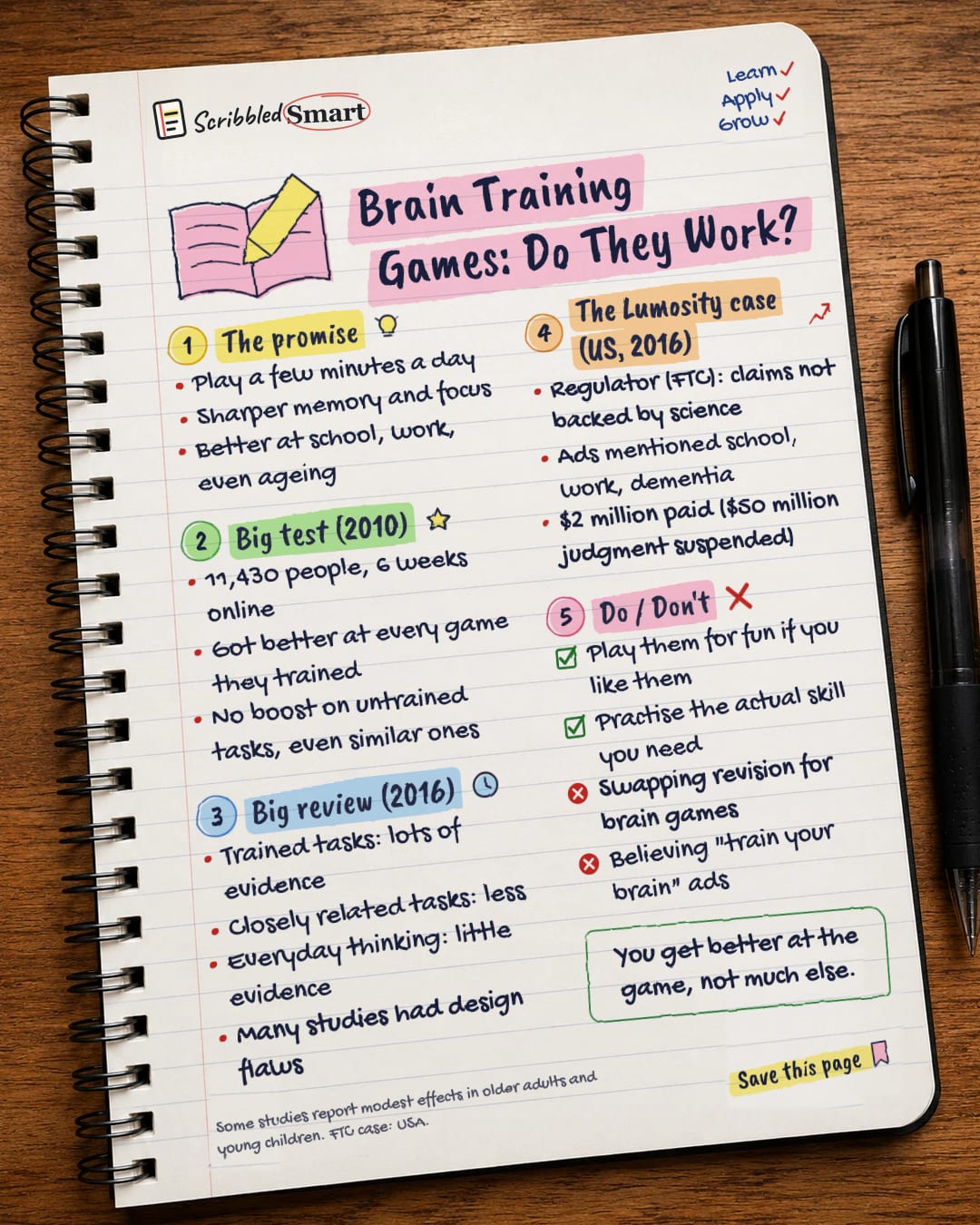
Brain games promise a sharper mind. The biggest studies say you mostly just get better at the game. Save this page.
Good to know
Some studies report modest effects in older adults and young children. FTC case: USA.
What's on the page
The note as text, so you can read it, copy it or use a screen reader.
The promise
- Play a few minutes a day
- Sharper memory and focus
- Better at school, work, even ageing
Big test (2010)
- 11,430 people, 6 weeks online
- Got better at every game they trained
- No boost on untrained tasks, even similar ones
Big review (2016)
- Trained tasks: lots of evidence
- Closely related tasks: less
- Everyday thinking: little evidence
- Many studies had design flaws
The Lumosity case (US, 2016)
- Regulator (FTC): claims not backed by science
- Ads mentioned school, work, dementia
- $2 million paid ($50 million judgment suspended)
Do / Don't
- Play them for fun if you like them
- Practise the actual skill you need
- Swapping revision for brain games
- Believing "train your brain" ads
Sources
- Owen, A.M. et al. (2010): Putting brain training to the test. Nature 465, 775–778
- Simons, D.J. et al. (2016): Do "Brain-Training" Programs Work? Psychological Science in the Public Interest 17(3), 103–186
- US Federal Trade Commission (5 Jan 2016): Lumosity to Pay $2 Million to Settle FTC Deceptive Advertising Charges for Its "Brain Training" Program
How we checked this
Every fact on this note comes from the 3 sources listed here, checked against official or peer-reviewed sources where possible. AI tools help with drafting; a person checks every fact against the sources. How we research
Spotted a mistake? Tell us and we'll fix it and log it on the corrections page.


