
Study One-page note
Photographic Memory: Is It Real?
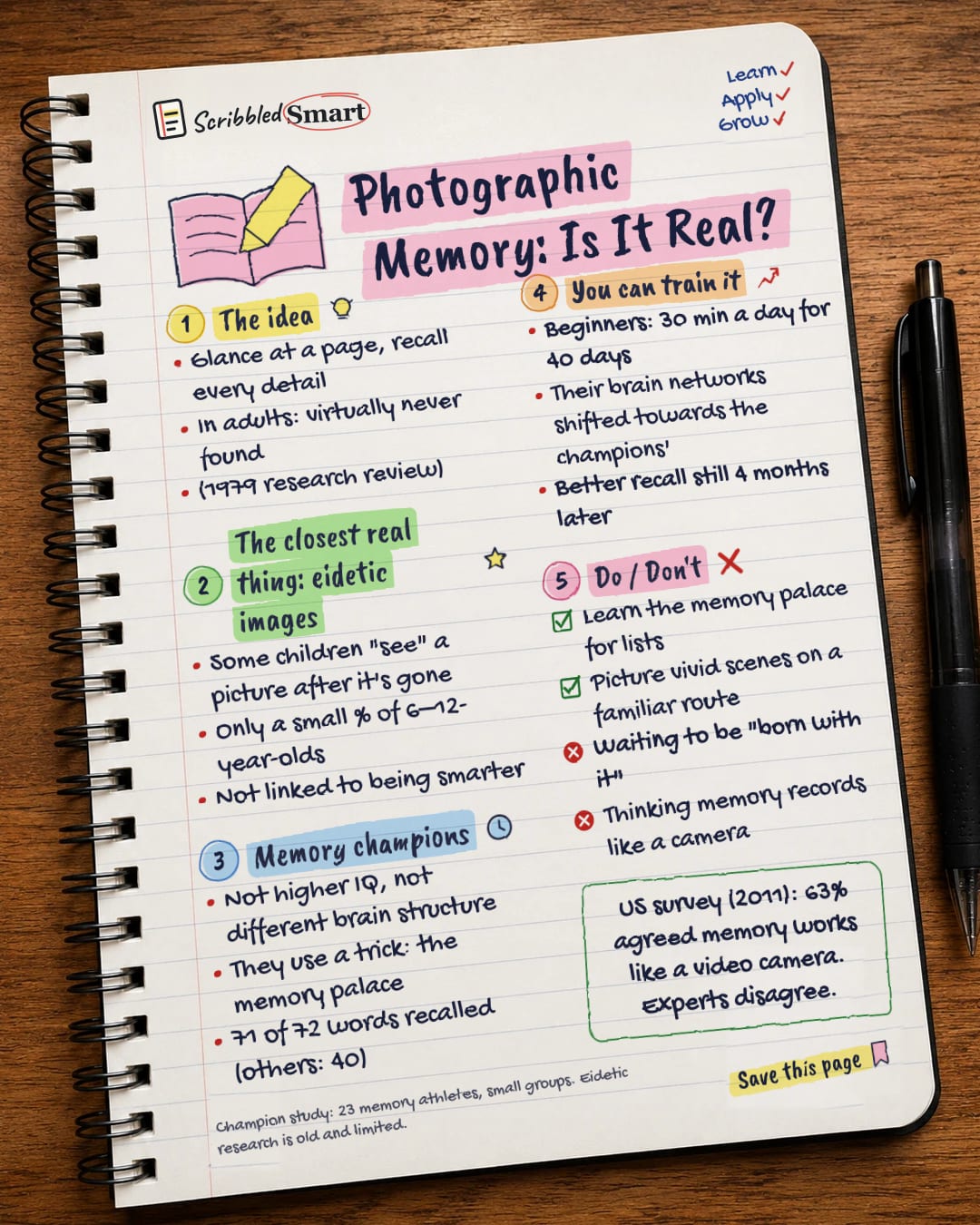
Photographic memory is a movie myth. Memory champions use a trick you can learn. Save this page.
Good to know
Champion study: 23 memory athletes, small groups. Eidetic research is old and limited.
What's on the page
The note as text, so you can read it, copy it or use a screen reader.
The idea
- Glance at a page, recall every detail
- In adults: virtually never found
- (1979 research review)
The closest real thing: eidetic images
- Some children "see" a picture after it's gone
- Only a small % of 6–12-year-olds
- Not linked to being smarter
Memory champions
- Not higher IQ, not different brain structure
- They use a trick: the memory palace
- 71 of 72 words recalled (others: 40)
You can train it
- Beginners: 30 min a day for 40 days
- Their brain networks shifted towards the champions'
- Better recall still 4 months later
Do / Don't
- Learn the memory palace for lists
- Picture vivid scenes on a familiar route
- Waiting to be "born with it"
- Thinking memory records like a camera
Sources
- Haber, R.N. (1979): Twenty years of haunting eidetic imagery: where's the ghost? Behavioral and Brain Sciences 2(4), 583–594
- Maguire, E.A., Valentine, E.R., Wilding, J.M. & Kapur, N. (2003): Routes to remembering: the brains behind superior memory. Nature Neuroscience 6(1), 90–95
- Dresler, M. et al. (2017): Mnemonic Training Reshapes Brain Networks to Support Superior Memory. Neuron 93(5), 1227–1235
- Simons, D.J. & Chabris, C.F. (2011): What people believe about how memory works: a representative survey of the U.S. population. PLOS ONE 6(8), e22757
How we checked this
Every fact on this note comes from the 4 sources listed here, checked against official or peer-reviewed sources where possible. AI tools help with drafting; a person checks every fact against the sources. How we research
Spotted a mistake? Tell us and we'll fix it and log it on the corrections page.


