
Study One-page note
Mnemonics: Acronyms, Rhymes and Stories
Richard Of York still helps you remember the rainbow. Here's when memory tricks work and when they don't. Save this page.
Good to know
A mnemonic helps you recall, not understand. Pair it with practice tests.
What's on the page
The note as text, so you can read it, copy it or use a screen reader.
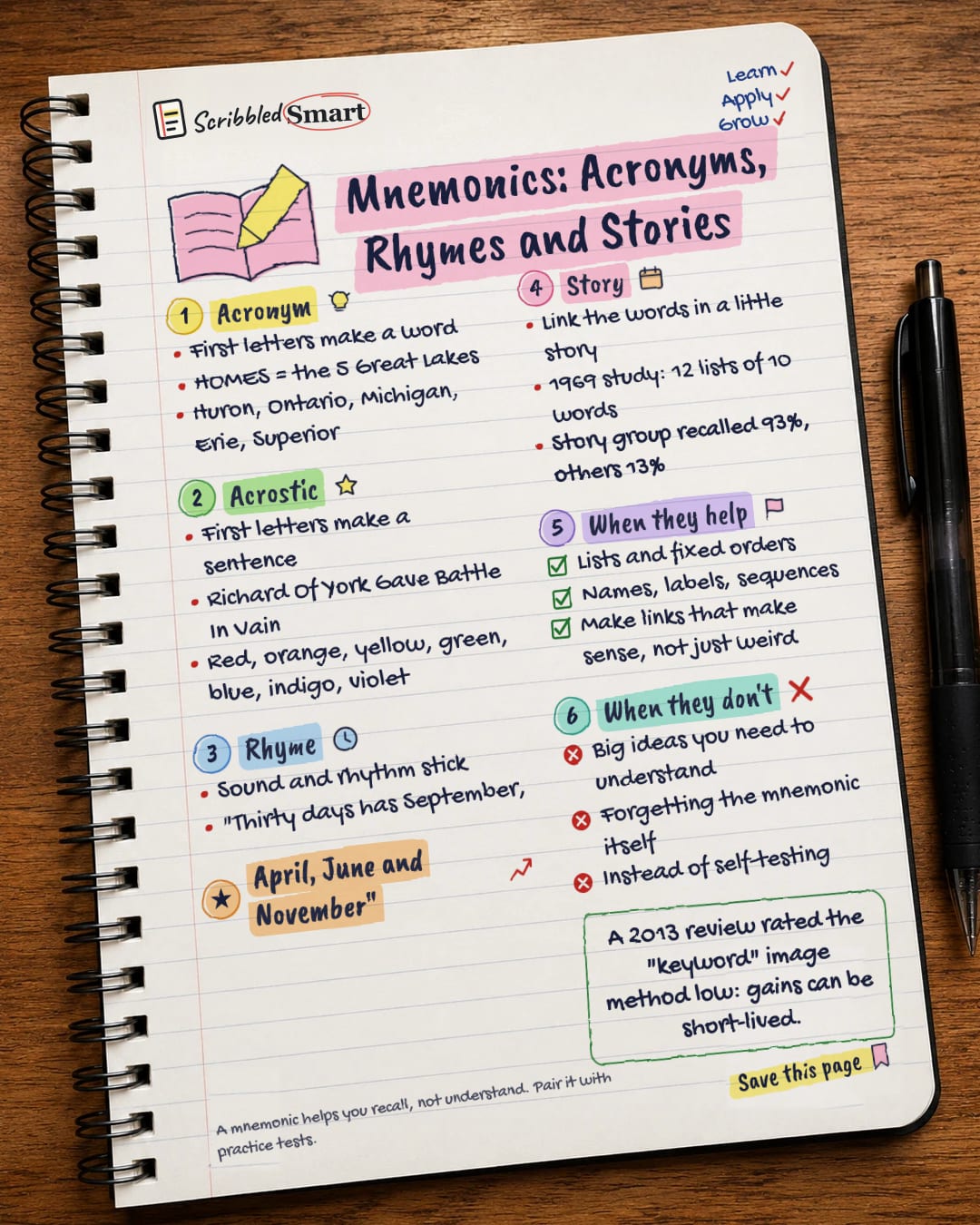
Acronym
- First letters make a word
- HOMES = the 5 Great Lakes
- Huron, Ontario, Michigan, Erie, Superior
Acrostic
- First letters make a sentence
- Richard Of York Gave Battle In Vain
- Red, orange, yellow, green, blue, indigo, violet
Rhyme
- Sound and rhythm stick
- "Thirty days has September, April, June and November"
Story
- Link the words in a little story
- 1969 study: 12 lists of 10 words
- Story group recalled 93%, others 13%
When they help
- Lists and fixed orders
- Names, labels, sequences
- Make links that make sense, not just weird
When they don't
- Big ideas you need to understand
- Forgetting the mnemonic itself
- Instead of self-testing
Sources
- Kansas State University Academic Assistance Center: Mnemonic Devices
- Metlink (Royal Meteorological Society): Rainbows
- timeanddate.com: Months of the year
- US EPA: Physical features of the Great Lakes
- Reysen & Fischer (2026): Adaptive Memory: Story Processing Improves Recall Performance. Evolutionary Psychology 24(1)
- Bower & Clark (1969): Narrative stories as mediators for serial learning. Psychonomic Science 14, 181–182
- The Learning Scientists: Digest #172 Mnemonic Devices
- Russ Dewey, Psychology: An Introduction (psywww.com): Memory improvement
- Dunlosky (2013): Strengthening the Student Toolbox. American Educator
- Putnam (2015): Mnemonics in education
How we checked this
Every fact on this note comes from the 10 sources listed here, checked against official or peer-reviewed sources where possible. AI tools help with drafting; a person checks every fact against the sources. How we research
Spotted a mistake? Tell us and we'll fix it and log it on the corrections page.


