
General knowledge One-page note
Atoms, Elements and Molecules
Everything around you is made of atoms. Atoms, elements, molecules and mixtures in one page. Save this page.
Good to know
Matches GCSE Chemistry (Atomic structure). Checked November 2026.
What's on the page
The note as text, so you can read it, copy it or use a screen reader.
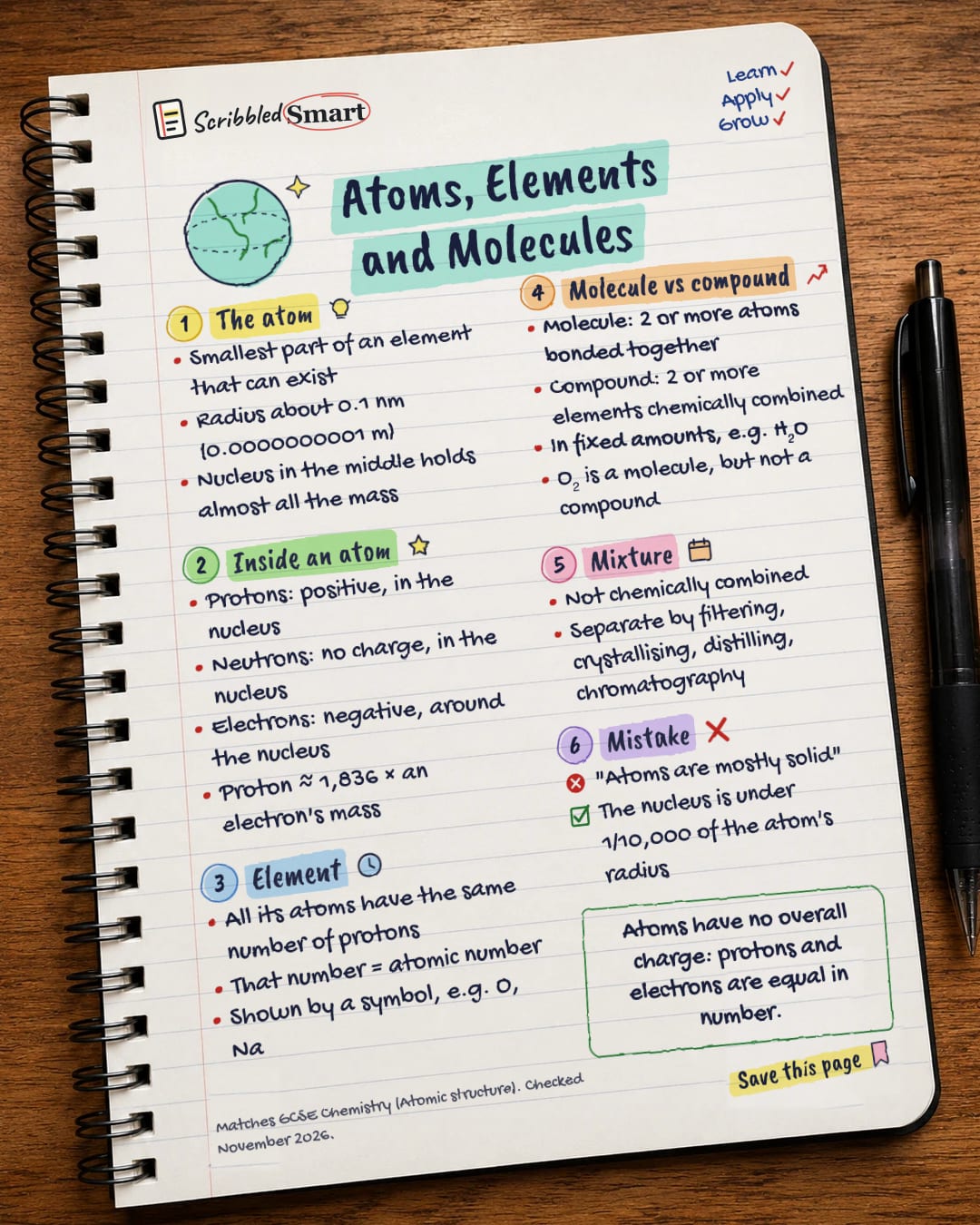
The atom
- Smallest part of an element that can exist
- Radius about 0.1 nm (0.0000000001 m)
- Nucleus in the middle holds almost all the mass
Inside an atom
- Protons: positive, in the nucleus
- Neutrons: no charge, in the nucleus
- Electrons: negative, around the nucleus
- Proton ≈ 1,836 × an electron's mass
Element
- All its atoms have the same number of protons
- That number = atomic number
- Shown by a symbol, e.g. O, Na
Molecule vs compound
- Molecule: 2 or more atoms bonded together
- Compound: 2 or more elements chemically combined
- In fixed amounts, e.g. H₂O
- O₂ is a molecule, but not a compound
Mixture
- Not chemically combined
- Separate by filtering, crystallising, distilling, chromatography
Mistake
- "Atoms are mostly solid"
- The nucleus is under 1/10,000 of the atom's radius
Sources
- AQA: GCSE Chemistry (8462) specification, 4.1 Atomic structure and the periodic table
- NIST: CODATA value: proton-electron mass ratio
- CASRAI: Molecule (search summary)
- Britannica: Molecule (search summary; site blocked)
- Royal Society of Chemistry Education: Atomic structure resources (search summary)
How we checked this
Every fact on this note comes from the 5 sources listed here, checked against official or peer-reviewed sources where possible. AI tools help with drafting; a person checks every fact against the sources. How we research
Spotted a mistake? Tell us and we'll fix it and log it on the corrections page.


