
General knowledge One-page note
How Your Eyes See Colour
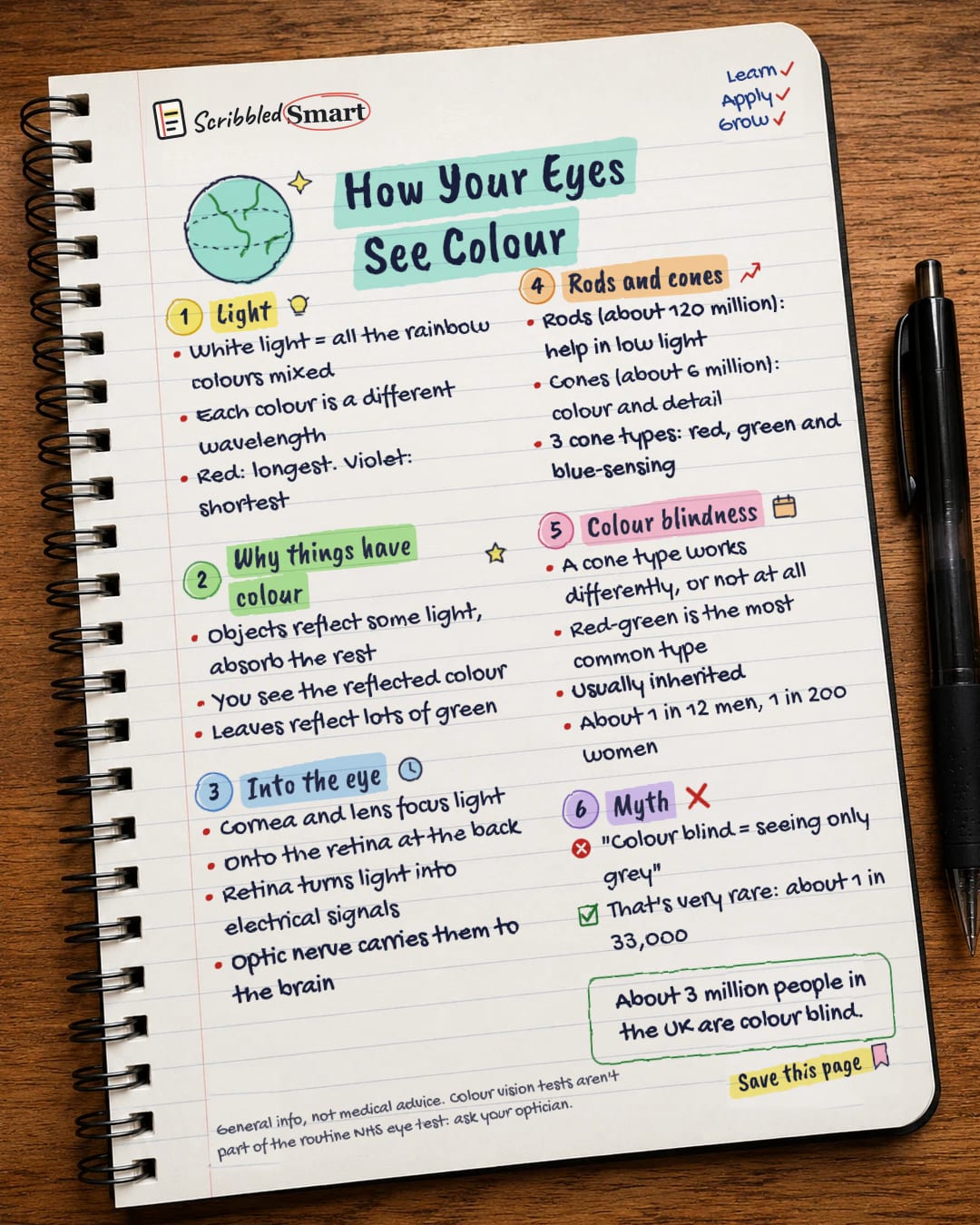
Why does a leaf look green? It's all about the light it reflects. How your eyes see colour, in one page. Save this page.
Good to know
General info, not medical advice. Colour vision tests aren't part of the routine NHS eye test: ask your optician.
What's on the page
The note as text, so you can read it, copy it or use a screen reader.
Light
- White light = all the rainbow colours mixed
- Each colour is a different wavelength
- Red: longest. Violet: shortest
Why things have colour
- Objects reflect some light, absorb the rest
- You see the reflected colour
- Leaves reflect lots of green
Into the eye
- Cornea and lens focus light
- Onto the retina at the back
- Retina turns light into electrical signals
- Optic nerve carries them to the brain
Rods and cones
- Rods (about 120 million): help in low light
- Cones (about 6 million): colour and detail
- 3 cone types: red, green and blue-sensing
Colour blindness
- A cone type works differently, or not at all
- Red-green is the most common type
- Usually inherited
- About 1 in 12 men, 1 in 200 women
Myth
- "Colour blind = seeing only grey"
- That's very rare: about 1 in 33,000
Sources
- NASA Science: Visible light
- National Eye Institute: How the eyes work
- National Eye Institute: Color blindness
- National Eye Institute: Causes of color blindness
- American Academy of Ophthalmology: Rods
- American Academy of Ophthalmology: Cones
- Colour Blind Awareness: Colour blindness
- Colour Blind Awareness: Types of colour blindness
- NHS: Colour vision deficiency (colour blindness)
How we checked this
Every fact on this note comes from the 9 sources listed here, checked against official or peer-reviewed sources where possible. AI tools help with drafting; a person checks every fact against the sources. How we research
Spotted a mistake? Tell us and we'll fix it and log it on the corrections page.


