
General knowledge One-page note
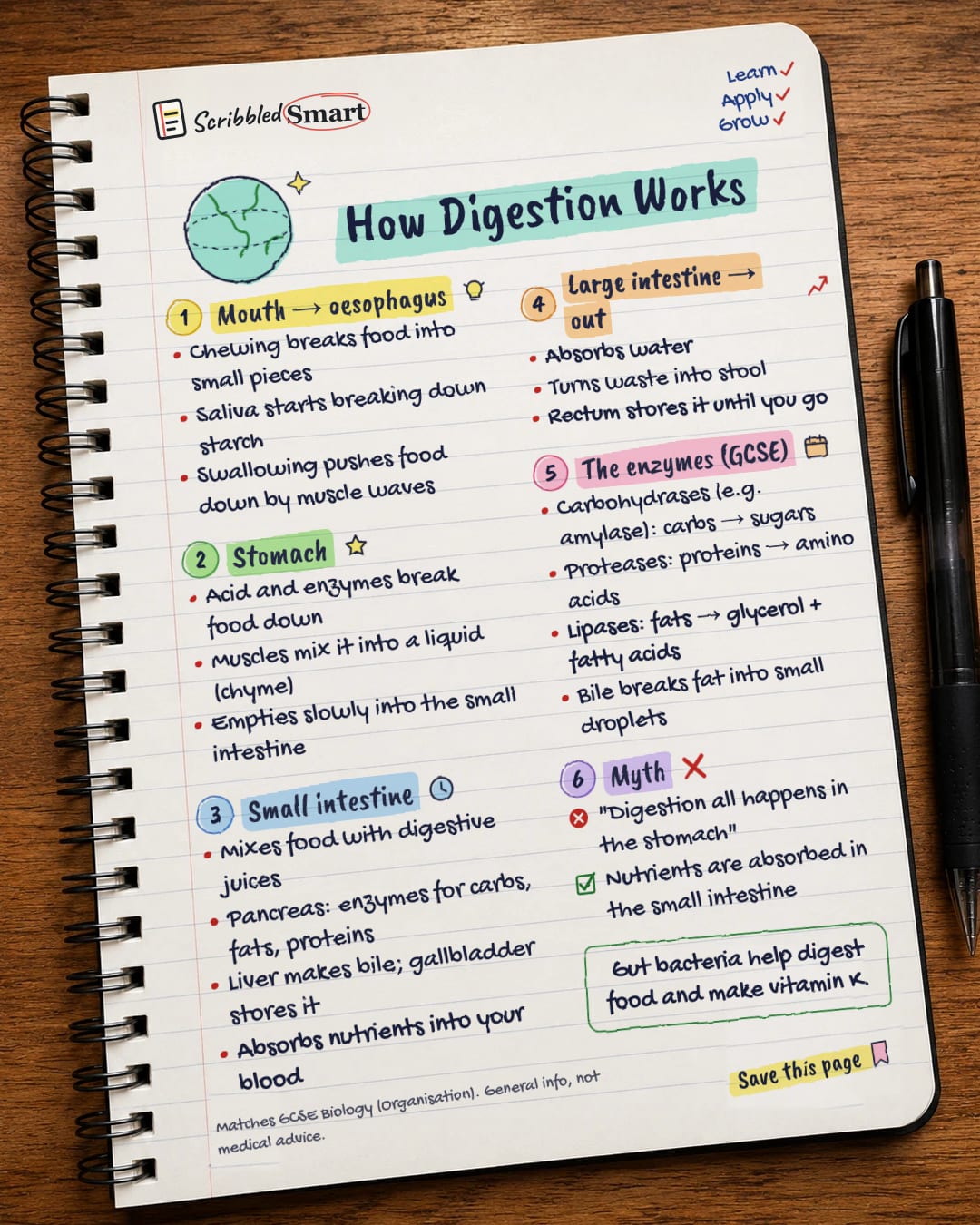
How Digestion Works
What happens to your lunch? From mouth to toilet in one page. Save this page.
Good to know
Matches GCSE Biology (Organisation). General info, not medical advice.
What's on the page
The note as text, so you can read it, copy it or use a screen reader.
Mouth → oesophagus
- Chewing breaks food into small pieces
- Saliva starts breaking down starch
- Swallowing pushes food down by muscle waves
Stomach
- Acid and enzymes break food down
- Muscles mix it into a liquid (chyme)
- Empties slowly into the small intestine
Small intestine
- Mixes food with digestive juices
- Pancreas: enzymes for carbs, fats, proteins
- Liver makes bile; gallbladder stores it
- Absorbs nutrients into your blood
Large intestine → out
- Absorbs water
- Turns waste into stool
- Rectum stores it until you go
The enzymes (GCSE)
- Carbohydrases (e.g. amylase): carbs → sugars
- Proteases: proteins → amino acids
- Lipases: fats → glycerol + fatty acids
- Bile breaks fat into small droplets
Myth
- "Digestion all happens in the stomach"
- Nutrients are absorbed in the small intestine
Sources
- National Institute of Diabetes and Digestive and Kidney Diseases (NIDDK): Your digestive system & how it works
- AQA: GCSE Biology (8461) specification, 4.2 Organisation
- Cleveland Clinic: Digestive system (length figures, Caution only)
- Wang YT et al. (2015) Regional gastrointestinal transit and pH studied in 215 healthy volunteers using the wireless motility capsule. Alimentary Pharmacology & Therapeutics
How we checked this
Every fact on this note comes from the 4 sources listed here, checked against official or peer-reviewed sources where possible. AI tools help with drafting; a person checks every fact against the sources. How we research
Spotted a mistake? Tell us and we'll fix it and log it on the corrections page.


