
General knowledge One-page note
How Fireworks Get Their Colours
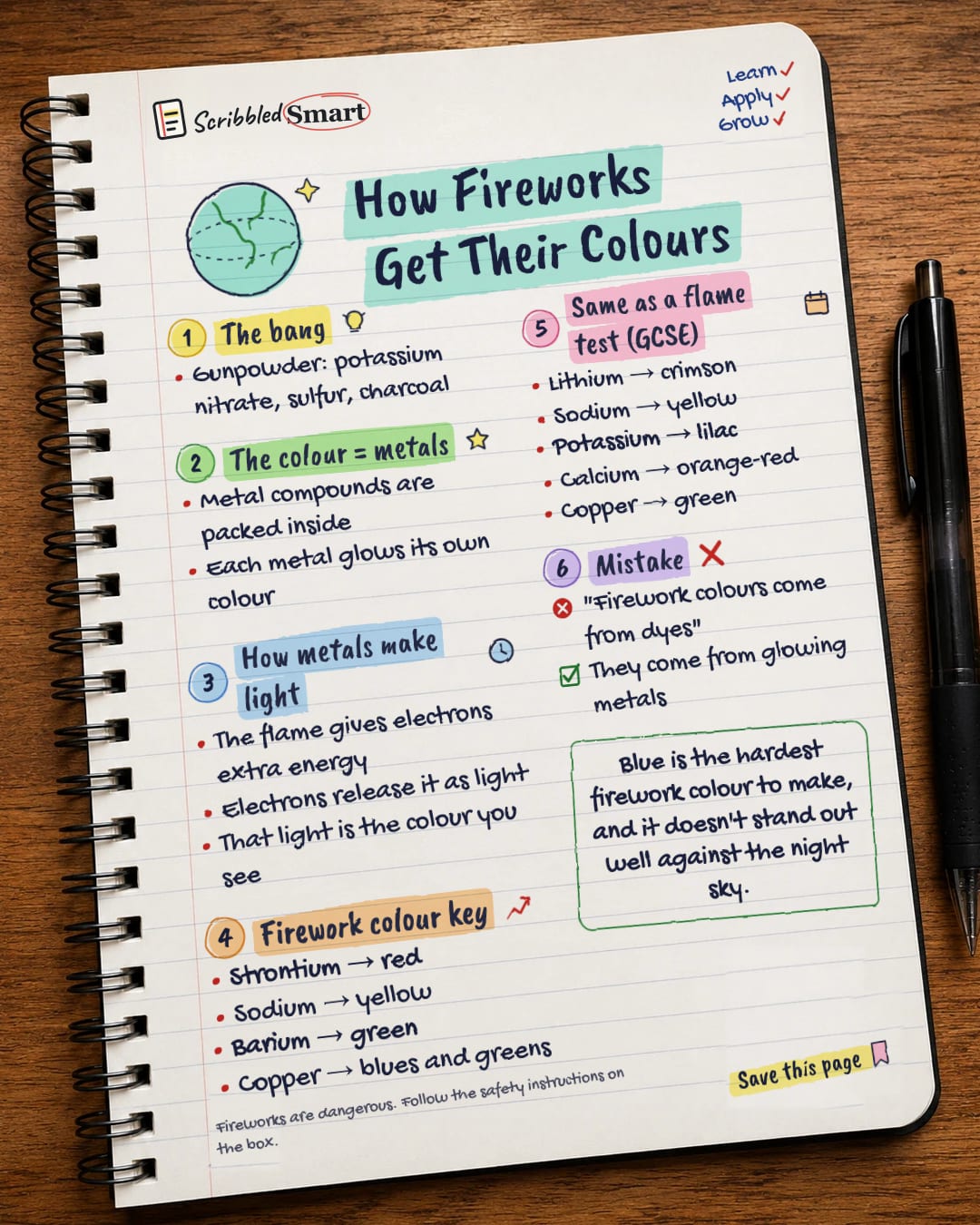
Red is strontium, green is barium, and blue is the hardest of all. Save this page.
Good to know
Fireworks are dangerous. Follow the safety instructions on the box.
What's on the page
The note as text, so you can read it, copy it or use a screen reader.
The bang
- Gunpowder: potassium nitrate, sulfur, charcoal
The colour = metals
- Metal compounds are packed inside
- Each metal glows its own colour
How metals make light
- The flame gives electrons extra energy
- Electrons release it as light
- That light is the colour you see
Firework colour key
- Strontium → red
- Sodium → yellow
- Barium → green
- Copper → blues and greens
Same as a flame test (GCSE)
- Lithium → crimson
- Sodium → yellow
- Potassium → lilac
- Calcium → orange-red
- Copper → green
Mistake
- "Firework colours come from dyes"
- They come from glowing metals
Sources
- RSC Education in Chemistry: Fireworks: the art and science (Hayley Bennett and Adam Boxer, 29 Aug 2019)
- The Conversation: Red, white, but rarely blue – the science of fireworks colors explained (Paul E. Smith, 2 Jul 2019)
- AQA: GCSE Chemistry (8462) specification, 4.8 Chemical analysis
- RSC Education: Flame colours – a demonstration
How we checked this
Every fact on this note comes from the 4 sources listed here, checked against official or peer-reviewed sources where possible. AI tools help with drafting; a person checks every fact against the sources. How we research
Spotted a mistake? Tell us and we'll fix it and log it on the corrections page.


