
General knowledge One-page note UK only
Leap Years Explained
Why does February get an extra day, and why won't 2100? Save this page.
Good to know
Gregorian calendar, used in the UK and most of the world.
What's on the page
The note as text, so you can read it, copy it or use a screen reader.
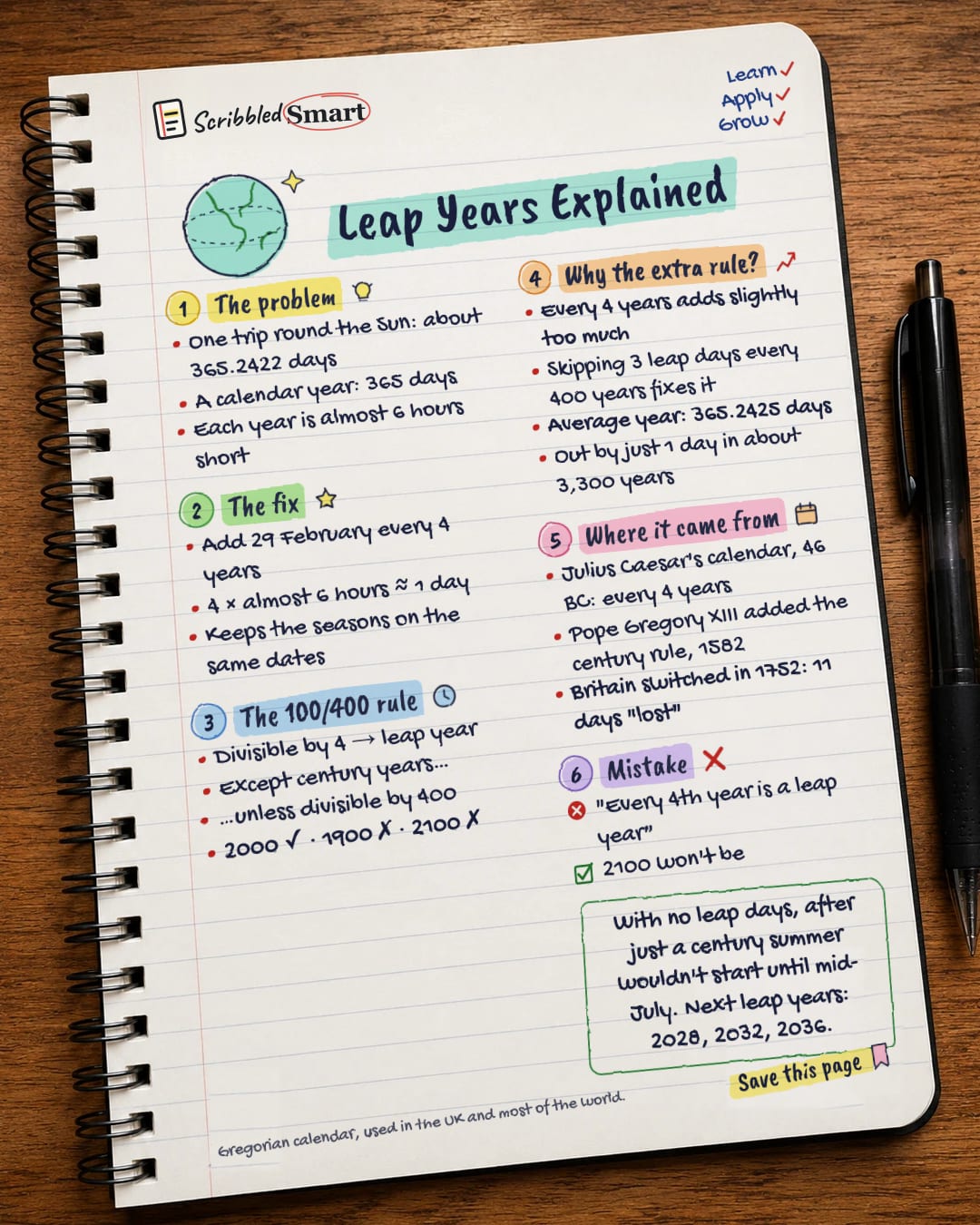
The problem
- One trip round the Sun: about 365.2422 days
- A calendar year: 365 days
- Each year is almost 6 hours short
The fix
- Add 29 February every 4 years
- 4 × almost 6 hours ≈ 1 day
- Keeps the seasons on the same dates
The 100/400 rule
- Divisible by 4 → leap year
- Except century years…
- …unless divisible by 400
- 2000 ✓ · 1900 ✗ · 2100 ✗
Why the extra rule?
- Every 4 years adds slightly too much
- Skipping 3 leap days every 400 years fixes it
- Average year: 365.2425 days
- Out by just 1 day in about 3,300 years
Where it came from
- Julius Caesar's calendar, 46 BC: every 4 years
- Pope Gregory XIII added the century rule, 1582
- Britain switched in 1752: 11 days "lost"
Mistake
- "Every 4th year is a leap year"
- 2100 won't be
Sources
How we checked this
Every fact on this note comes from the 4 sources listed here, checked against official or peer-reviewed sources where possible. AI tools help with drafting; a person checks every fact against the sources. How we research
Spotted a mistake? Tell us and we'll fix it and log it on the corrections page.


