
General knowledge One-page note UK only
Why the Clocks Change in the UK
The clocks change twice a year, and no, it wasn't for farmers. Save this page.
Good to know
UK only. Checked Nov 2026.
What's on the page
The note as text, so you can read it, copy it or use a screen reader.
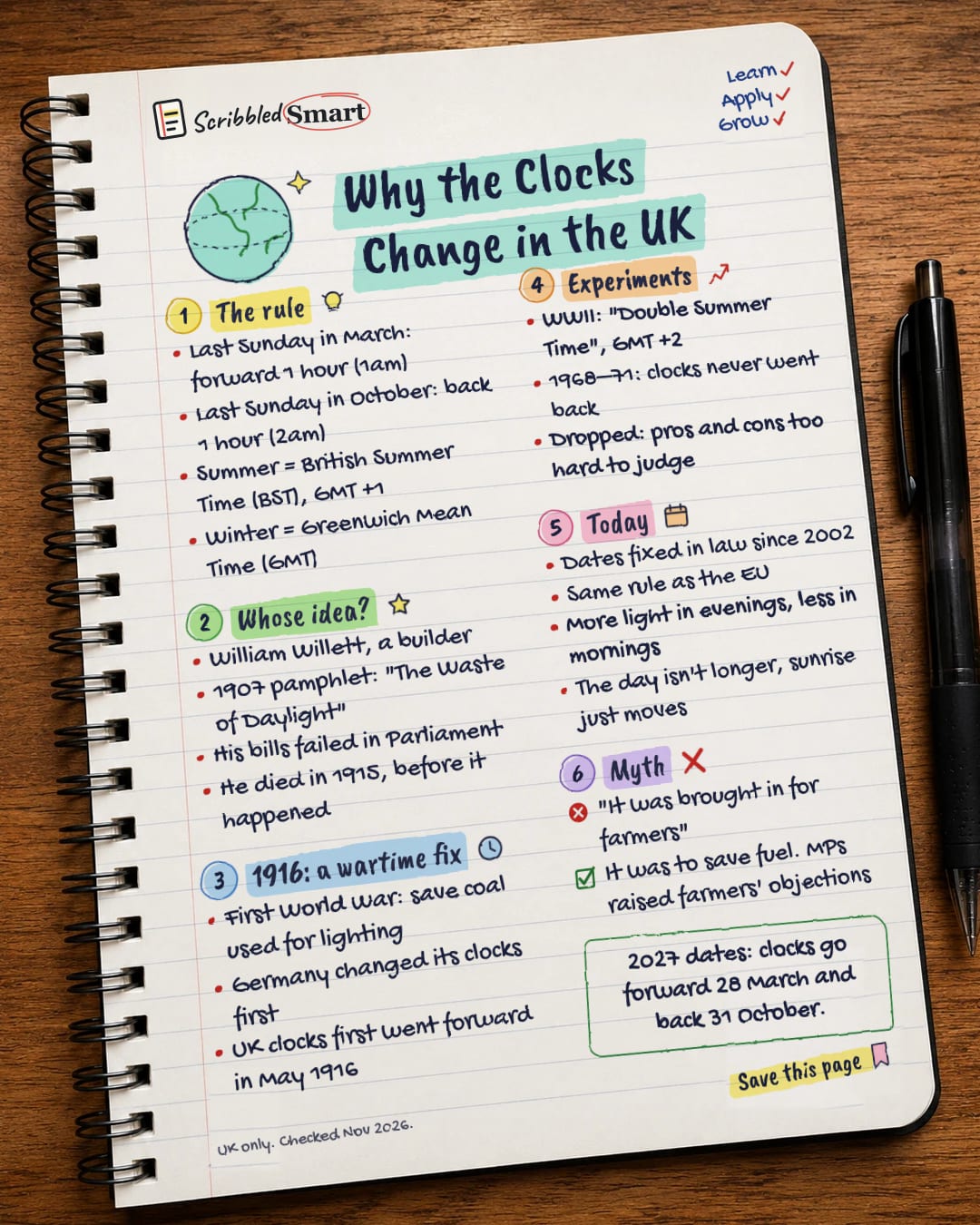
The rule
- Last Sunday in March: forward 1 hour (1am)
- Last Sunday in October: back 1 hour (2am)
- Summer = British Summer Time (BST), GMT +1
- Winter = Greenwich Mean Time (GMT)
Whose idea?
- William Willett, a builder
- 1907 pamphlet: "The Waste of Daylight"
- His bills failed in Parliament
- He died in 1915, before it happened
1916: a wartime fix
- First World War: save coal used for lighting
- Germany changed its clocks first
- UK clocks first went forward in May 1916
Experiments
- WWII: "Double Summer Time", GMT +2
- 1968–71: clocks never went back
- Dropped: pros and cons too hard to judge
Today
- Dates fixed in law since 2002
- Same rule as the EU
- More light in evenings, less in mornings
- The day isn't longer, sunrise just moves
Myth
- "It was brought in for farmers"
- It was to save fuel. MPs raised farmers' objections
Sources
- GOV.UK: When do the clocks change?
- Royal Museums Greenwich: British Summer Time (BST) and daylight saving
- Hansard (House of Commons), 8 May 1916: Daylight Saving
- legislation.gov.uk: The Summer Time Order 2002 (SI 2002/262)
- House of Commons Library: briefing SN03796 (25 March 2026)
- House of Lords European Union Committee: Clock changes: is it time for change?
How we checked this
Every fact on this note comes from the 6 sources listed here, checked against official or peer-reviewed sources where possible. AI tools help with drafting; a person checks every fact against the sources. How we research
Spotted a mistake? Tell us and we'll fix it and log it on the corrections page.


