
Language One-page note
Punctuation in One Page
Commas, colons, semicolons and apostrophes: the key rules on one page. Save this page.
What's on the page
The note as text, so you can read it, copy it or use a screen reader.
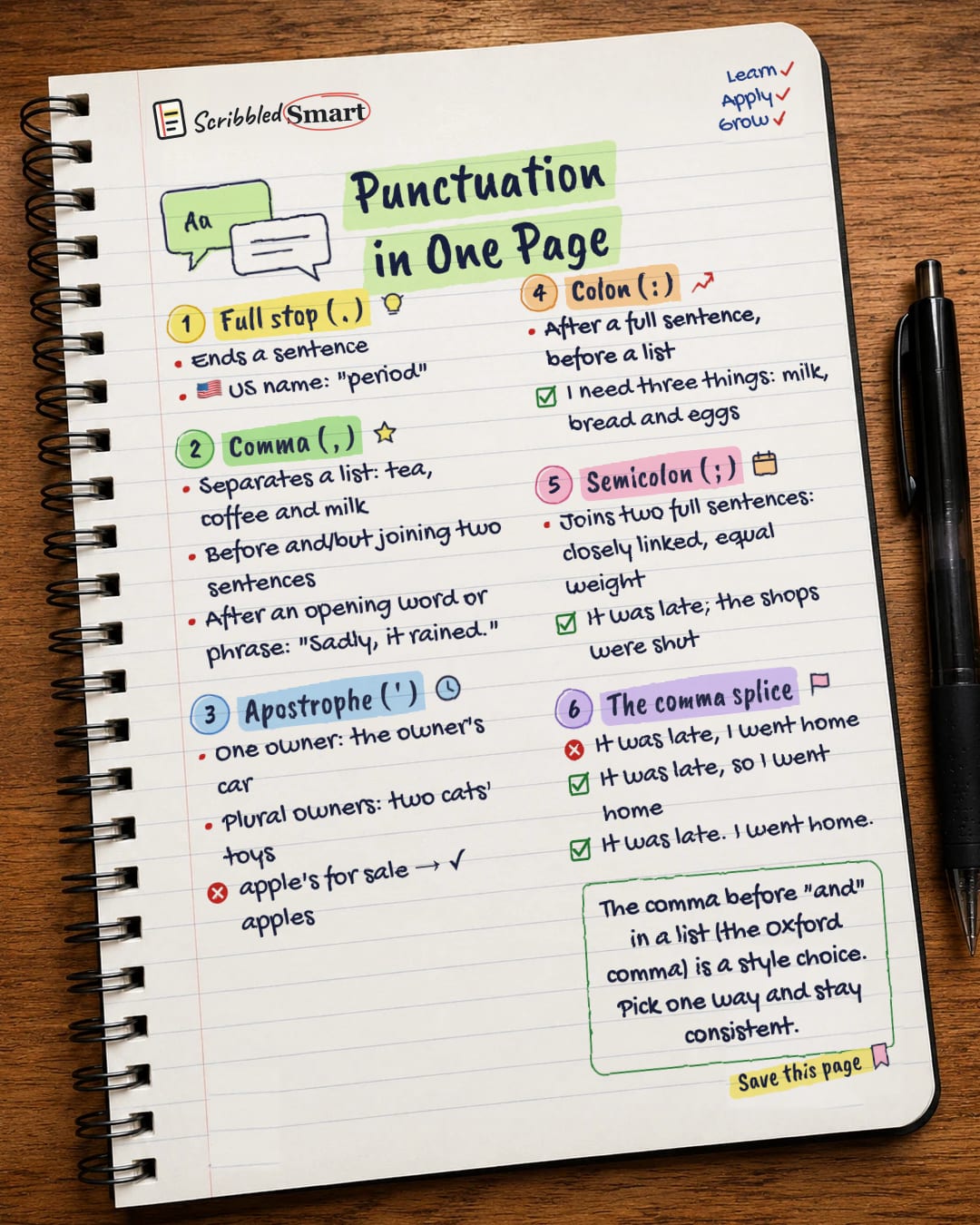
Full stop ( . )
- Ends a sentence
- 🇺🇸 US name: "period"
Comma ( , )
- Separates a list: tea, coffee and milk
- Before and/but joining two sentences
- After an opening word or phrase: "Sadly, it rained."
Apostrophe ( ' )
- One owner: the owner's car
- Plural owners: two cats' toys
- apple's for sale → ✓ apples
Colon ( : )
- After a full sentence, before a list
- I need three things: milk, bread and eggs
Semicolon ( ; )
- Joins two full sentences: closely linked, equal weight
- It was late; the shops were shut
The comma splice
- It was late, I went home
- It was late, so I went home
- It was late. I went home.
Sources
- Longman Dictionary of Contemporary English: full stop
- Purdue OWL: Extended rules for using commas
- Purdue OWL: Apostrophe
- Purdue OWL: Punctuation overview
- Purdue OWL: Run-ons, comma splices, fused sentences
- GOV.UK: Style guide A to Z
- Wikipedia: Serial comma
- Scribbr: Oxford comma
- Editor's Manual: Serial or Oxford comma
How we checked this
Every fact on this note comes from the 9 sources listed here, checked against official or peer-reviewed sources where possible. AI tools help with drafting; a person checks every fact against the sources. How we research
Spotted a mistake? Tell us and we'll fix it and log it on the corrections page.


