
On this page
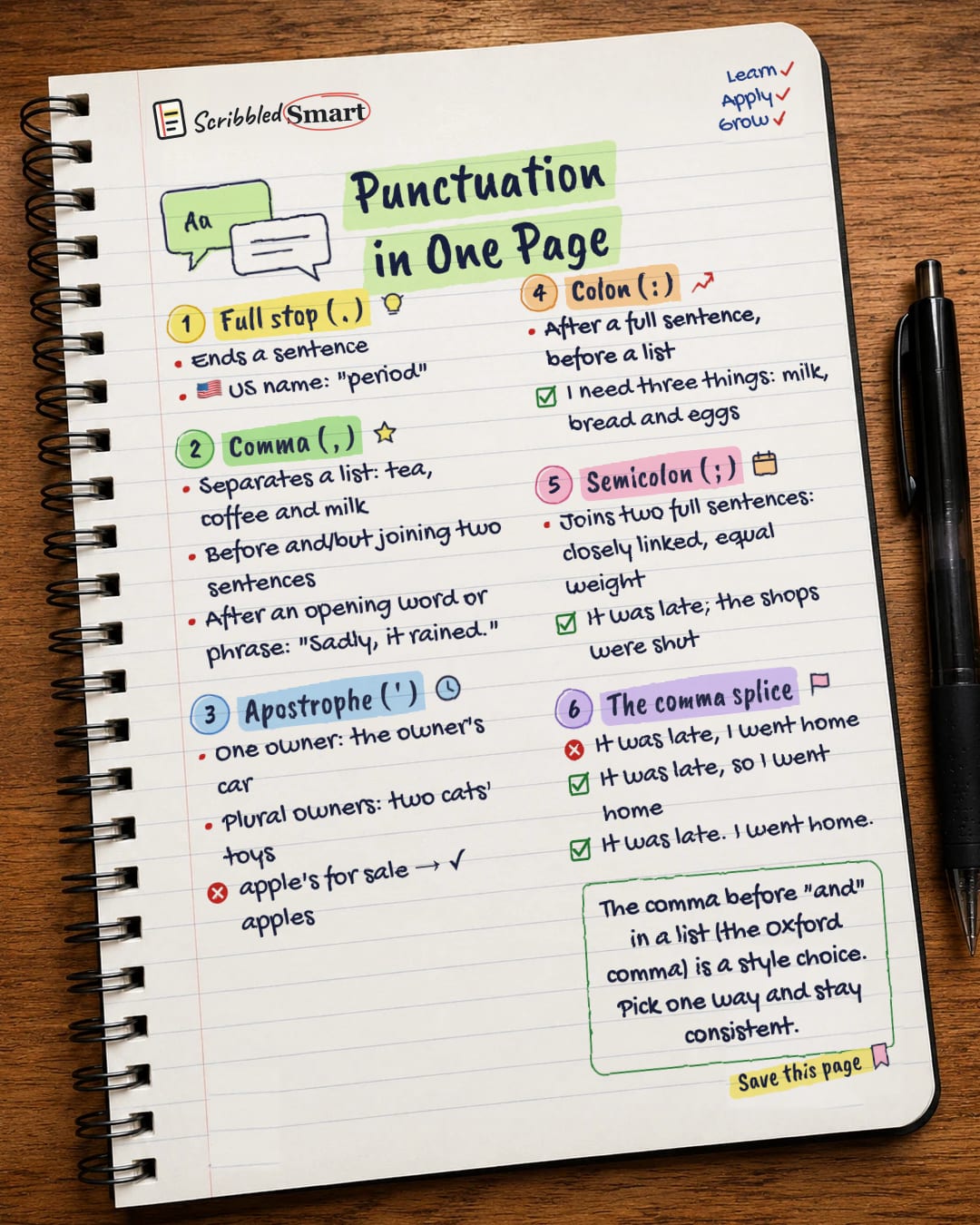
The main punctuation rules are short: a full stop ends a sentence, commas separate list items and join sentences with "and" or "but", an apostrophe shows ownership, a colon introduces a list, and a semicolon joins two full sentences. One mistake to watch for is the comma splice. This guide explains each mark with simple examples, mostly from the Purdue Online Writing Lab (OWL), a university writing guide.
Full stop ( . )
The Longman Dictionary of Contemporary English describes the full stop as a point that marks the end of a sentence or the short form of a word. "Full stop" is the British English name. In American English, it is called a "period".
- ✓ The train was late.
Comma ( , )
Commas have many jobs. Here are three of them, from Purdue OWL's rules.
1. In a list
Use commas to separate three or more words, phrases or clauses in a series.
- ✓ I bought tea, coffee and milk.
2. Before "and" or "but" joining two sentences
Purdue says to use a comma between two independent clauses (two parts that could each be a full sentence) when they are joined by one of seven words: and, but, for, or, nor, so, yet.
- ✓ I was tired, but I finished the report.
- ✓ It was late, so I went home.
3. After an opening word or phrase
Purdue says to use a comma after an introductory clause, phrase or word that comes before the main part of the sentence.
- ✓ Sadly, it rained.
- ✓ After lunch, we went for a walk.
In modern style, this comma is often optional after a short phrase. After a single opening word like "Sadly", it is standard.
Apostrophe ( ' )
Purdue OWL gives clear rules for showing ownership with nouns:
| Owner | Rule | Example |
|---|---|---|
| One owner | add 's | the owner's car |
| Plural owners ending in -s | add ' | two cats' toys |
| Plural owners not ending in -s | add 's | the children's game |
Purdue also says: don't use apostrophes for noun plurals.
- ✗ Apple's for sale
- ✓ Apples for sale
What about names that end in "s"? Purdue gives "James's hat", but "James' hat" is also accepted. Pick one and use it every time.
Words like "its", "your" and "their" are different: they never take an apostrophe. Our guide to its vs it's explains why.
Colon ( : )
Purdue says to use a colon after an independent clause (a full sentence) when it is followed by a list, a quotation or an explanation.
- ✓ I need three things: milk, bread and eggs.
- ✗ I need: milk, bread and eggs.
The second example is wrong because "I need" is not a full sentence on its own.
A colon can also join two full sentences when you want to put weight on the second one.
- ✓ There was only one problem: nobody had the key.
Semicolon ( ; )
Purdue says a semicolon can go between two independent clauses when the second one restates the first, or when the two have equal weight.
- ✓ It was late; the shops were shut.
Semicolons have two more uses, according to Purdue:
- Before words like "however" and "in fact" when they join two full sentences: It rained all day; however, we still went out.
- In lists where the items already contain commas: We visited Leeds, in the north; Bristol, in the west; and Brighton, on the south coast.
A note on GOV.UK style
🇬🇧 The GOV.UK style guide, used for UK government websites, says: "Do not use semicolons as they are often mis-read." This is a plain-English house rule for GOV.UK, not a grammar rule. Semicolons are still correct when used well. If you write for a wide audience, though, two short sentences can be clearer.
What is a comma splice?
A comma splice is when two full sentences are joined by only a comma. Purdue groups comma splices with run-ons and fused sentences: compound sentences that are not punctuated correctly.
- ✗ It was late, I went home.
There are three simple fixes:
| Fix | Example |
|---|---|
| Add a joining word after the comma | It was late, so I went home. |
| Use a semicolon | It was late; I went home. |
| Use a full stop | It was late. I went home. |
Should you use the Oxford comma?
The Oxford comma (also called the serial comma) is the comma before "and" at the end of a list:
- With it: tea, coffee, and milk
- Without it: tea, coffee and milk
This is a real style disagreement, not a right-or-wrong rule. According to style sources, it is often used in American English, and US style guides such as Chicago generally use it. Most British style guides do not require it. Even in Oxford, the two guides differ: the Oxford Style Manual uses it, while the University of Oxford Style Guide advises against it. Cambridge's Butcher's Copy-Editing treats it as optional.
Many UK writers leave it out except where it avoids confusion. The examples in this guide follow common British practice. The main advice all the sources share is simple: pick one way and stay consistent.
Punctuation rules people often get wrong
- Read your sentence aloud. If it could be two sentences, check you have not joined them with just a comma.
- Check before a colon. The words before it should make a full sentence.
- No apostrophes for plurals. Apples, CDs and cars do not need one.
- Be consistent. Whatever you choose for the Oxford comma or names ending in "s", use it the same way throughout.
- Follow your house style. The GOV.UK style guide, for example, asks for "and" rather than "&". It also avoids negative contractions such as "can't" and "don't" because some users misread them.
Related reading
- Its vs it's: why possessive words like its and your never take an apostrophe.
- British vs American English: full stop vs period, and other UK/US differences.
- Write a CV: clean punctuation helps your CV look careful and clear.
- Email phrases: professional phrases for well-punctuated emails.
Sources
- Longman Dictionary of Contemporary English: full stop
- Purdue OWL: Extended rules for using commas
- Purdue OWL: Apostrophe
- Purdue OWL: Punctuation overview
- Purdue OWL: Run-ons, comma splices, fused sentences
- GOV.UK: Style guide A to Z
- Wikipedia: Serial comma
- Scribbr: Oxford comma
- Editor's Manual: Serial or Oxford comma
How we checked this
Every fact in this article comes from the 9 sources listed above, checked against official or peer-reviewed sources where possible. AI tools help with drafting; a person checks every fact against the sources. How we research
- Published and checked
Spotted a mistake? Tell us and we'll fix it and log it on the corrections page.


