
On this page
Compound interest means you earn interest on your money and on the interest it has already earned. Your savings grow a little faster every year, because each year's interest is added to the pot before the next year's is worked out. This guide shows the numbers, a quick way to estimate doubling time, and why the same effect can work against you on debt.
What is compound interest?
Compound interest is interest worked out on the original amount (the "principal") and on all the interest added so far. In the UK, government-backed NS&I puts it simply: you earn interest "on both the money you originally save and any interest that has already been added to your account". US regulators Investor.gov and the Consumer Financial Protection Bureau (CFPB) define it the same way.
Simple interest is different. It is only ever worked out on the starting amount, so you earn the same amount every year.
Simple vs compound interest: a 5-year example
Investor.gov gives a clear example. $1,000 at 5% for 5 years:
- Simple interest: $1,250
- Compound interest (yearly): $1,276.28
That gap looks small after 5 years. Give it longer, and it grows a lot.
NS&I gives a UK example with £10,000 at a fixed 5%, paid yearly. After 10 years the simple interest balance is £15,000, while the compound balance is £16,288.95. That's exactly ten times the £1,000 figures in the table below.
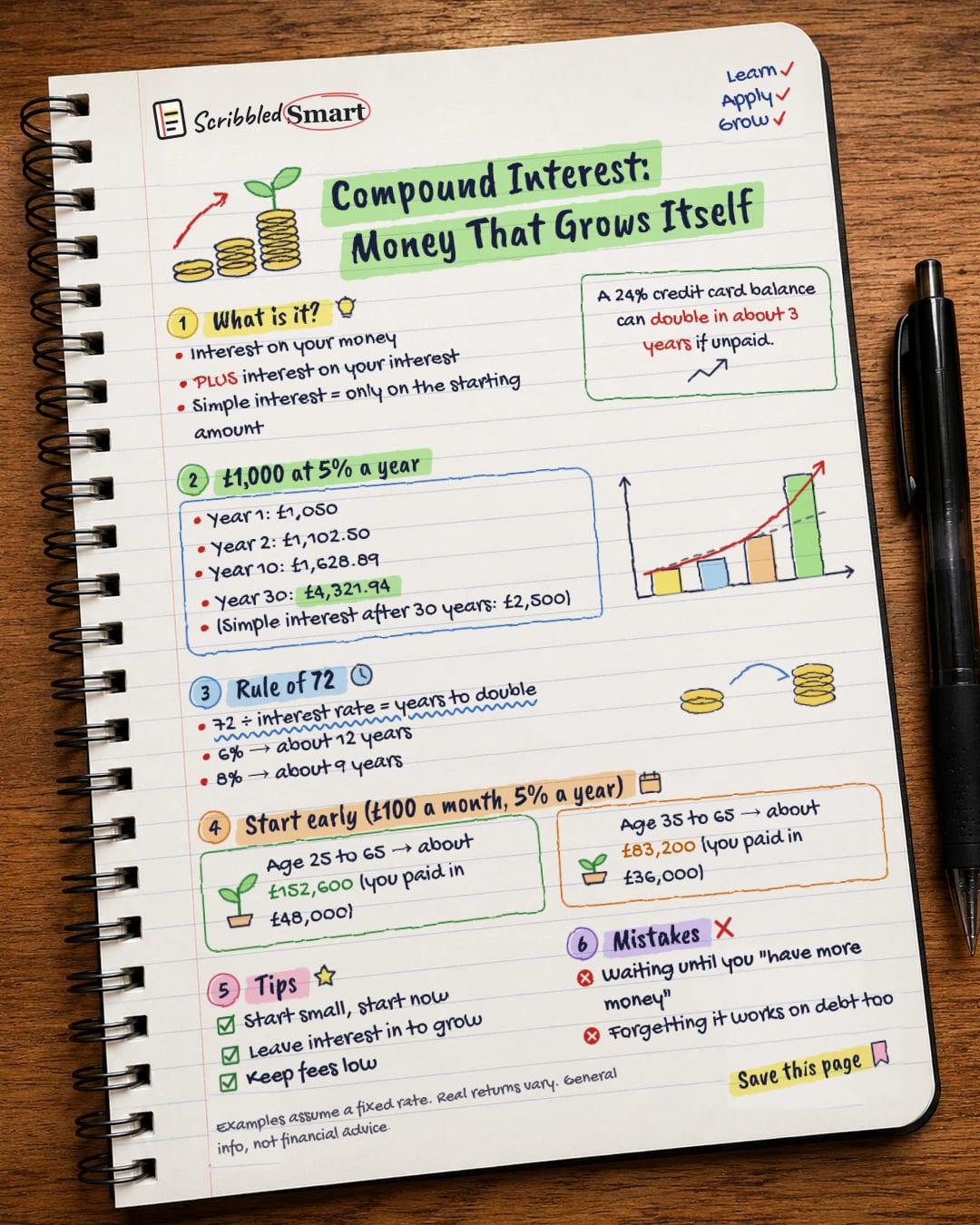
How fast does £1,000 grow at 5% a year?
Take £1,000 and leave it alone at a fixed 5% a year, with the interest added once a year (calculated as 1,000 × 1.05 to the power of the number of years):
| After | Compound interest | Simple interest |
|---|---|---|
| 1 year | £1,050.00 | £1,050.00 |
| 2 years | £1,102.50 | £1,100.00 |
| 10 years | £1,628.89 | £1,500.00 |
| 30 years | £4,321.94 | £2,500.00 |
In year 2 you earn interest on £1,050, not £1,000. That extra £2.50 is "interest on interest". By year 30, the compound pot is worth well over 4 times what you started with. The simple-interest pot is worth 2.5 times.
The compound interest formula
If you like formulas, this is the one:
A = P × (1 + r/n)^(n × t)
- A = the final amount
- P = the principal (what you start with)
- r = the yearly interest rate as a decimal (5% = 0.05)
- n = how many times a year interest is added
- t = the number of years
The CFPB notes that more frequent compounding (monthly rather than yearly) grows money slightly faster.
The Rule of 72: a shortcut for doubling
The Rule of 72 is a quick mental estimate: 72 ÷ interest rate = roughly the number of years to double your money. New Mexico State University's Arrowhead Center describes it this way, as a rule of thumb.
- At 6%, money doubles in about 12 years (the exact figure is 11.9).
- At 8%, it doubles in about 9 years (exact: 9.01).
You can check it with the exact doubling formula, years = ln(2) ÷ ln(1 + rate). The same NMSU explainer says the rule works fairly well for rates from about 1 or 2% up to 10 or 12%, but not very well for extremely high or low rates, so treat it as an estimate.
The same rule works for prices. At 3% inflation, prices roughly double in about 24 years.
Why does starting early matter so much?
Compound interest needs time more than anything else. This table shows £100 a month at 5% a year, with interest added monthly, up to age 65:
| Start at | You pay in | Pot at 65 (about) |
|---|---|---|
| 25 | £48,000 | £152,600 |
| 35 | £36,000 | £83,200 |
Starting 10 years earlier means paying in only £12,000 more. But the pot ends up nearly £70,000 bigger. Those extra years give the interest longer to earn interest of its own. As NS&I puts it, "time increases the effect of compounding". In focus groups run for HM Treasury and the FCA, older people said they wished they had started investing earlier. It's one reason opting out of a workplace pension in your 20s can cost so much later.
Three ways to grow savings faster
The CFPB lists three levers:
- Compound more often: monthly beats yearly.
- Get a higher rate.
- Add to the principal: keep paying in.
The dark side: compound interest on debt
Compound interest doesn't care whether you're saving or borrowing. On debt, it works against you: NS&I explains that future interest is then worked out "on both the original amount borrowed and interest already charged".
A credit card charging 24% a year could double an unpaid balance in about 3 years (72 ÷ 24 = 3; the exact figure is 3.22 years, because 24% is above the range where the rule works best). That assumes no payments and interest added once a year. Card interest is usually added monthly, which makes it grow slightly faster. If you have debts, see how to pay them off with the avalanche or snowball method.
Tips and common mistakes
Do:
- ✅ Start small, start now. Time matters more than the amount.
- ✅ Leave the interest in, so it can earn interest too.
- ✅ Keep fees low. An FCA research paper notes that "due to compounding, over time, a seemingly small difference in charges can have a significant impact on returns". (FCA occasional papers don't necessarily represent the FCA's official position.)
Avoid:
- ❌ Waiting until you "have more money". Every year you wait is a year of growth lost.
- ❌ Forgetting it works on debt too. Clear high-interest balances first.
A note on the famous Einstein quote
You may have seen compound interest called "the eighth wonder of the world", with the line credited to Albert Einstein. There is no reliable source showing he ever said it, so we don't quote it. The maths is impressive enough without him.
Related reading
- What is inflation?: why your savings rate needs to beat rising prices.
- Index funds explained: a low-cost way people invest for the long term.
- Paying off debt: avalanche vs snowball: how to beat compound interest on what you owe.
- How habits really form: making regular saving automatic.
Sources
- NS&I: What is compound interest?
- FCA Occasional Paper 32: Now you see it: drawing attention to charges in the asset management industry (2018)
- Financial Advice Working Group for HM Treasury and the FCA: Rules of Thumb and Nudges (2017)
- Investor.gov: Compound Interest (glossary)
- Investor.gov: What is compound interest?
- CFPB: How does compound interest work?
- New Mexico State University, Arrowhead Center: What is the Rule of 72? (PDF)
Further reading (not checked: the site blocks automated reading): MoneyHelper: How compound interest can make your savings grow
Earlier Rule of 72 sources we could not re-check on 16 November 2026, so this article no longer relies on them: Wealthsimple: Rule of 72 (original page, no longer available: https://wealthsimple.com/en-ca/learn/rule-of-72-definition-formula); Nasdaq: The Rule of 72 Explained (page blocks automated checks: https://www.nasdaq.com/articles/the-rule-of-72-explained:-how-long-will-it-take-to-double-your-savings); Business Professor: Rule of 72 (original page, no longer online: https://thebusinessprofessor.helpjuice.com/rule-of-72-explained).
How we checked this
Every fact in this article comes from the 7 sources listed above, checked against official or peer-reviewed sources where possible. AI tools help with drafting; a person checks every fact against the sources. How we research
- Published and checked
Examples assume a fixed rate. Real returns vary. General info, not financial advice.
Spotted a mistake? Tell us and we'll fix it and log it on the corrections page.


