
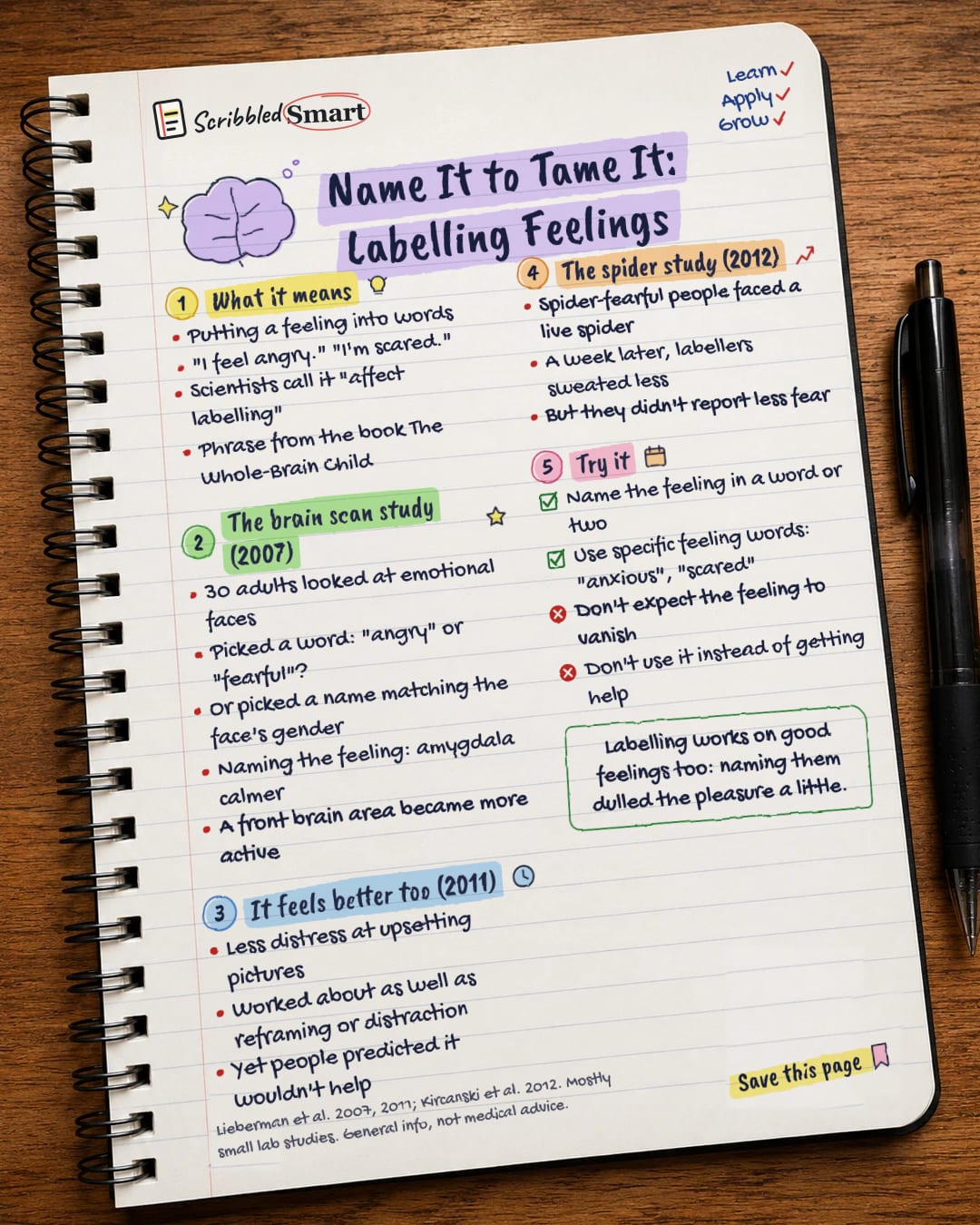
Psychology One-page note
Name It to Tame It: Labelling Feelings
Saying "I feel anxious" sounds too simple to work. Brain scans and lab studies say it helps a little. Save this page.
Good to know
Lieberman et al. 2007, 2011; Kircanski et al. 2012. Mostly small lab studies. General info, not medical advice.
What's on the page
The note as text, so you can read it, copy it or use a screen reader.
What it means
- Putting a feeling into words
- "I feel angry." "I'm scared."
- Scientists call it "affect labelling"
- Phrase from the book The Whole-Brain Child
The brain scan study (2007)
- 30 adults looked at emotional faces
- Picked a word: "angry" or "fearful"?
- Or picked a name matching the face's gender
- Naming the feeling: amygdala calmer
- A front brain area became more active
It feels better too (2011)
- Less distress at upsetting pictures
- Worked about as well as reframing or distraction
- Yet people predicted it wouldn't help
The spider study (2012)
- Spider-fearful people faced a live spider
- A week later, labellers sweated less
- But they didn't report less fear
Try it
- Name the feeling in a word or two
- Use specific feeling words: "anxious", "scared"
- Don't expect the feeling to vanish
- Don't use it instead of getting help
Sources
- Lieberman, M. D. et al. (2007): Putting feelings into words: affect labeling disrupts amygdala activity in response to affective stimuli. Psychological Science
- UCLA Health (21 June 2007): Putting feelings into words produces therapeutic effects in the brain
- Lieberman, M. D., Inagaki, T. K., Tabibnia, G. & Crockett, M. J. (2011): Subjective responses to emotional stimuli during labeling, reappraisal, and distraction. Emotion
- Kircanski, K., Lieberman, M. D. & Craske, M. G. (2012): Feelings into words: contributions of language to exposure therapy. Psychological Science
- Torre, J. B. & Lieberman, M. D. (2018): Putting feelings into words: Affect labeling as implicit emotion regulation. Emotion Review 10(2), 116–124
- Hachette UK: The Whole-Brain Child (Siegel & Bryson)
- Open-access copies (added 2026-11-17): Lieberman 2007 abstract via Crossref
- 2026 bilingual study: Affect labeling down-regulates amygdala only in a dominant native language. PNAS
How we checked this
Every fact on this note comes from the 8 sources listed here, checked against official or peer-reviewed sources where possible. AI tools help with drafting; a person checks every fact against the sources. How we research
Spotted a mistake? Tell us and we'll fix it and log it on the corrections page.


