
Psychology One-page note
Fight, Flight or Freeze: The Threat Response
Ever frozen when you wanted to run or speak up? That's part of your threat response too. Save this page.
Good to know
Kozlowska et al. 2015; Roelofs 2017. General info, not medical advice.
What's on the page
The note as text, so you can read it, copy it or use a screen reader.
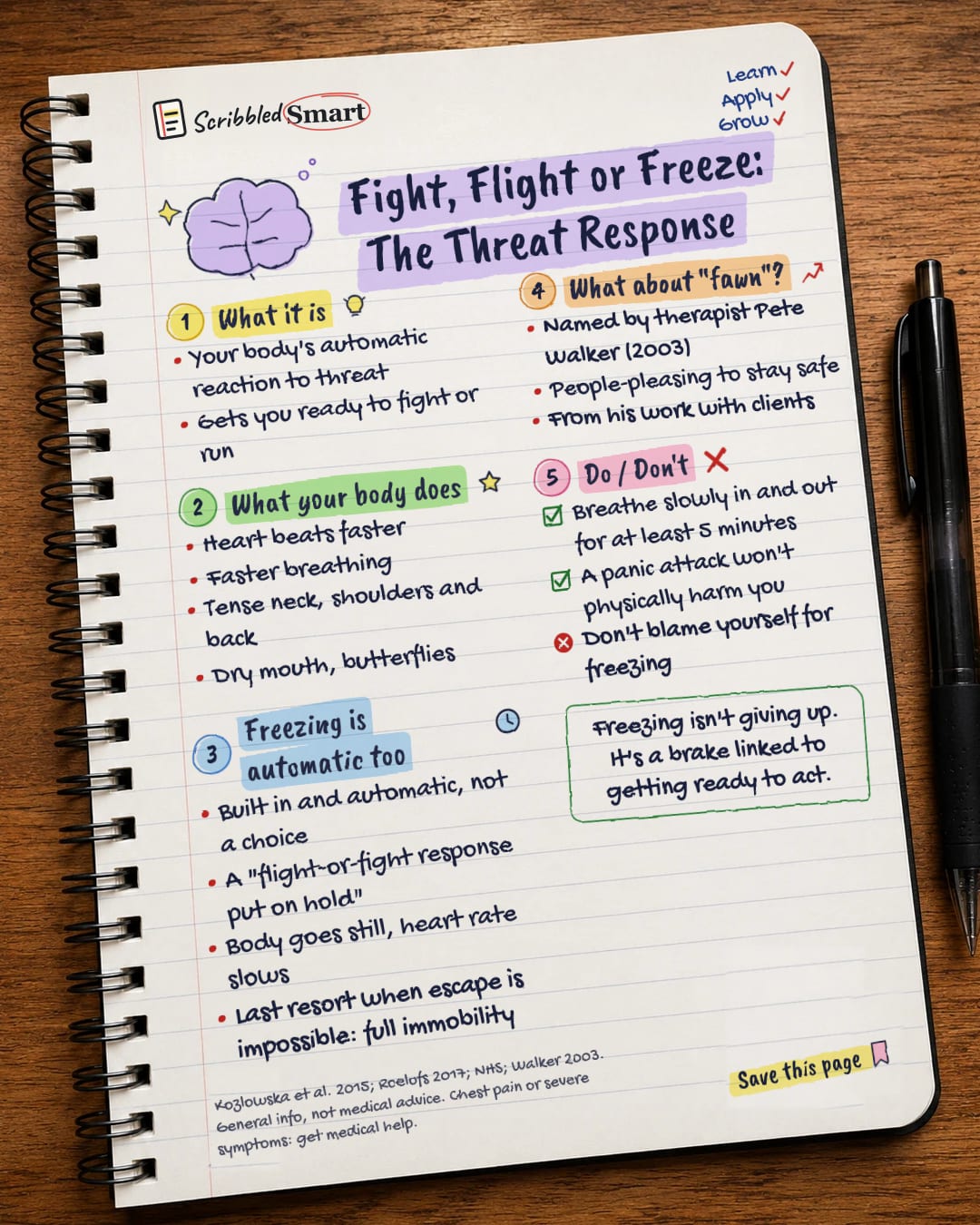
What it is
- Your body's automatic reaction to threat
- Gets you ready to fight or run
- Uncomfortable, but not dangerous
What your body does
- Heart beats faster: blood to your muscles
- Faster breathing: more oxygen
- Muscles tense, ready for action
- Sweating, dry mouth, butterflies
- Shaky and weak once it passes
Freezing is normal too
- Built in and automatic, not a choice
- Fight-or-flight "put on hold"
- Body goes still, heart rate slows
- Not passive: the body gets ready to act
- Last resort: you can't move at all
What about "fawn"?
- Named by therapist Pete Walker (2003)
- People-pleasing to stay safe
- Based on his therapy work, not lab studies
Do / Don't
- Breathe in and out slowly, counting to 5
- Remind yourself: anxiety can't harm you
- Don't blame yourself for freezing
- Don't treat "fawn" as proven science
Sources
- Cumbria, Northumberland, Tyne and Wear NHS Foundation Trust: Anxiety (self-help guide)
- NHS: Breathing exercises for stress
- Kozlowska, K., Walker, P., McLean, L. & Carrive, P. (2015): Fear and the defense cascade: clinical implications and management. Harvard Review of Psychiatry
- Roelofs, K. (2017): Freeze for action: neurobiological mechanisms in animal and human freezing. Phil Trans R Soc B
- Walker, P. (2003): Codependency, Trauma and the Fawn Response. The East Bay Therapist
- Möller, A., Söndergaard, H. P. & Helström, L. (2017): Tonic immobility during sexual assault. Acta Obstetricia et Gynecologica Scandinavica
How we checked this
Every fact on this note comes from the 6 sources listed here, checked against official or peer-reviewed sources where possible. AI tools help with drafting; a person checks every fact against the sources. How we research
Spotted a mistake? Tell us and we'll fix it and log it on the corrections page.


