
Psychology One-page note
Are There Really 6 Basic Emotions?
Six basic emotions, one face each, the same everywhere? That's the famous theory. Newer research isn't so sure. Save this page.
Good to know
Ekman et al. 1969; Gendron et al. 2014; Barrett et al. 2019; Cowen & Keltner 2017. Still debated.
What's on the page
The note as text, so you can read it, copy it or use a screen reader.
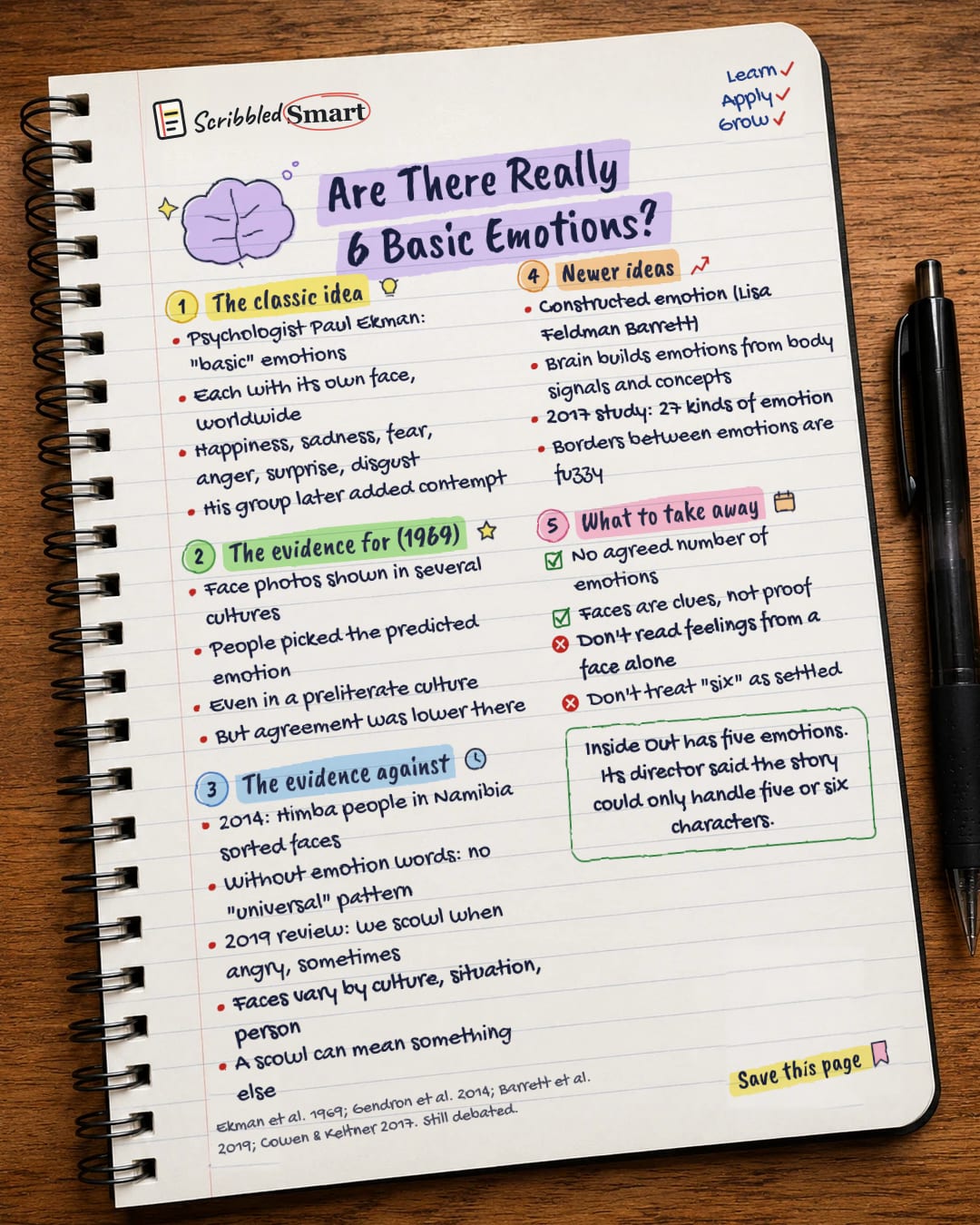
The classic idea
- Psychologist Paul Ekman: "basic" emotions
- Each with its own face, worldwide
- Happiness, sadness, fear, anger, surprise, disgust
- His group later added contempt
The evidence for (1969)
- Face photos shown in several cultures
- People picked the predicted emotion
- Even in a preliterate culture
- But agreement was lower there
The evidence against
- 2014: Himba people in Namibia sorted faces
- Without emotion words: no "universal" pattern
- 2019 review: we scowl when angry, sometimes
- Faces vary by culture, situation, person
- A scowl can mean something else
Newer ideas
- Constructed emotion (Lisa Feldman Barrett)
- Brain builds emotions from body signals and concepts
- 2017 study: 27 kinds of emotion
- Borders between emotions are fuzzy
What to take away
- No agreed number of emotions
- Faces are clues, not proof
- Don't read feelings from a face alone
- Don't treat "six" as settled
Sources
- Ekman, P. (1992): An argument for basic emotions. Cognition and Emotion 6(3–4), 169–200
- Ekman, P., Sorenson, E. R. & Friesen, W. V. (1969): Pan-cultural elements in facial displays of emotion. Science
- Gendron, M., Roberson, D., van der Vyver, J. M. & Barrett, L. F. (2014): Perceptions of emotion from facial expressions are not culturally universal. Emotion
- Barrett, L. F. et al. (2019): Emotional expressions reconsidered. Psychological Science in the Public Interest
- Barrett, L. F. (2017): The theory of constructed emotion. Social Cognitive and Affective Neuroscience
- Cowen, A. S. & Keltner, D. (2017): Self-report captures 27 distinct categories of emotion. PNAS
- Jack, R. E. et al. (2012): Facial expressions of emotion are not culturally universal. PNAS
- Jack, R. E., Garrod, O. G. B. & Schyns, P. G. (2014): Dynamic facial expressions of emotion transmit an evolving hierarchy of signals over time. Current Biology
- Ekman, P. (2016): What scientists who study emotion agree about. Perspectives on Psychological Science
- Paul Ekman Group: Universal Emotions
- Keltner, D. & Ekman, P. (2015): The Science of 'Inside Out'. New York Times (copy
How we checked this
Every fact on this note comes from the 11 sources listed here, checked against official or peer-reviewed sources where possible. AI tools help with drafting; a person checks every fact against the sources. How we research
Spotted a mistake? Tell us and we'll fix it and log it on the corrections page.


