
Psychology One-page note
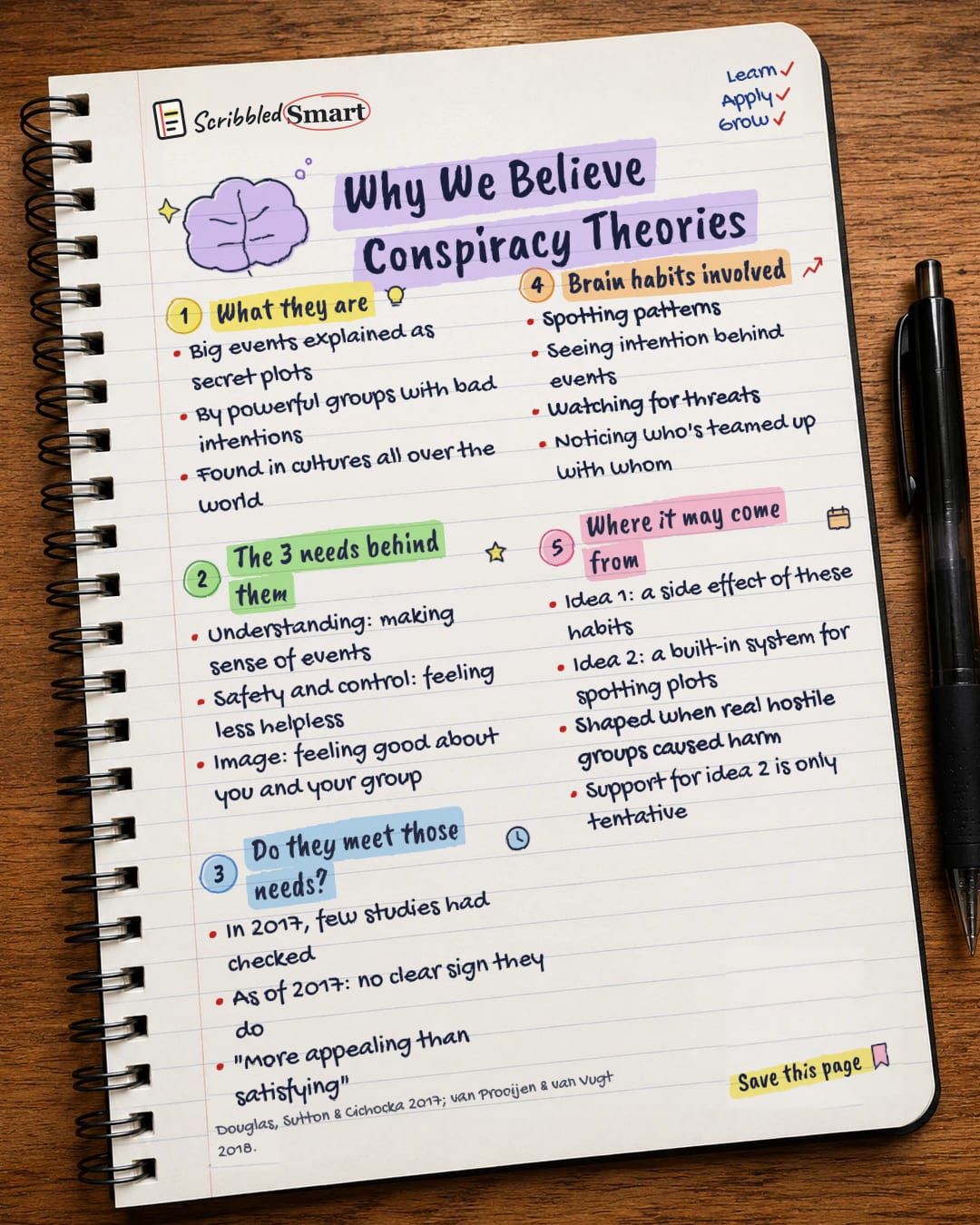
Why We Believe Conspiracy Theories
Conspiracy theories aren't just about facts. They meet deeper needs. Here's the psychology. Save this page.
Good to know
Douglas, Sutton & Cichocka 2017; van Prooijen & van Vugt 2018.
What's on the page
The note as text, so you can read it, copy it or use a screen reader.
What they are
- Big events explained as secret plots
- By powerful groups with bad intentions
- Found in cultures all over the world
The 3 needs behind them
- Understanding: making sense of events
- Safety and control: feeling less helpless
- Image: feeling good about you and your group
Do they meet those needs?
- In 2017, few studies had checked
- As of 2017: no clear sign they do
- "More appealing than satisfying"
Brain habits involved
- Spotting patterns
- Seeing intention behind events
- Watching for threats
- Noticing who's teamed up with whom
Where it may come from
- Idea 1: a side effect of these habits
- Idea 2: a built-in system for spotting plots
- Shaped when real hostile groups caused harm
- Support for idea 2 is only tentative
Sources
- Douglas, K. M., Sutton, R. M. & Cichocka, A. (2017): The psychology of conspiracy theories. Current Directions in Psychological Science
- van Prooijen, J.-W. & van Vugt, M. (2018): Conspiracy theories: evolved functions and psychological mechanisms. Perspectives on Psychological Science
- Costello, T. H., Pennycook, G. & Rand, D. G. (2024): Durably reducing conspiracy beliefs through dialogues with AI. Science
- American Psychological Association (O'Hara, D., 2023): David Rapp explores how best to combat misinformation
How we checked this
Every fact on this note comes from the 4 sources listed here, checked against official or peer-reviewed sources where possible. AI tools help with drafting; a person checks every fact against the sources. How we research
Spotted a mistake? Tell us and we'll fix it and log it on the corrections page.


