
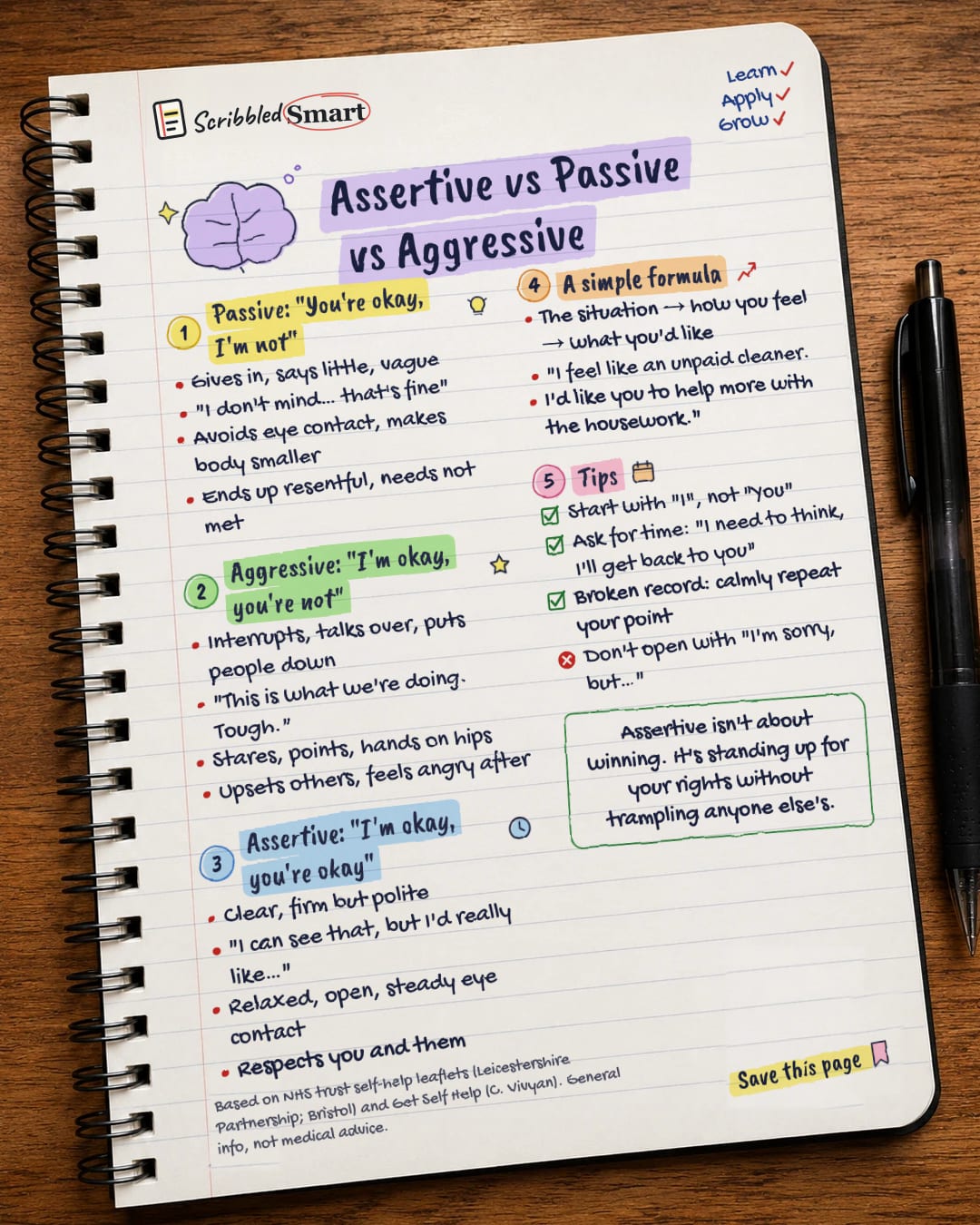
Psychology One-page note
Assertive vs Passive vs Aggressive
Do you give in, blow up, or say what you need? Three communication styles and one simple formula. Save this page.
Good to know
Based on NHS trust self-help leaflets (Leicestershire Partnership; Bristol) and Get Self Help (C. Vivyan). General info, not medical advice.
What's on the page
The note as text, so you can read it, copy it or use a screen reader.
Passive: "You're okay, I'm not"
- Gives in, says little, vague
- "I don't mind… that's fine"
- Avoids eye contact, makes body smaller
- Ends up resentful, needs not met
Aggressive: "I'm okay, you're not"
- Interrupts, talks over, puts people down
- "This is what we're doing. Tough."
- Stares, points, hands on hips
- Upsets others, feels angry after
Assertive: "I'm okay, you're okay"
- Clear, firm but polite
- "I can see that, but I'd really like…"
- Relaxed, open, steady eye contact
- Respects you and them
A simple formula
- The situation → how you feel → what you'd like
- "I feel like an unpaid cleaner.
- I'd like you to help more with the housework."
Tips
- Start with "I", not "You"
- Ask for time: "I need to think, I'll get back to you"
- Broken record: calmly repeat your point
- Don't open with "I'm sorry, but…"
Sources
- Leicestershire Partnership NHS Trust: Assertiveness (leaflet 492, edition 2)
- University Hospitals Bristol / Avon Partnership Occupational Health Service: Assertiveness
- University of Huddersfield & South West Yorkshire Partnership NHS FT (SHARP): Assertiveness & You
- Get Self Help (Carol Vivyan): Assertiveness
How we checked this
Every fact on this note comes from the 4 sources listed here, checked against official or peer-reviewed sources where possible. AI tools help with drafting; a person checks every fact against the sources. How we research
Spotted a mistake? Tell us and we'll fix it and log it on the corrections page.


