
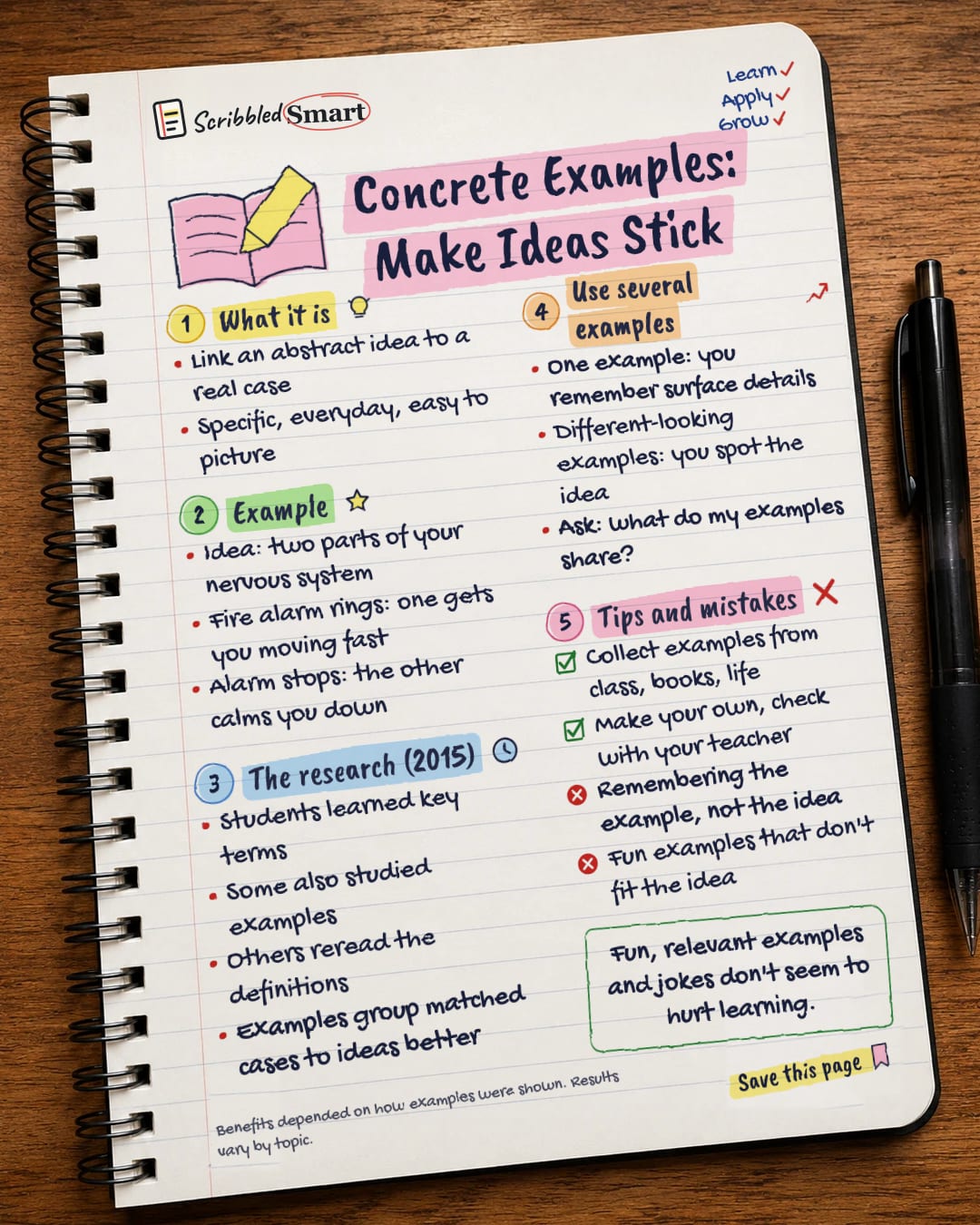
Study One-page note
Concrete Examples: Make Ideas Stick
Abstract ideas not sticking? Give each one a real example, then another. Save this page.
Good to know
Benefits depended on how examples were shown. Results vary by topic.
What's on the page
The note as text, so you can read it, copy it or use a screen reader.
What it is
- Link an abstract idea to a real case
- Specific, everyday, easy to picture
Example
- Idea: two parts of your nervous system
- Fire alarm rings: one gets you moving fast
- Alarm stops: the other calms you down
The research (2015)
- Students learned key terms
- Some also studied examples
- Others reread the definitions
- Examples group matched cases to ideas better
Use several examples
- One example: you remember surface details
- Different-looking examples: you spot the idea
- Ask: what do my examples share?
Tips and mistakes
- Collect examples from class, books, life
- Make your own, check with your teacher
- Remembering the example, not the idea
- Fun examples that don't fit the idea
Sources
- Weinstein, Madan & Sumeracki (2018), Teaching the science of learning, Cognitive Research: Principles and Implications 3:2 (PMC)
- Rawson, Thomas & Jacoby (2015), Educational Psychology Review 27
- The Learning Scientists: Learn how to study using concrete examples
- Gick & Holyoak (1983), Schema induction and analogical transfer, Cognitive Psychology 15
How we checked this
Every fact on this note comes from the 4 sources listed here, checked against official or peer-reviewed sources where possible. AI tools help with drafting; a person checks every fact against the sources. How we research
Spotted a mistake? Tell us and we'll fix it and log it on the corrections page.


